Before reading this lesson, make sure you already understand:
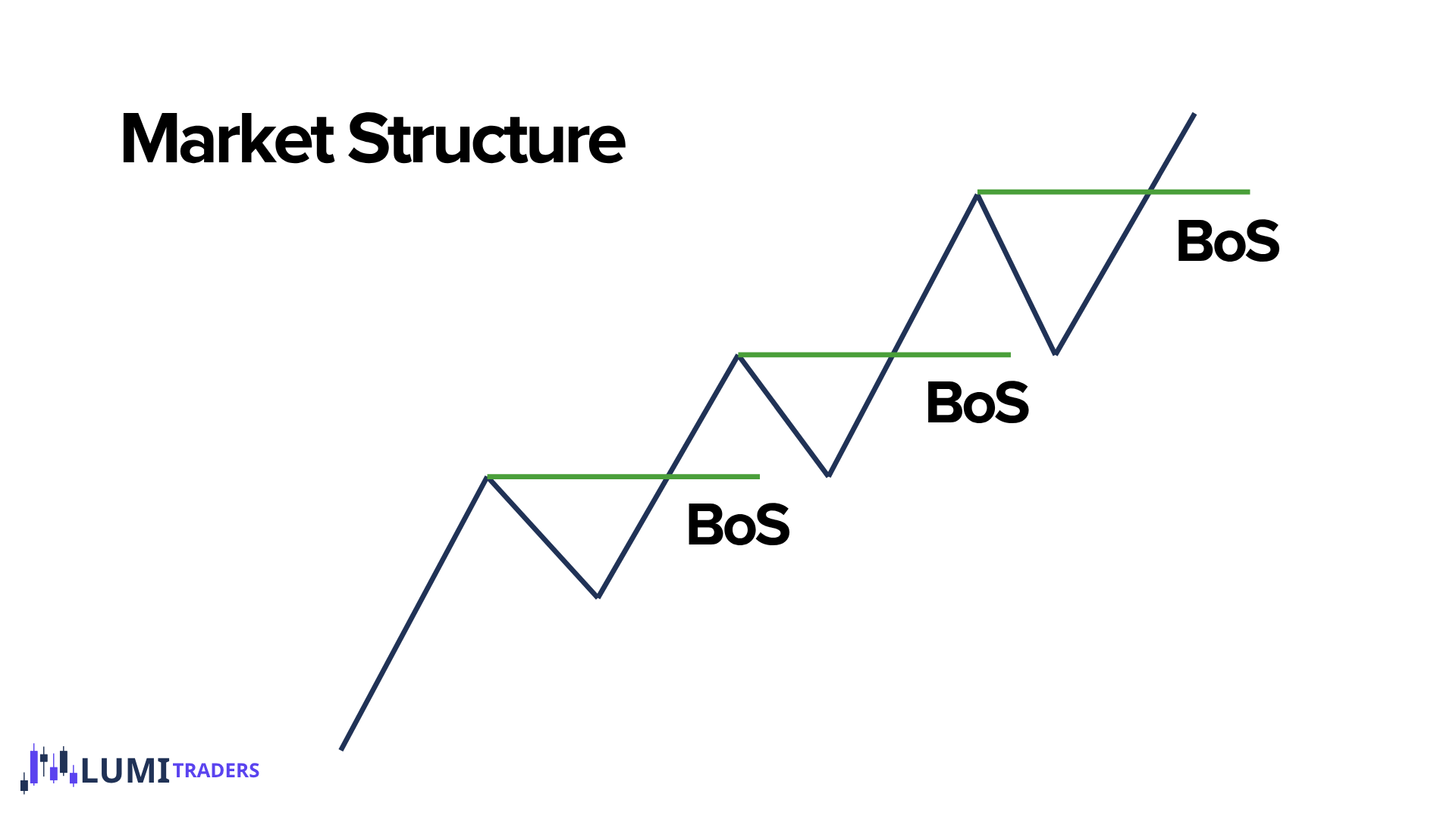
Market Maker Model — MMXM
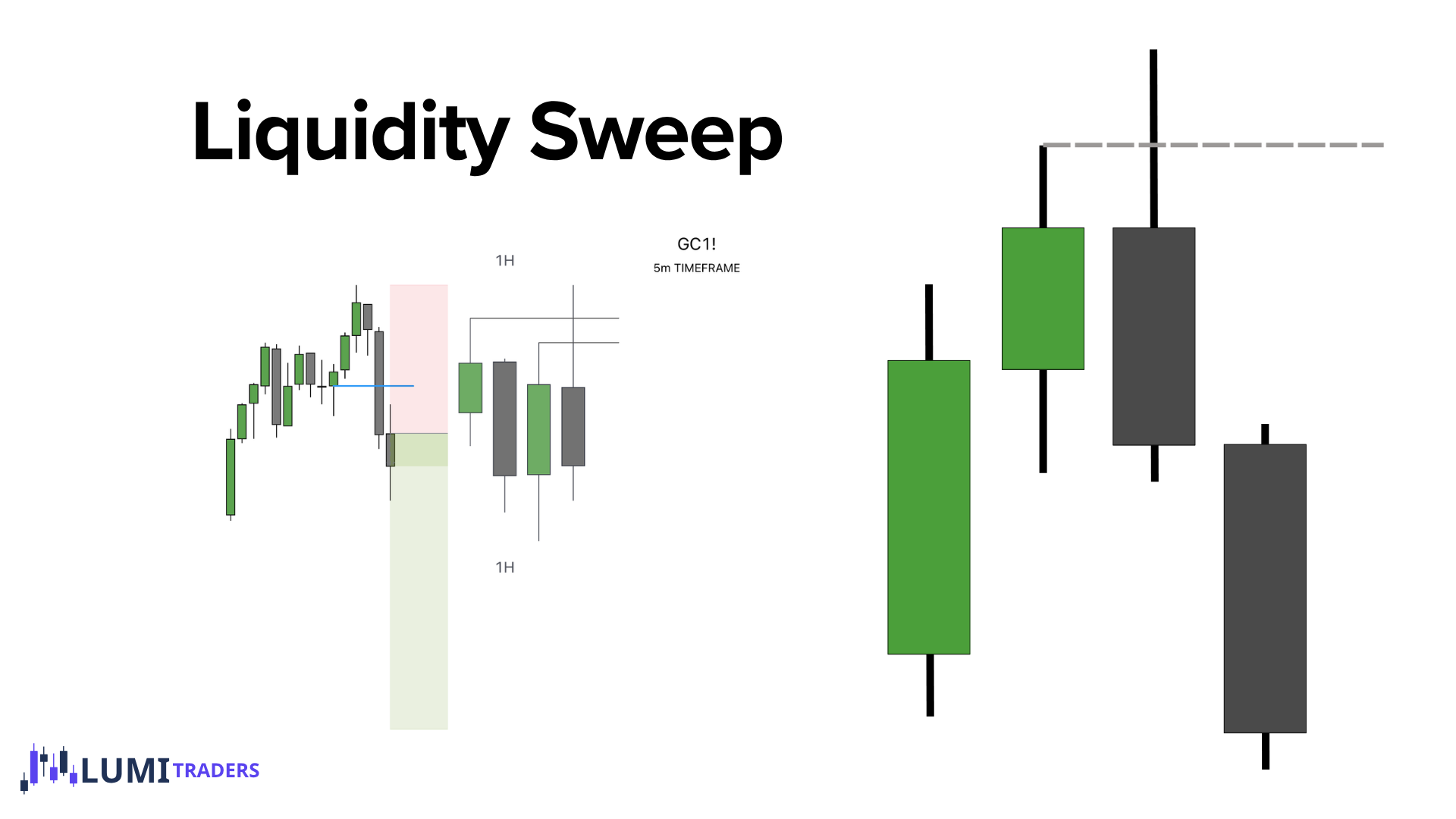
Liquidity Sweep Model
CISD
Timeframe Alignment
If you have not read those lessons yet, read them first.
This lesson builds directly on those concepts.
We are now going to study a more advanced question:
How can we recognize that a continuation move is beginning to fail before the entire higher-timeframe structure fully reverses?
The answer starts with understanding the behavior of expansion candles.
Continuation vs. Reversal
When a market is trending and the current higher-timeframe objective has not yet been reached, we generally expect continuation.
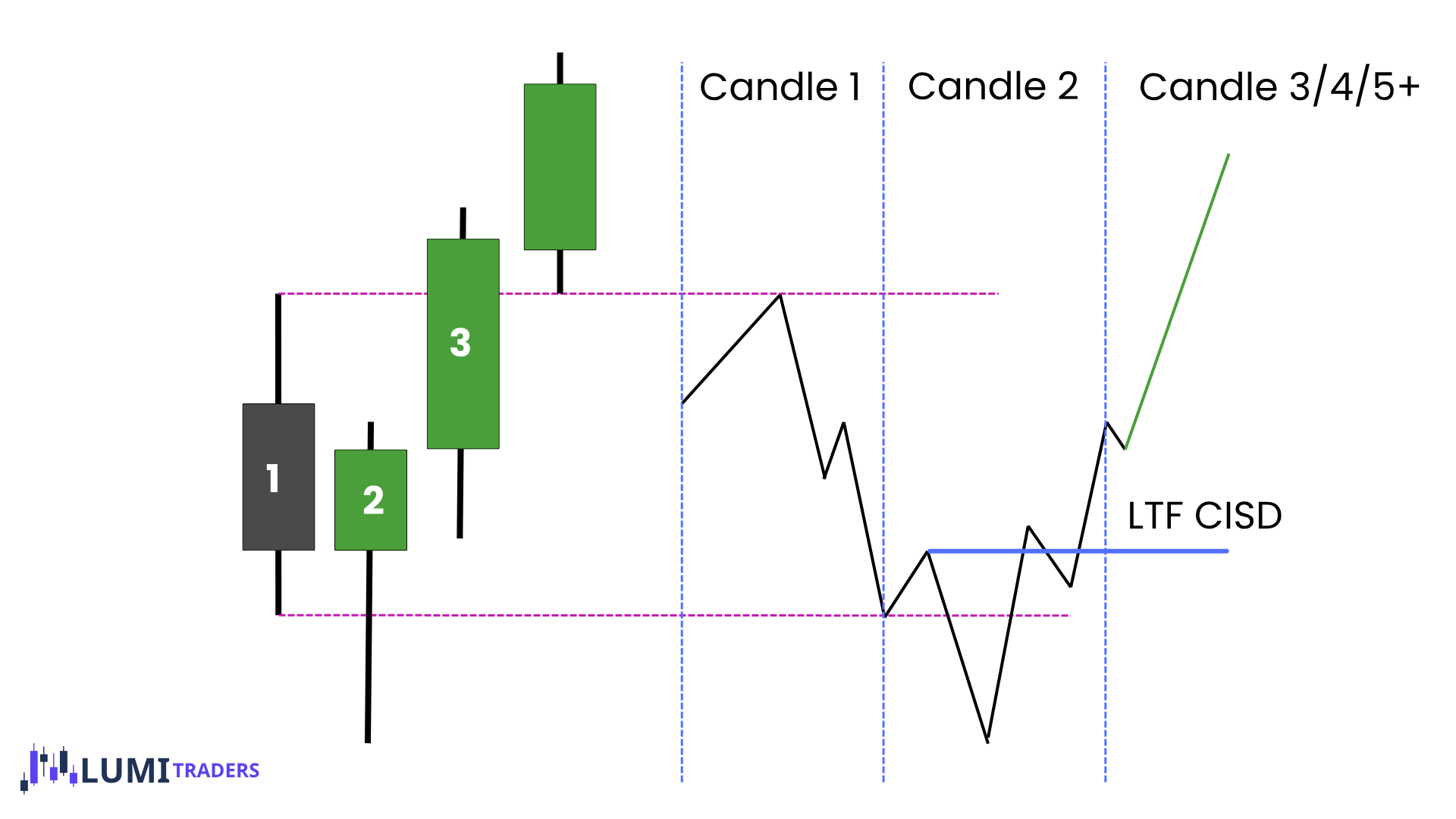
For example, in our Liquidity Sweep model:
Candle 1 creates liquidity.
Candle 2 sweeps the liquidity.
The aligned lower timeframe confirms CISD.
We trade Candle 2.
After that reversal is established, the following candles often become continuation candles.
Depending on the structure, Candle 3, Candle 4, and sometimes Candle 5 or Candle 6 may become part of the expansion phase.
These candles are important because they show us whether the directional program remains healthy.
What Is an Expansion Candle?
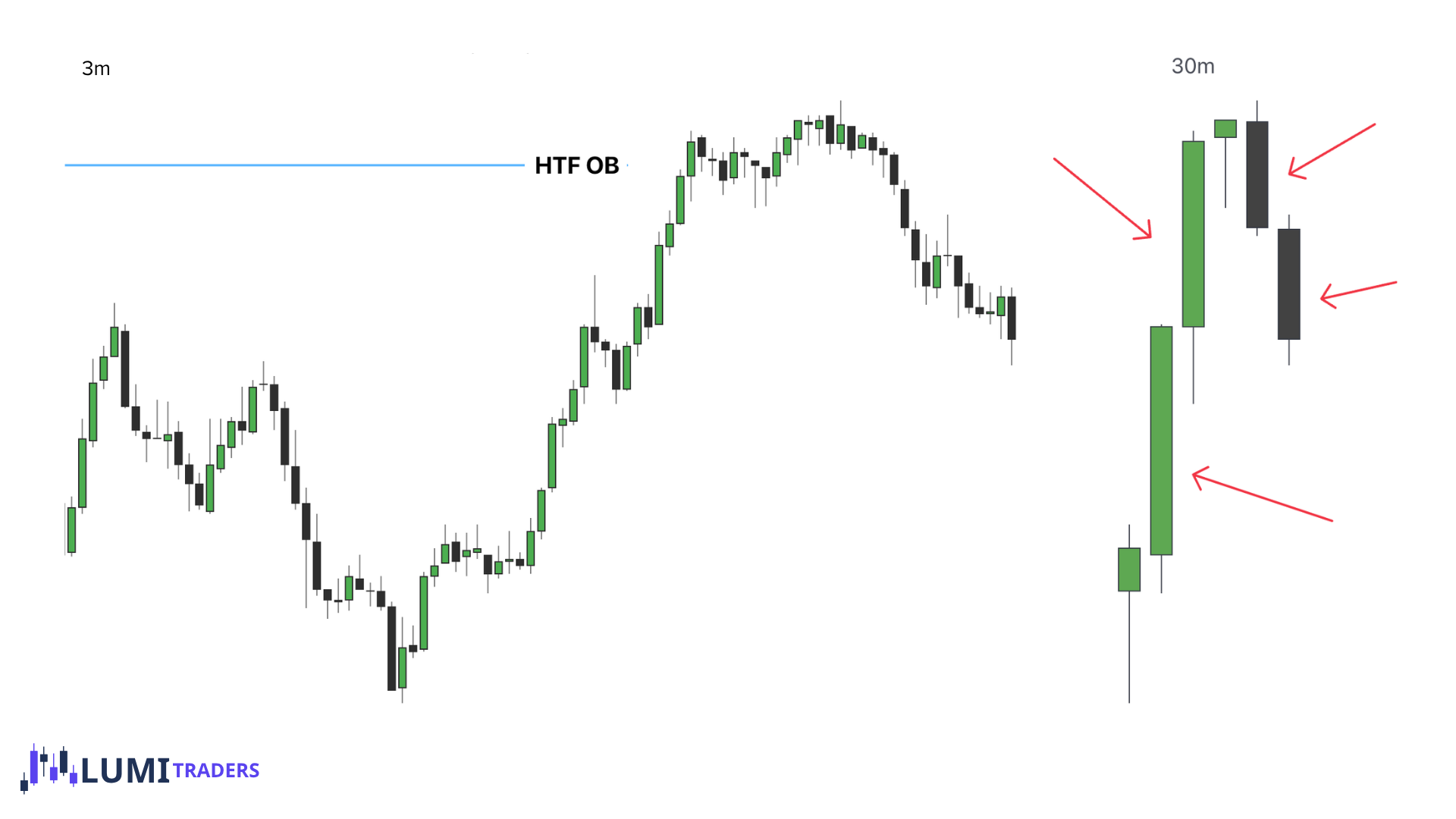
An expansion candle is a strong directional candle that delivers price away from a confirmed reversal or continuation setup.
A bullish expansion candle generally has:
A large bullish body.
Strong displacement.
Limited overlap with prior candles.
A close toward the upper part of its range.
A clear move toward the higher-timeframe objective.
A bearish expansion candle is the opposite:
Large bearish body.
Strong downside displacement.
Limited overlap.
Close toward the lower part of the range.
Continued delivery toward the HTF objective.
Expansion candles tell us:
The market is actively repricing in the direction of the current program.
Why Expansion Candles Matter
Once a reversal has been confirmed and the market begins expanding, we expect continuation candles to behave differently from manipulation candles.
A healthy bullish expansion should generally:
Hold most of its body.
Avoid deep retracement.
Continue making progress toward the objective.
A healthy bearish expansion should do the same in the opposite direction.
This gives us a very useful continuation rule:
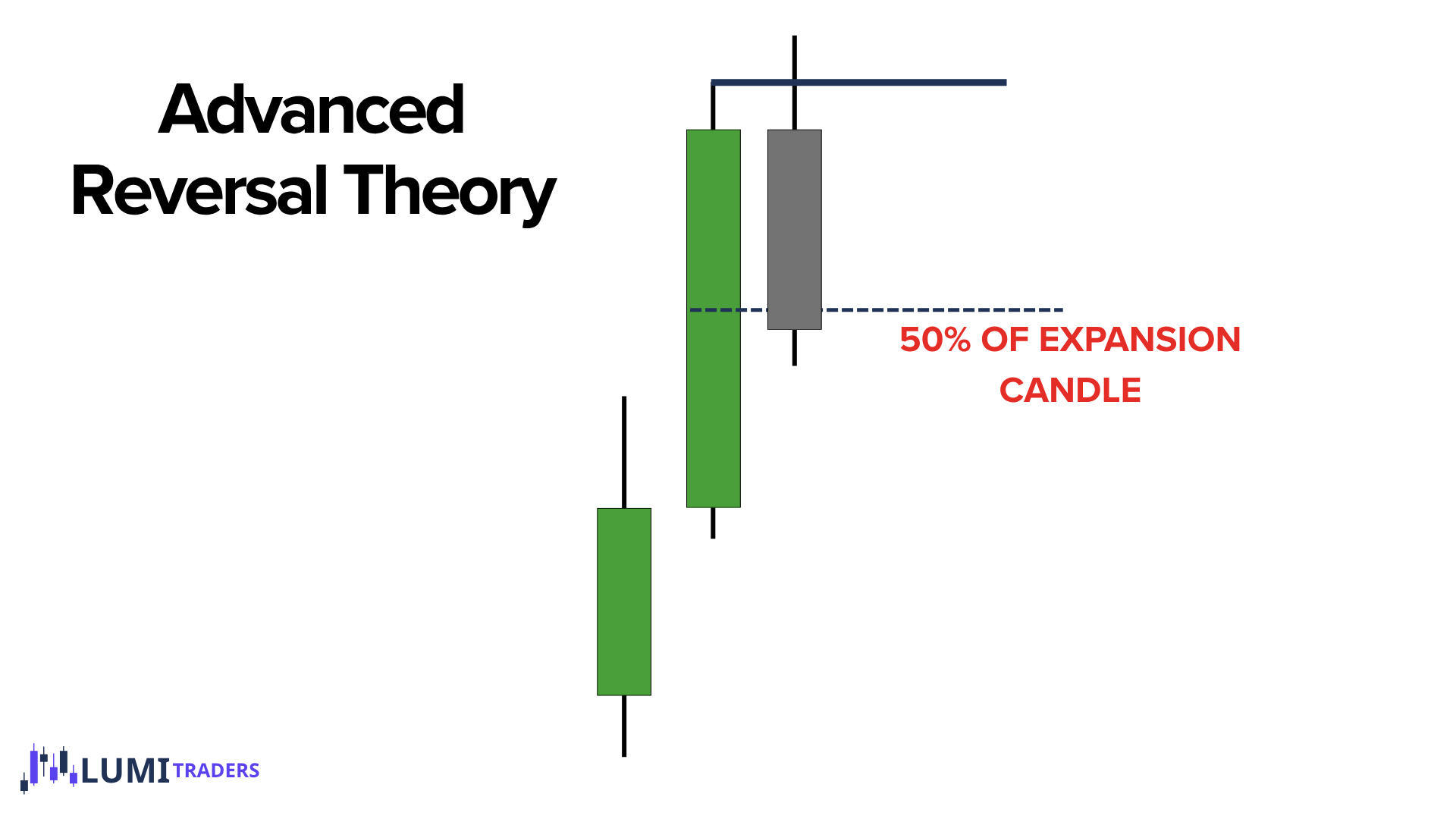
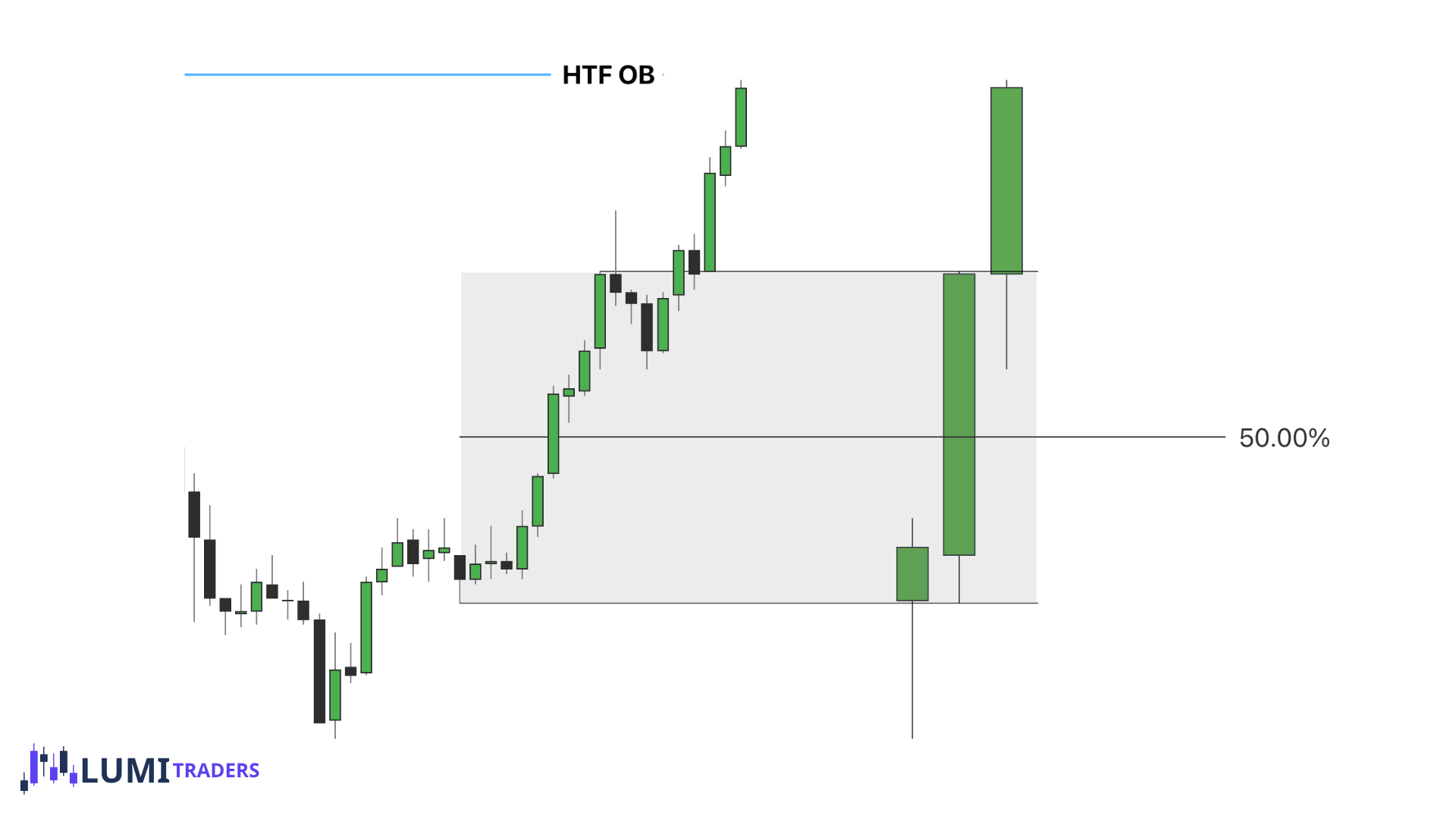
For continuation to remain healthy, price should ideally respect the 50% level of the previous expansion candle.
This is one of the main concepts of this lesson.
The 50% Rule
Take the previous expansion candle and mark its midpoint.
That is:
50% of the candle range.
For a bullish expansion candle:
Price should ideally remain above its 50% level during the next retracement.
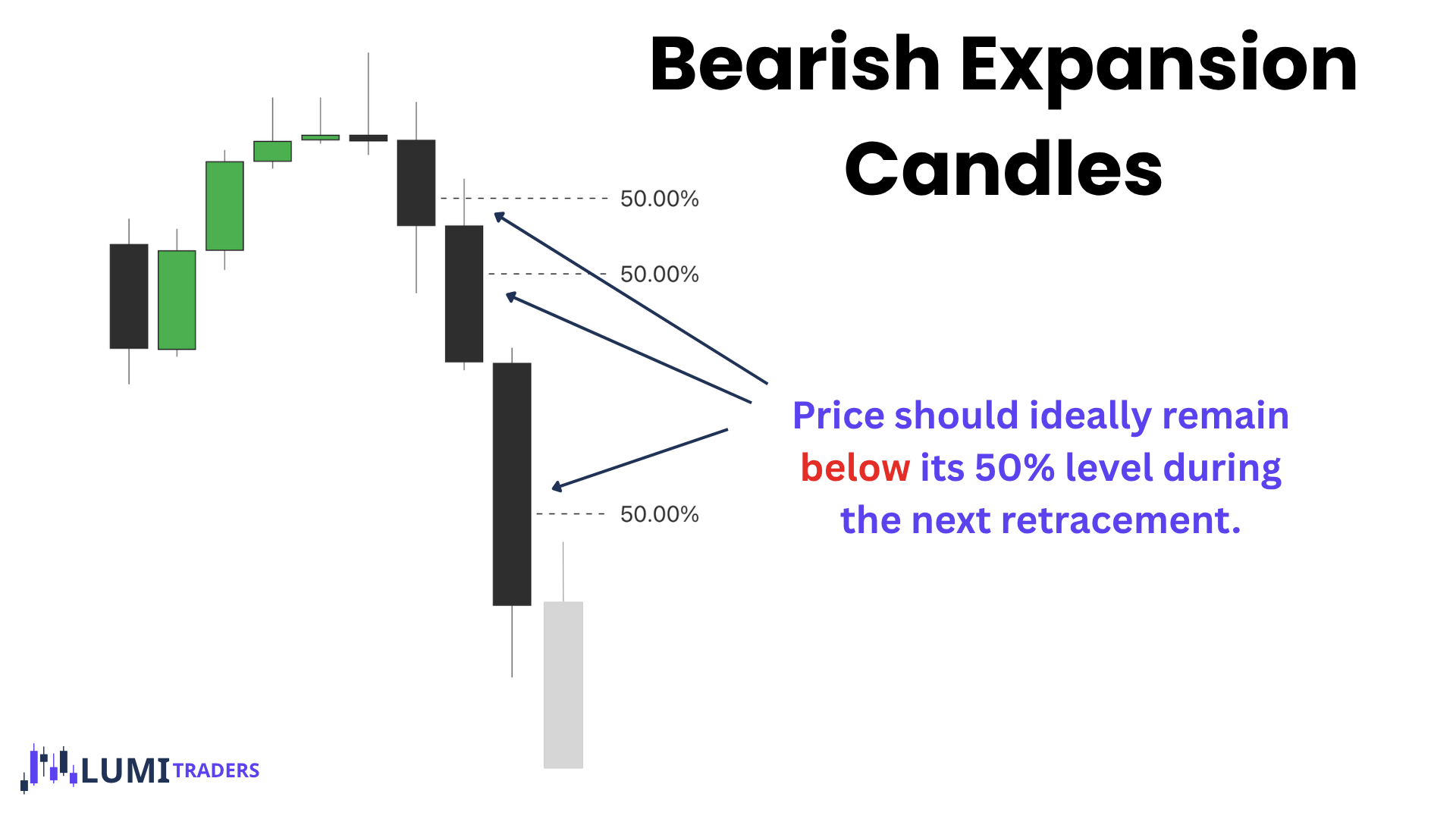
For a bearish expansion candle:
Price should ideally remain below its 50% level.
This tells us whether the previous expansion is still being respected.
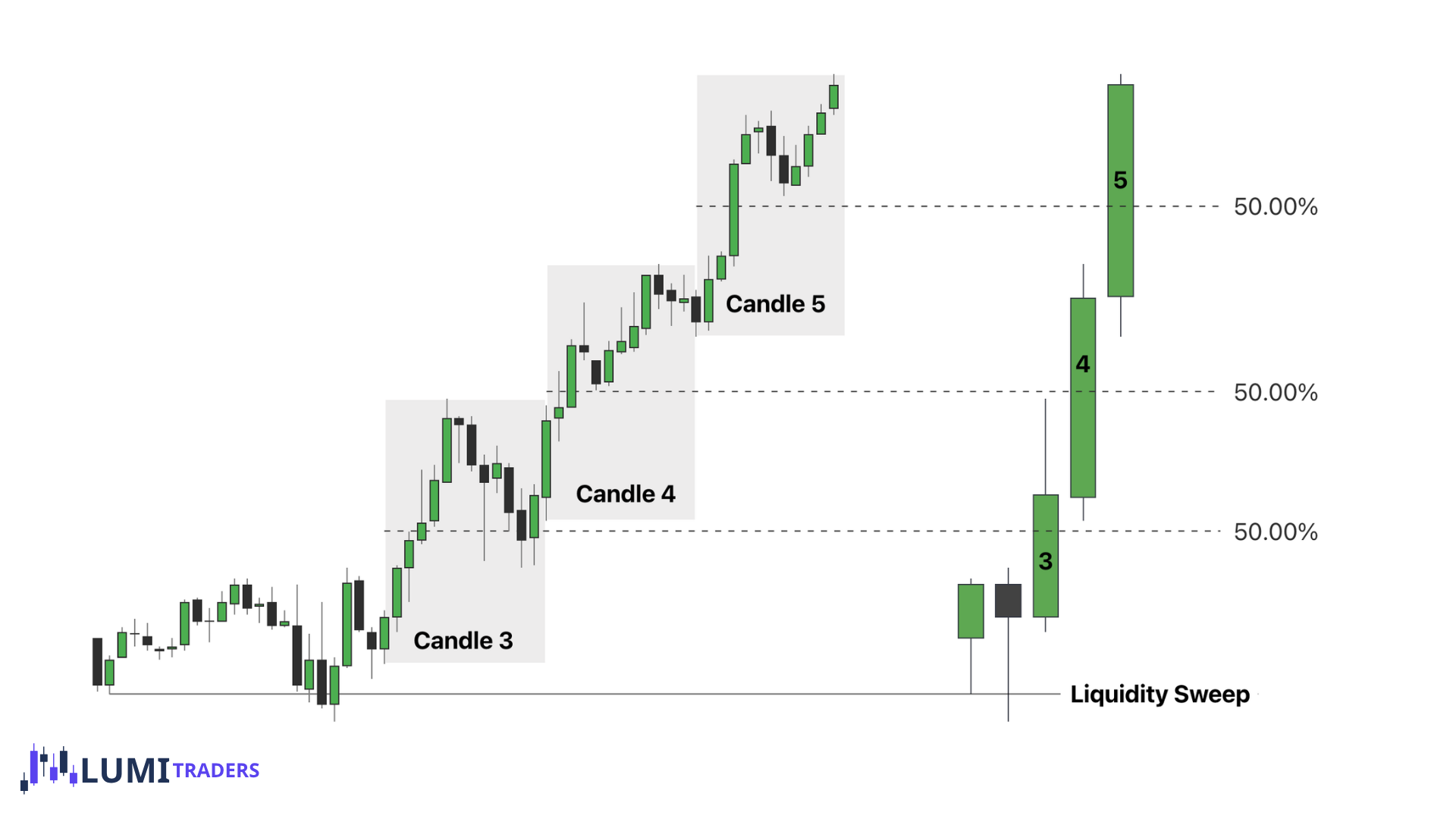
Suppose we have a bullish reversal and price starts expanding higher.
Candle 3 produces a large bullish expansion candle.
Now Candle 4 retraces.
For bullish continuation, we ideally want Candle 4 to respect:
50% of Candle 3
If price trades into that area but does not obtain the required lower-timeframe closure through it, continuation remains healthy.
Then we can continue expecting:
higher prices toward the HTF objective.
What If Price Sweeps 50% Previous Expansion Candle?
This is important.
A sweep through the midpoint can actually become useful confirmation when price fails to accept beyond it.
For bullish continuation:
Sweep below 50% → fail to close below on LTF → reclaim → continuation
For bearish continuation:
Sweep above 50% → fail to close above on LTF → reject → continuation
This shows that the previous expansion candle is still being respected despite the temporary penetration of its midpoint.
Situation 1 — Sweep but 50% Holds
Continuation is still healthy.
Situation 2 — 50% Breaks With Proper LTF Closure
Continuation may be failing.
This second condition is where we begin looking for reversal.
Why Breaking 50% Matters
A strong expansion candle represents aggressive repricing.
If that repricing is genuine, the market should not easily give back more than half of the previous expansion.
Once price begins breaking through the 50% level, the previous directional candle is losing control.
This tells us:
The continuation leg may be failing.
That does not automatically mean the entire higher-timeframe trend has reversed.
But it is an important early warning.
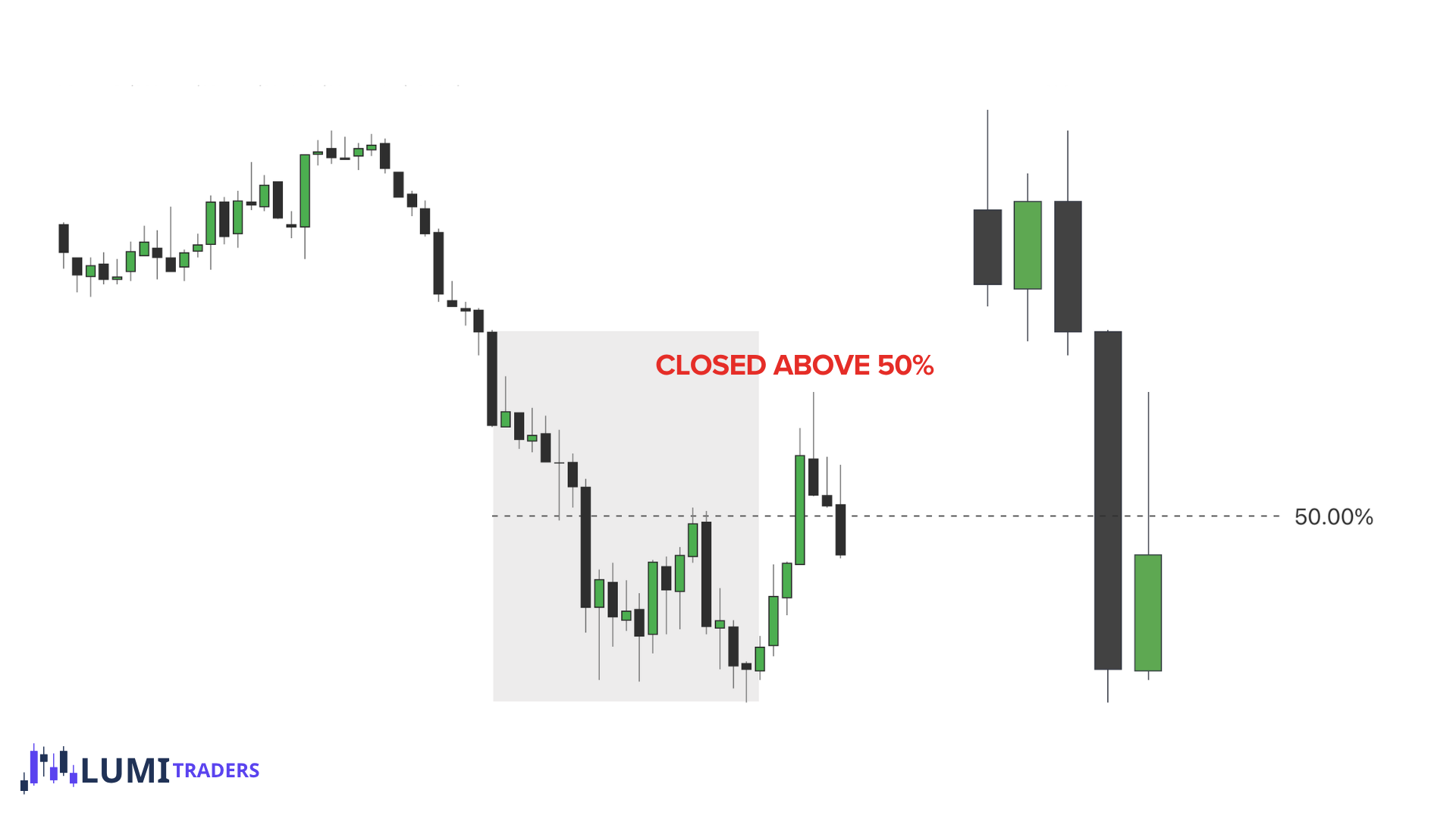
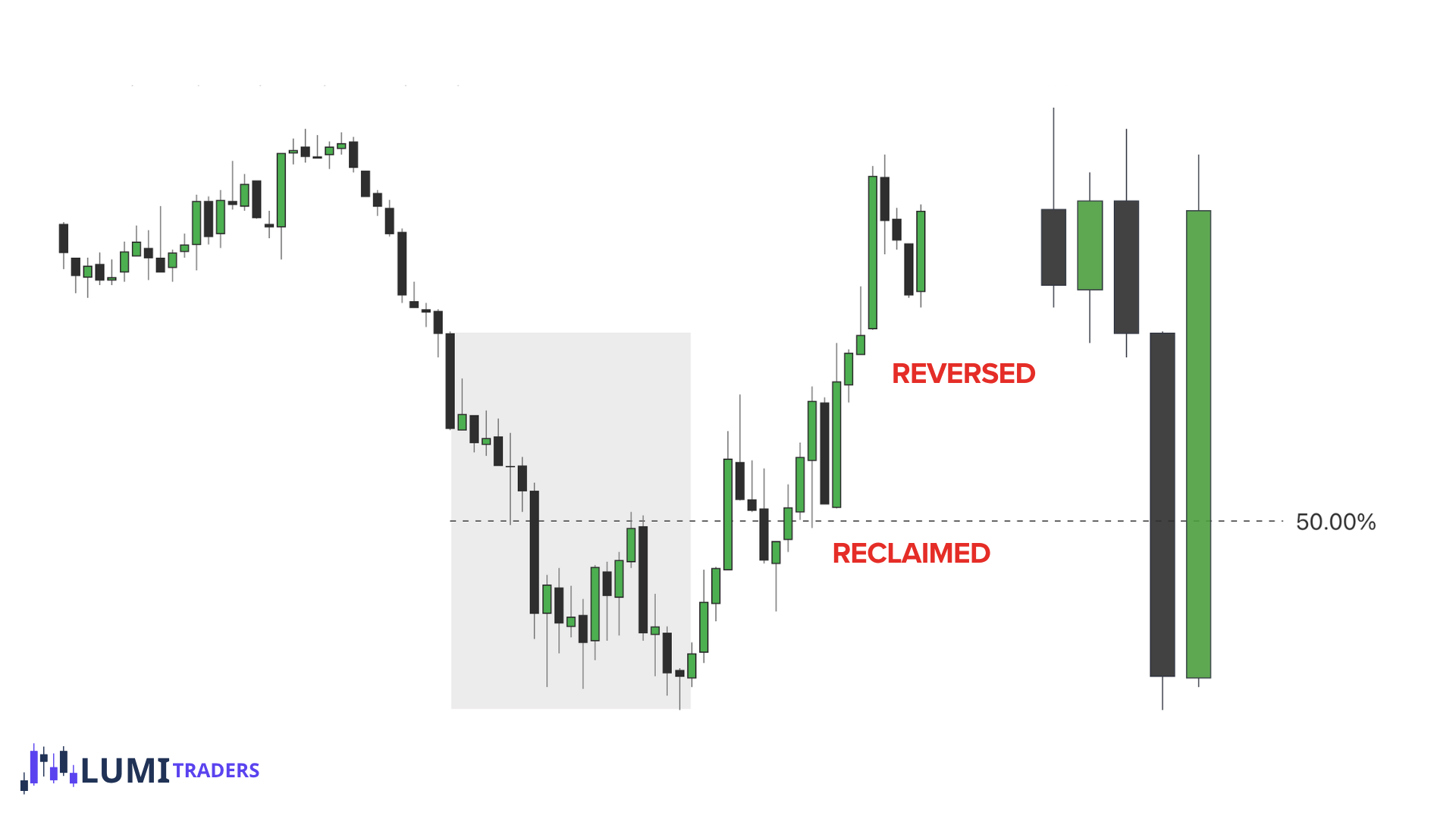
Expansion Failure = Reversal Warning
Imagine we have:
Bullish expansion → bullish expansion → bullish expansion
Then the next retracement closes through the midpoint of the previous bullish expansion candle.
Now something has changed.
The market is no longer respecting the previous bullish displacement.
This is where we stop thinking:
“Just another bullish pullback.”
And start asking:
“Is continuation failing?”
This is the beginning of the advanced reversal model.
We Do Not Use the Same Timeframe to Confirm the Break
This is where our timeframe-alignment model becomes extremely important.
We do not simply wait for the higher-timeframe expansion candle itself to close through its 50%.
Instead, we use an aligned lower timeframe to confirm the failure.
This allows us to recognize the reversal earlier.
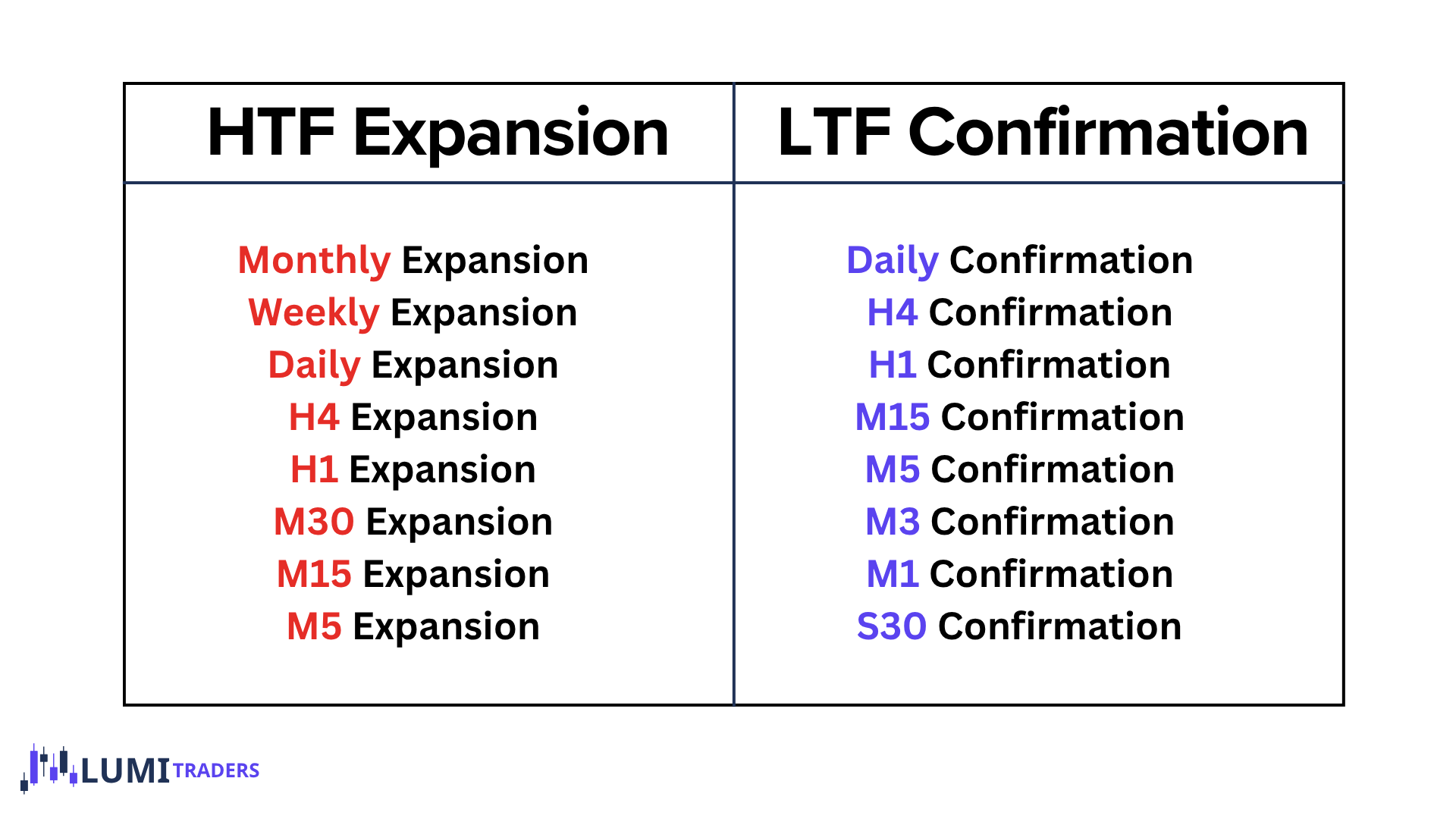
This means:
30M Expansion Candle
Use:
3M closure through the 50% level
1H Expansion Candle
Use:
5M closure through the 50% level
4H Expansion Candle
Use:
15M closure through the 50% level
Daily Expansion Candle
Use:
1H closure through the 50% level
And so on.
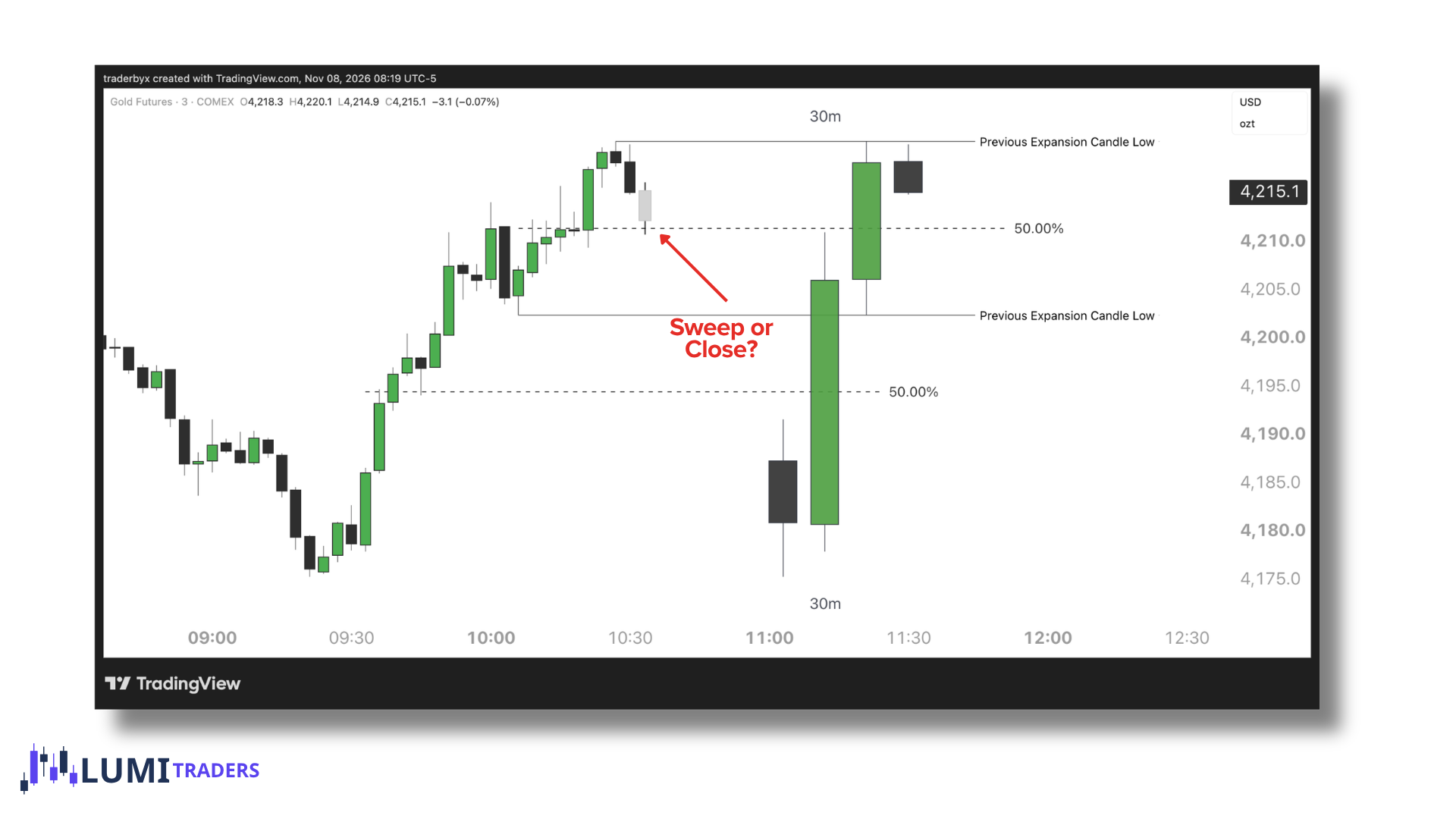
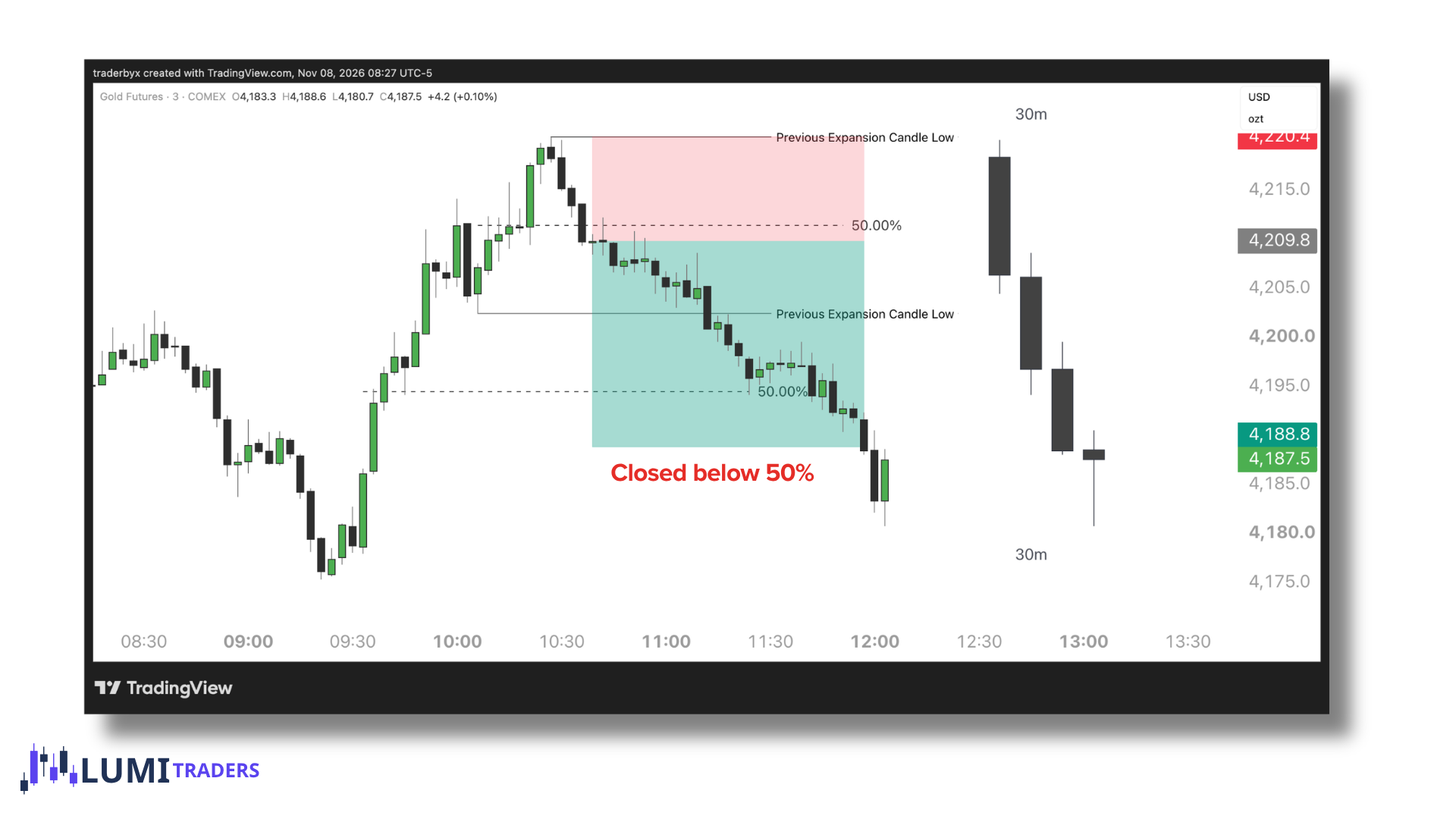
Example: 30M Bullish Expansion → 3M Reversal Confirmation
Suppose the 30-minute chart is bullish.
We have a strong 30M expansion candle.
The HTF objective remains above.
Normally we expect the next retracement to respect 50% of that candle.
We mark the midpoint.
Now price retraces.
If the 3-minute chart trades below the 50% level but only wicks through:
No confirmed reversal yet.
But if a 3-minute candle closes below the 50% level:
Now we have:
failure to respect the previous 30M bullish expansion candle
This becomes a signal that bullish continuation may be failing.
Now we can begin considering a reversal trade.
What Does a 50% Break Actually Confirm?
It does not necessarily confirm the final trend reversal.
It confirms something more specific:
The previous expansion candle is no longer being respected.
That is the first piece of evidence that the continuation model is weakening.
Think of it as:
Continuation failure first.
Structural reversal may follow.
Two Ways to Trade the Reversal
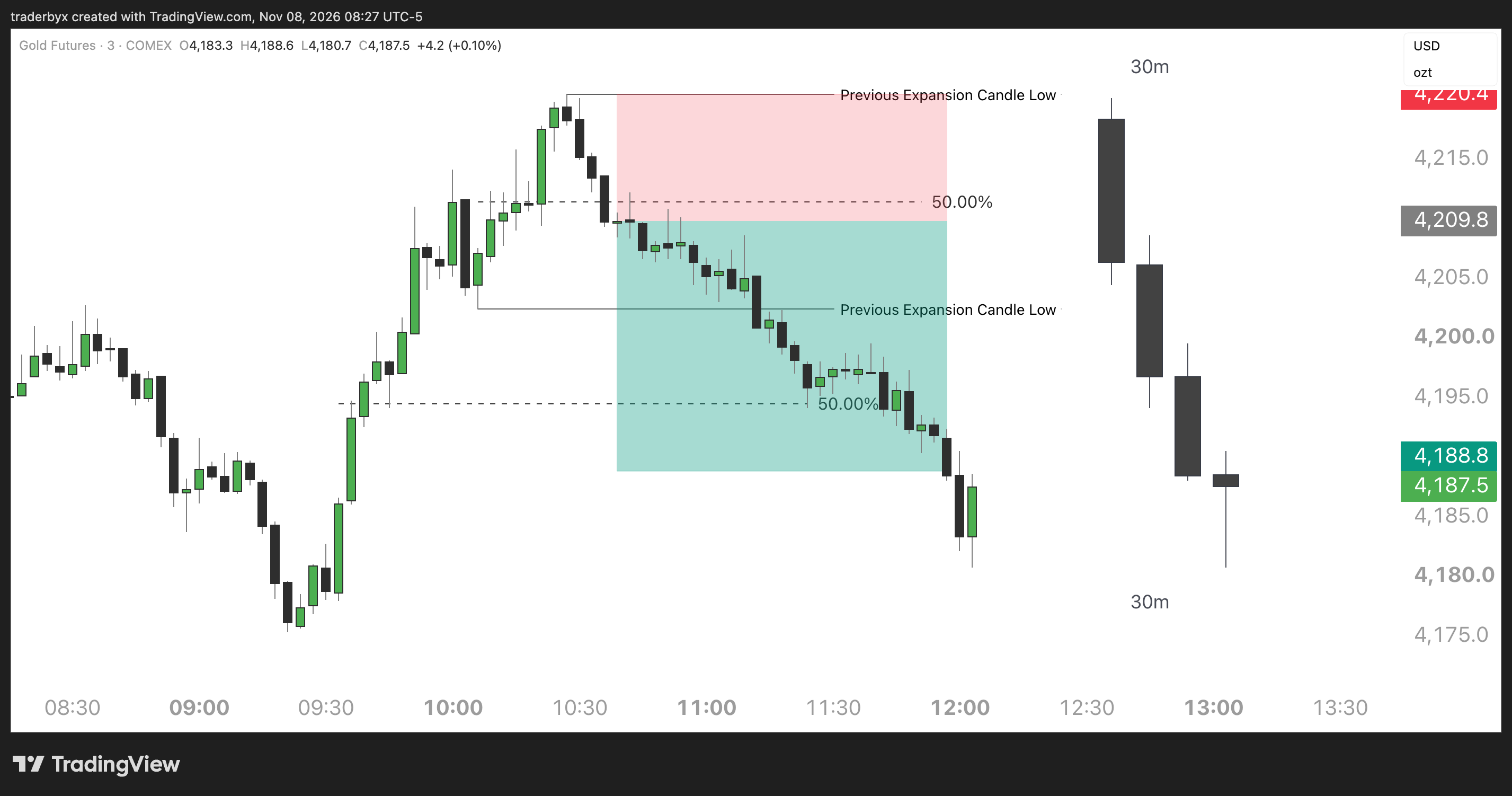
Entry Model 1 — Immediate Entry
This is the more aggressive approach.
Once the aligned LTF gives us the required candle-body closure through 50%, we can enter in the reversal direction.
Bullish Expansion Failure
HTF bullish expansion candle.
Aligned LTF closes below 50%.
Potential entry:
Short after the closure.
Stop:
Above the previous relevant swing high.
Bearish Expansion Failure
HTF bearish expansion candle.
Aligned LTF closes above 50%.
Potential entry:
Long after the closure.
Stop:
Below the previous relevant swing low.
This allows us to participate early in the possible reversal.
Entry Model 2 — Wait for Pullback + LTF CISD
This is the more conservative entry.
After the 50% failure:
Wait for the initial reversal displacement.
Allow price to retrace.
Wait for aligned LTF CISD.
Enter with the new directional continuation.
This gives us more confirmation.
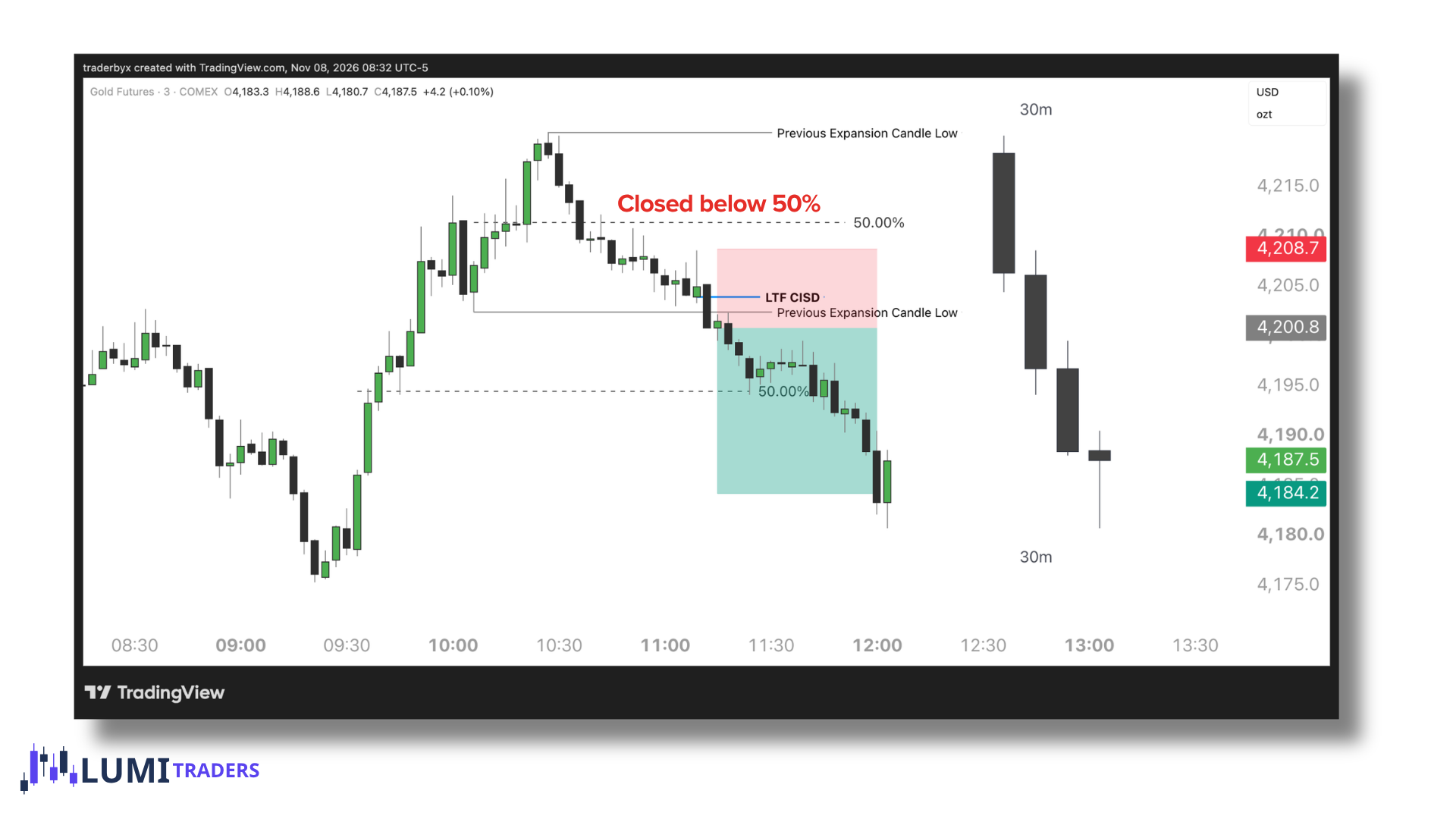
Why CISD Helps After the 50% Failure
The 50% failure tells us:
the old continuation model is weakening.
CISD tells us:
the new delivery is taking control.
Together:
50% failure + CISD
provides a much stronger reversal framework.
The Full Reversal Sequence
A clean advanced reversal may look like:
HTF expansion
→ continuation expected
→ 50% should hold
→ aligned LTF closes through 50%
→ continuation fails
→ reversal displacement
→ LTF pullback
→ CISD
→ entry
This is the core model.
Bullish-to-Bearish Reversal Model
Same applies for Bearish-to-Bullish Reversal Model
Suppose the market is bullish.
We have:
confirmed bullish structure,
one or more expansion candles,
HTF objective still active or nearing completion.
Normally:
the previous bullish expansion candle should hold 50%.
Then price retraces.
Aligned LTF closes below the midpoint.
Now:
bullish continuation begins failing.
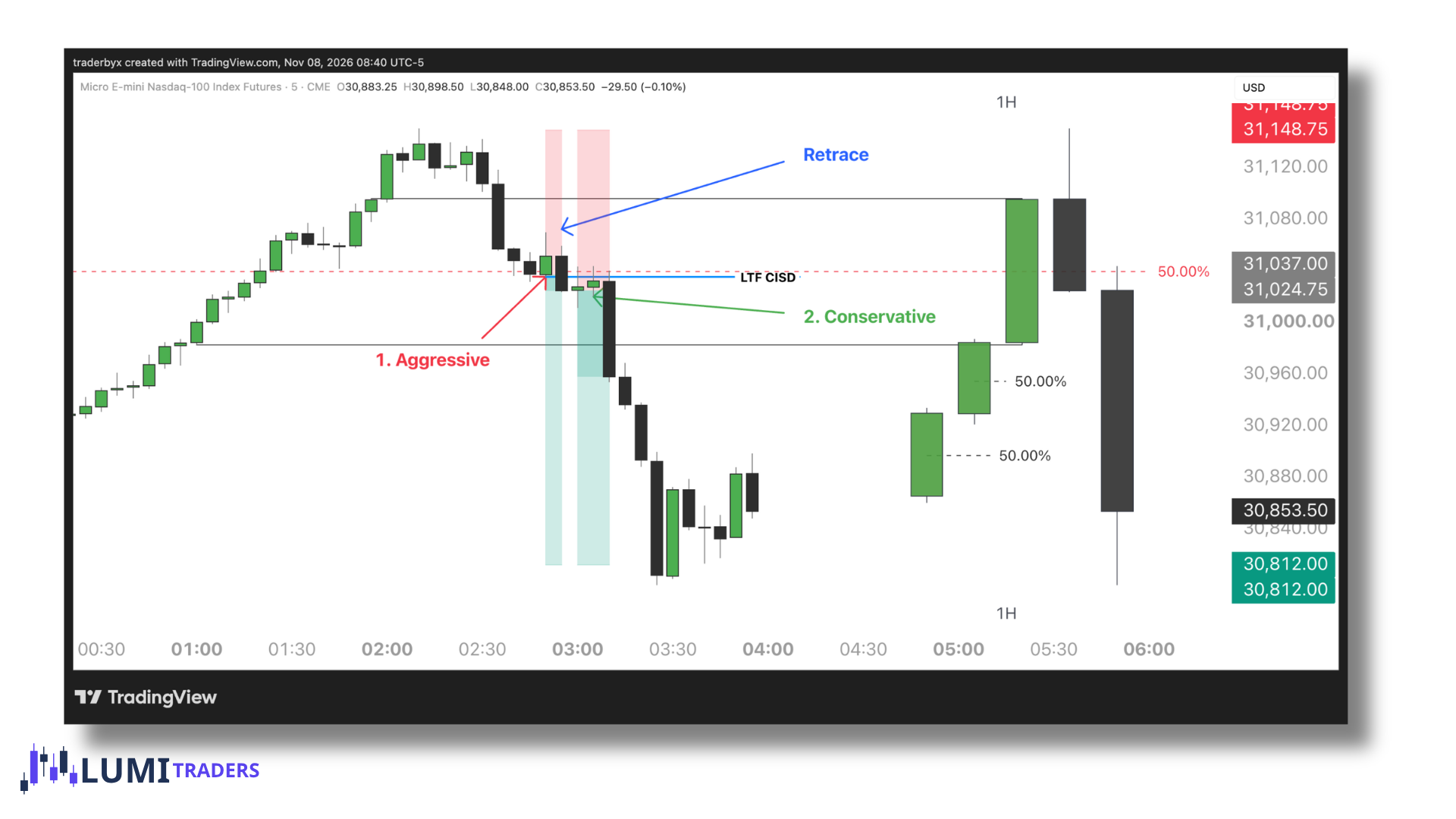
We can:
Aggressive
Short immediately after the LTF closure.
Stop above swing high.
Conservative
Wait for:
pullback → bearish CISD → short
Now our new objective becomes opposing liquidity.
What If Price Breaks 50% but Reclaims Immediately?
This is why we use candle-body closure rather than a wick.
If price briefly trades through 50% and immediately reclaims:
No confirmed failure.
But if the aligned LTF obtains a body close through the midpoint:
Now the signal becomes meaningful.
Again:
Wick = test
Close = acceptance
Which Expansion Candle Do We Use?
Use the most recent meaningful expansion candle in the current directional move.
Do not use:
tiny indecision candles,
dojis,
small overlapping candles,
random consolidation candles.
We want the candle that clearly represents directional displacement.
Ask:
Which candle actually expanded price toward the current HTF objective?
That is the candle whose 50% matters.
Multiple Expansion Candles
Sometimes we have:
Candle 3 → Candle 4 → Candle 5
all expanding in the same direction.
Each new strong expansion candle can provide a new 50% reference.
The market is effectively stair-stepping.
As long as each previous expansion is being respected:
continuation remains healthy.
Once the latest important expansion candle loses its midpoint:
reversal risk increases.
Continuation Sequence
A healthy bullish sequence may look like:
Expansion Candle 3
→ shallow retracement holding 50%
→ Expansion Candle 4
→ shallow retracement holding 50%
→ Expansion Candle 5
The bearish version is the same.
This is why Candle 3, 4, 5, and sometimes 6 can remain part of the continuation program.
Reversal Sequence
Eventually:
Expansion Candle
→ retracement
→ 50% breaks
→ aligned LTF closes through midpoint
Now:
continuation behavior has changed.
We stop automatically expecting another expansion candle in the same direction.
Instead:
prepare for reversal.