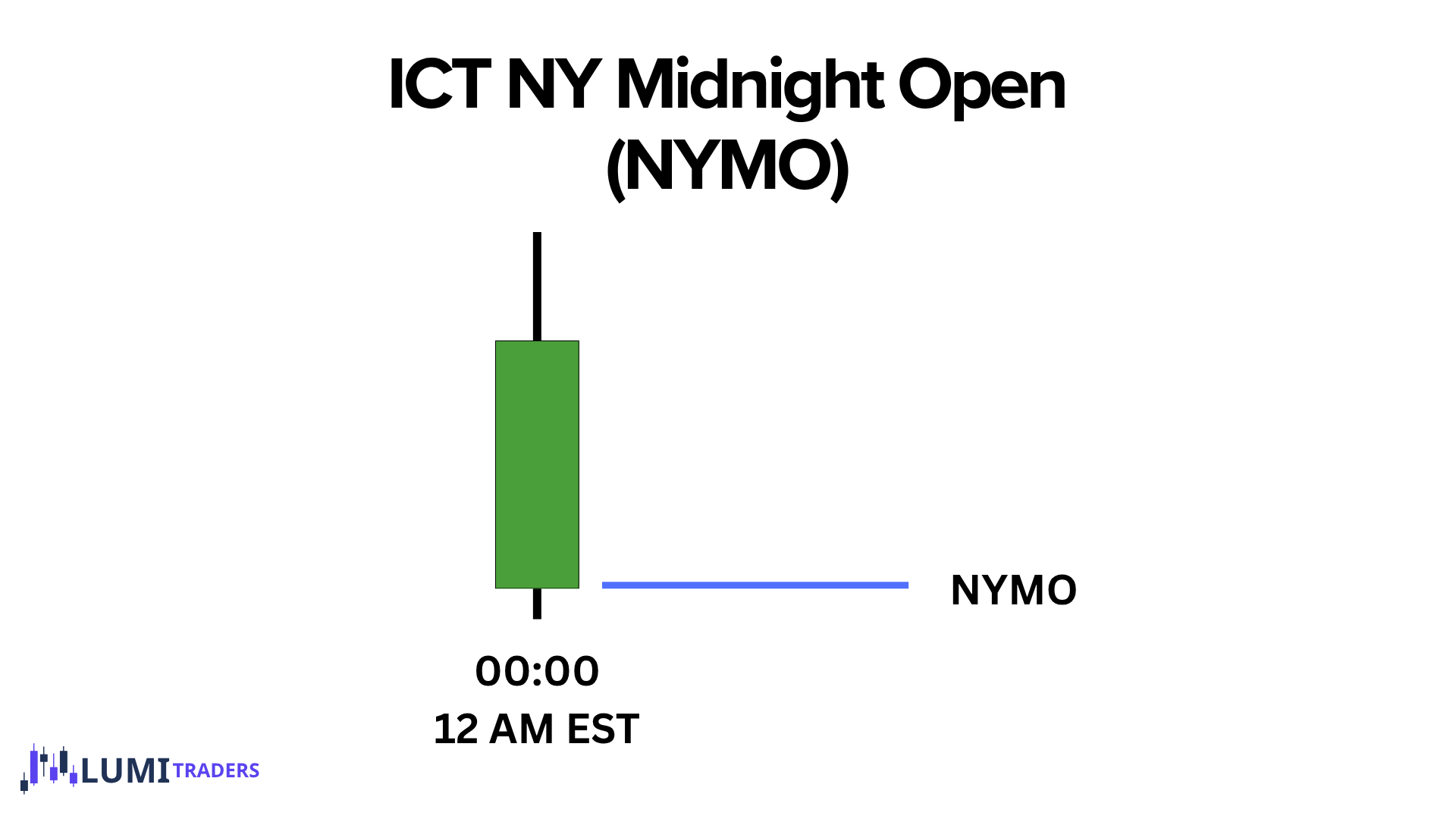
New York Midnight Open (NYMO)
The New York Midnight Open (NYMO) is the price at 12:00 AM New York time.
For intraday trading, NYMO gives us a fixed reference that helps answer several important questions:
Is price currently delivering above or below the Midnight Open?
Is the overnight move manipulation or true expansion?
Has NYMO remained untouched?
Is NYMO likely to become a morning objective?
Is price accepting above or below NYMO?
Is New York likely to continue the overnight move or reverse it?
Should we be looking primarily for longs or shorts?
NYMO is primarily a:
Directional filter + liquidity reference + price-delivery reference.
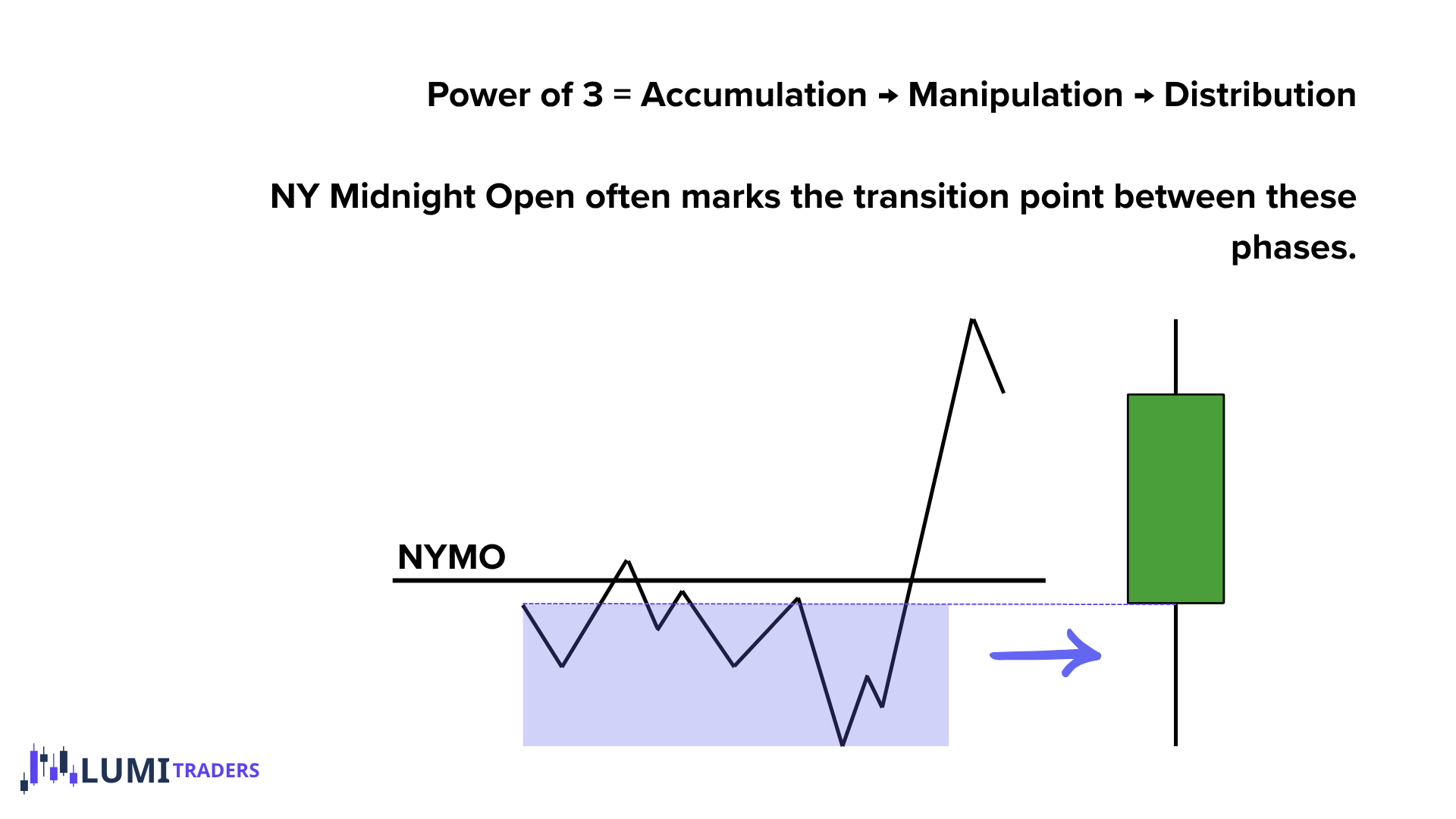
NYMO is the reference point around which the early intraday dealing range develops.
But being above or below NYMO does not immediately give us direction.
We first need to understand which phase of Power of 3 price is currently completing.
NYMO and Power of 3
Power of 3 consists of:
Accumulation → Manipulation → Distribution
The NY Midnight Open can act as an important transition point between these phases. Your lesson illustrates NYMO as the reference around which accumulation and manipulation occur before price finally expands and forms the body of the move.
This gives us three NYMO phases.
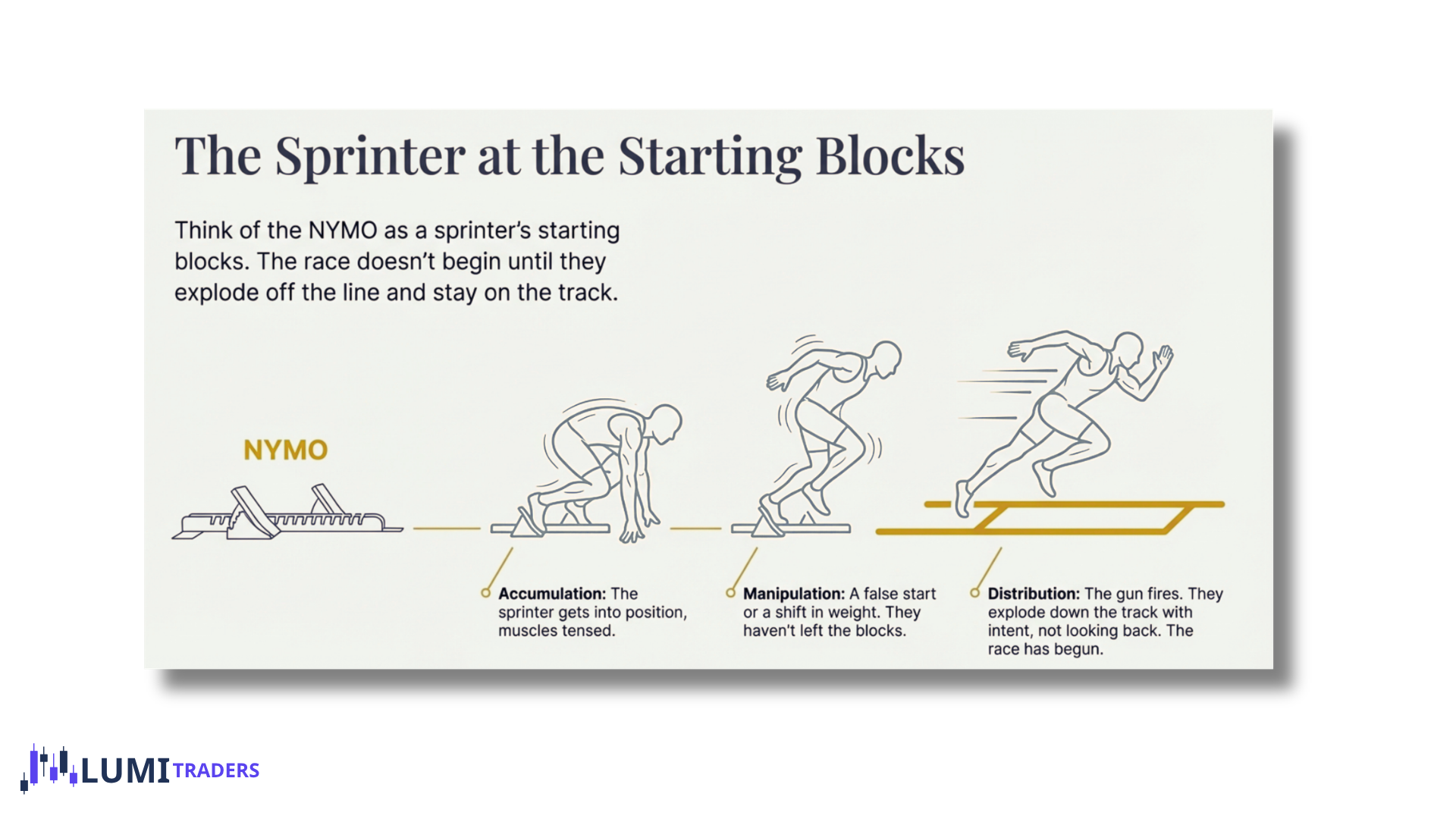
NYMO as the Early Dealing-Range Centerline
NYMO is an early centerline of the developing dealing range.
Before real expansion:
price is still defining the range.
Only once distribution begins do we get:
meaningful expansion,
clearer highs and lows,
and a proper Premium/Discount framework.
This means you cannot logically use “discount” if the dealing range has not been established yet. Your lesson explicitly states that the range needs to hold away from NYMO before true premium/discount logic becomes useful.
Phase 1 — Accumulation Around NYMO
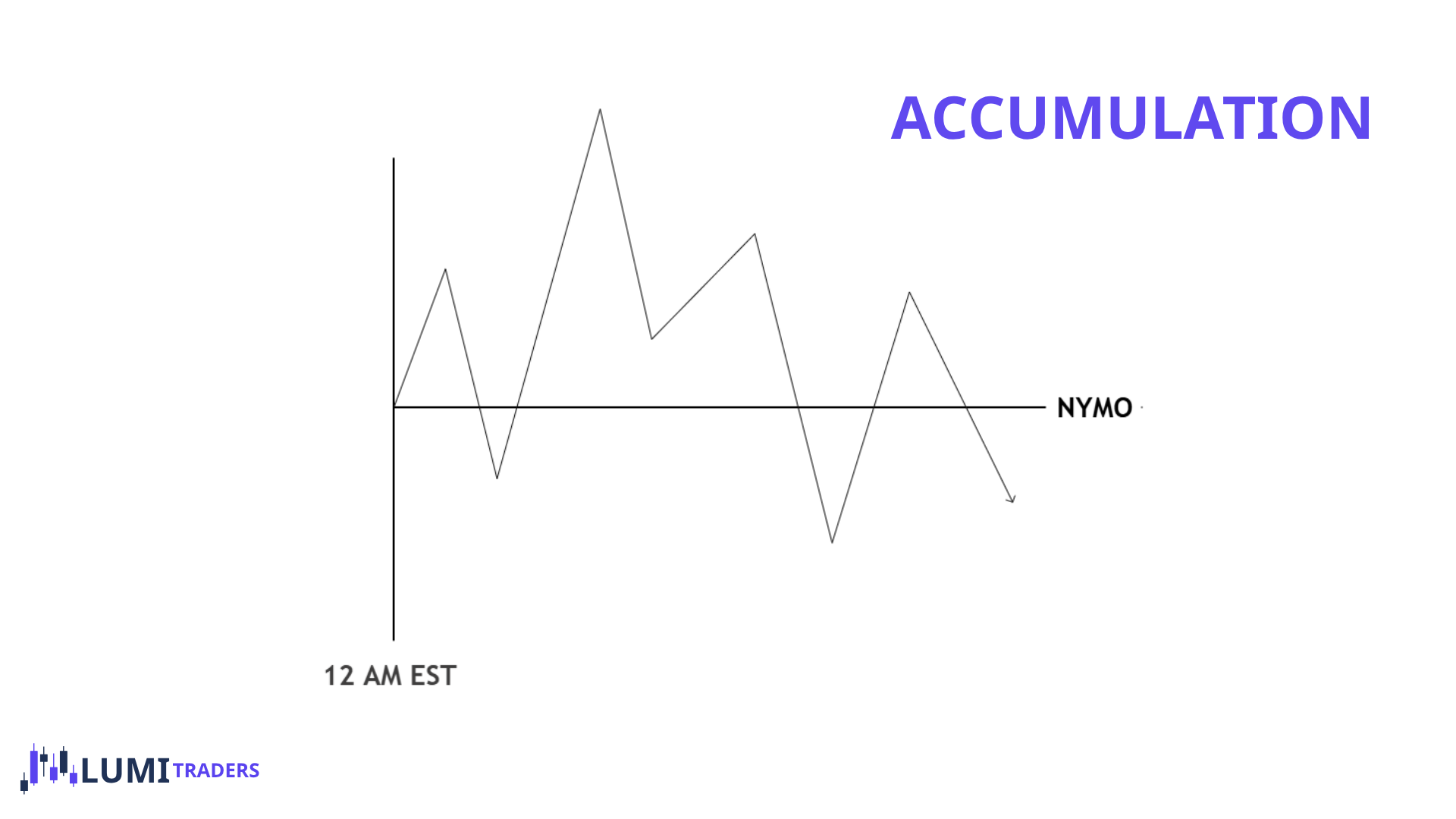
Shortly after midnight, price may remain close to NYMO.
The range may be narrow.
Price may repeatedly trade slightly above and below the open.
At this point:
there is no confirmed direction yet.
The dealing range is still being created.
This is extremely important because a common beginner mistake is to think:
“Price is below NYMO, therefore I should buy because it is in discount.”
or:
“Price is above NYMO, therefore I should sell because it is in premium.”
That logic is incorrect at this stage.
During accumulation, being above or below NYMO by itself means very little because the true dealing range has not yet been established.
Why NYMO Is Not Automatically Premium or Discount
This is one of the most important clarifications.
Price being below NYMO does not automatically mean:
discount
and price above NYMO does not automatically mean:
premium.
Premium and discount require a defined dealing range.
Early in the session, while price is still oscillating around NYMO, that range may not yet exist.
So NYMO is initially a reference point, not a complete dealing range by itself.
This means:
Do not buy simply because price is below NYMO.
Do not short simply because price is above NYMO.
We first need manipulation and then confirmation that distribution has started.
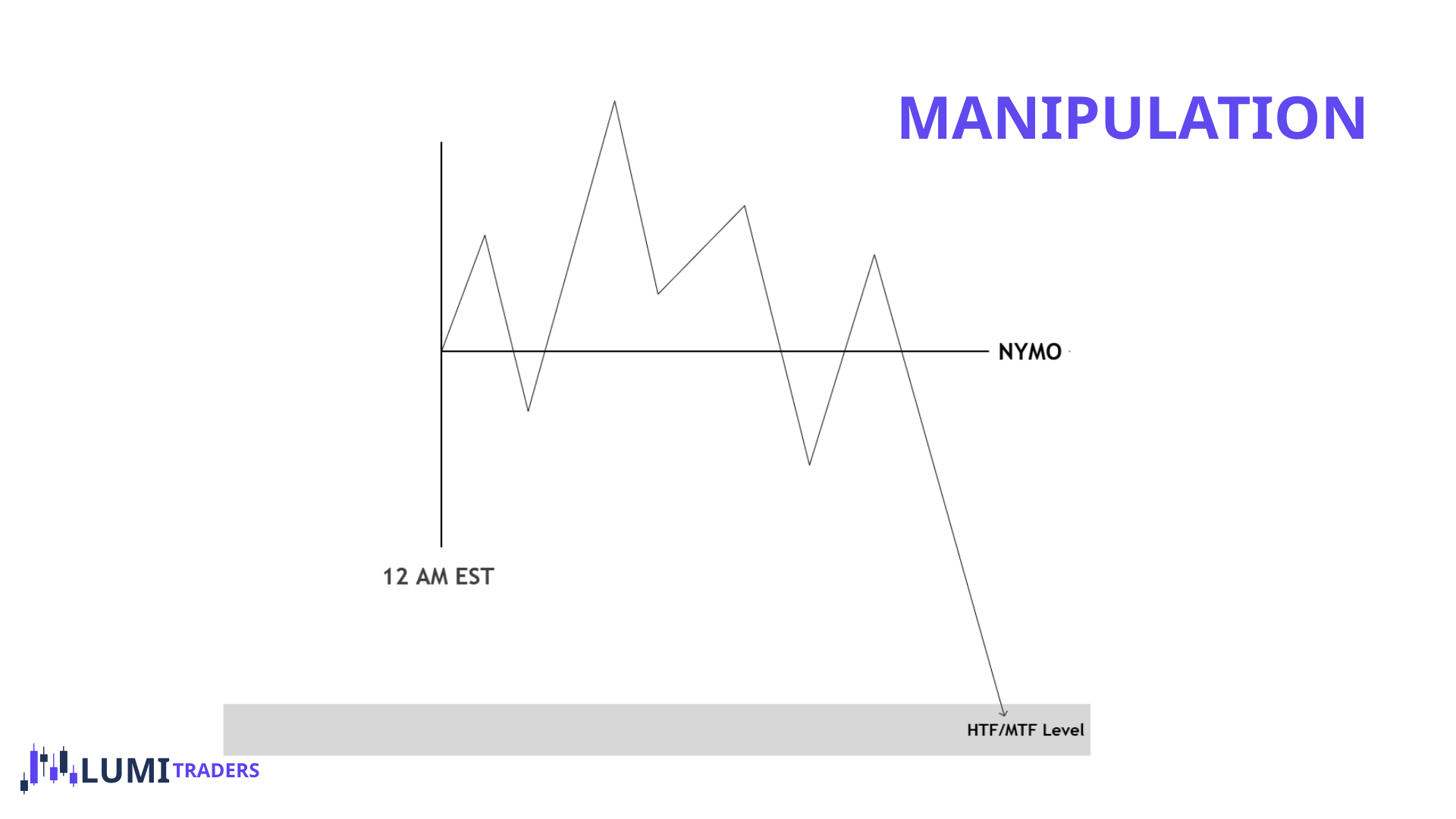
Phase 2 — Manipulation
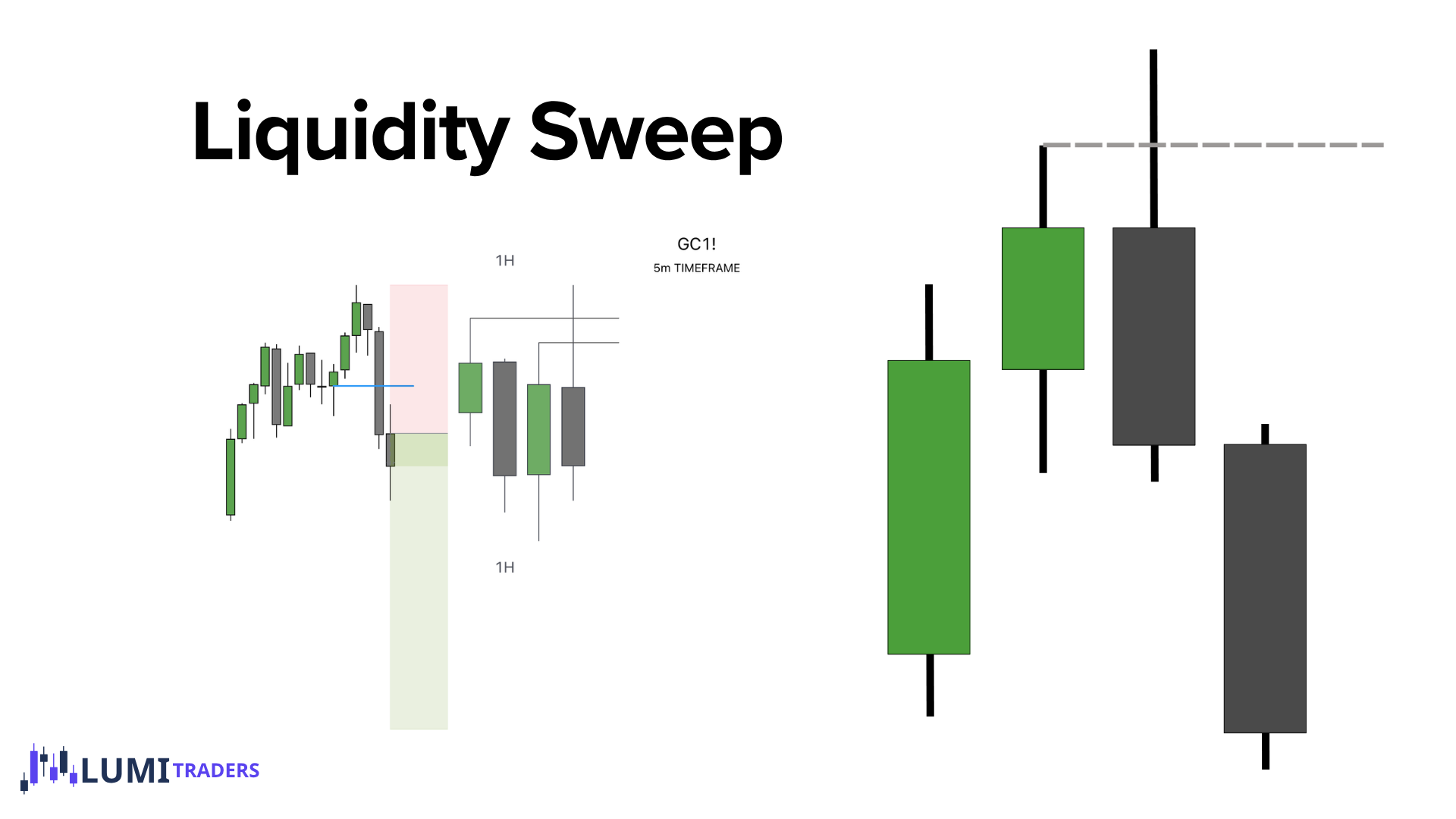
After accumulation, price may make a false move away from NYMO.
It may trade:
below NYMO
or:
above NYMO
without producing real follow-through.
This movement often reaches:
liquidity,
a HTF PD Array,
an FVG,
an Order Block,
or another meaningful level.
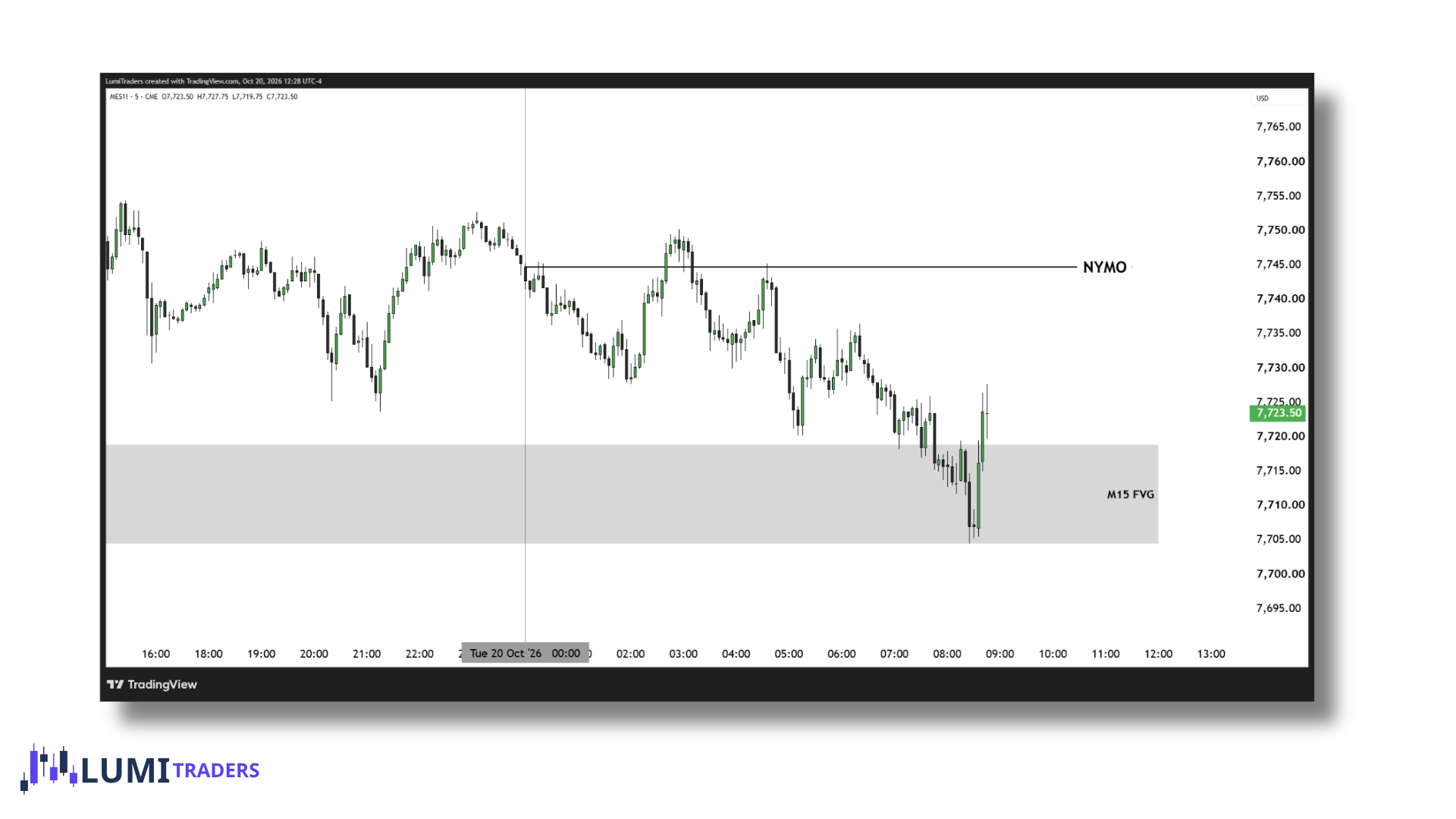
This is the manipulation phase of Power of 3. Your NYMO lesson describes this phase as a move away from NYMO without sustained follow-through, often into a HTF level, and says that a reversal from this area should be confirmed by CISD.
Bearish Manipulation Above NYMO
The bearish version:
Price trades above NYMO.
It may attack:
Asia High,
London High,
equal highs,
BSL,
premarket high,
bearish HTF PD Array.
Again:
being above NYMO alone is not a short signal.
We wait for the bullish delivery to fail.
A bearish CISD around the manipulation area can tell us that the move above the open is beginning to reverse.
Bullish Manipulation Below NYMO
Suppose price trades below Midnight Open.
It may take:
Asia Low,
London Low,
equal lows,
internal SSL,
premarket SSL,
or another HTF level.
At this moment:
we do not buy just because price is below NYMO.
It may still continue lower.
Instead, we want to see evidence that the downside move was manipulation.
For example:
SSL taken → bullish HTF/LTF reaction → bullish CISD → price returns toward NYMO
Now we begin watching for the transition into distribution.
Phase 3 — Distribution
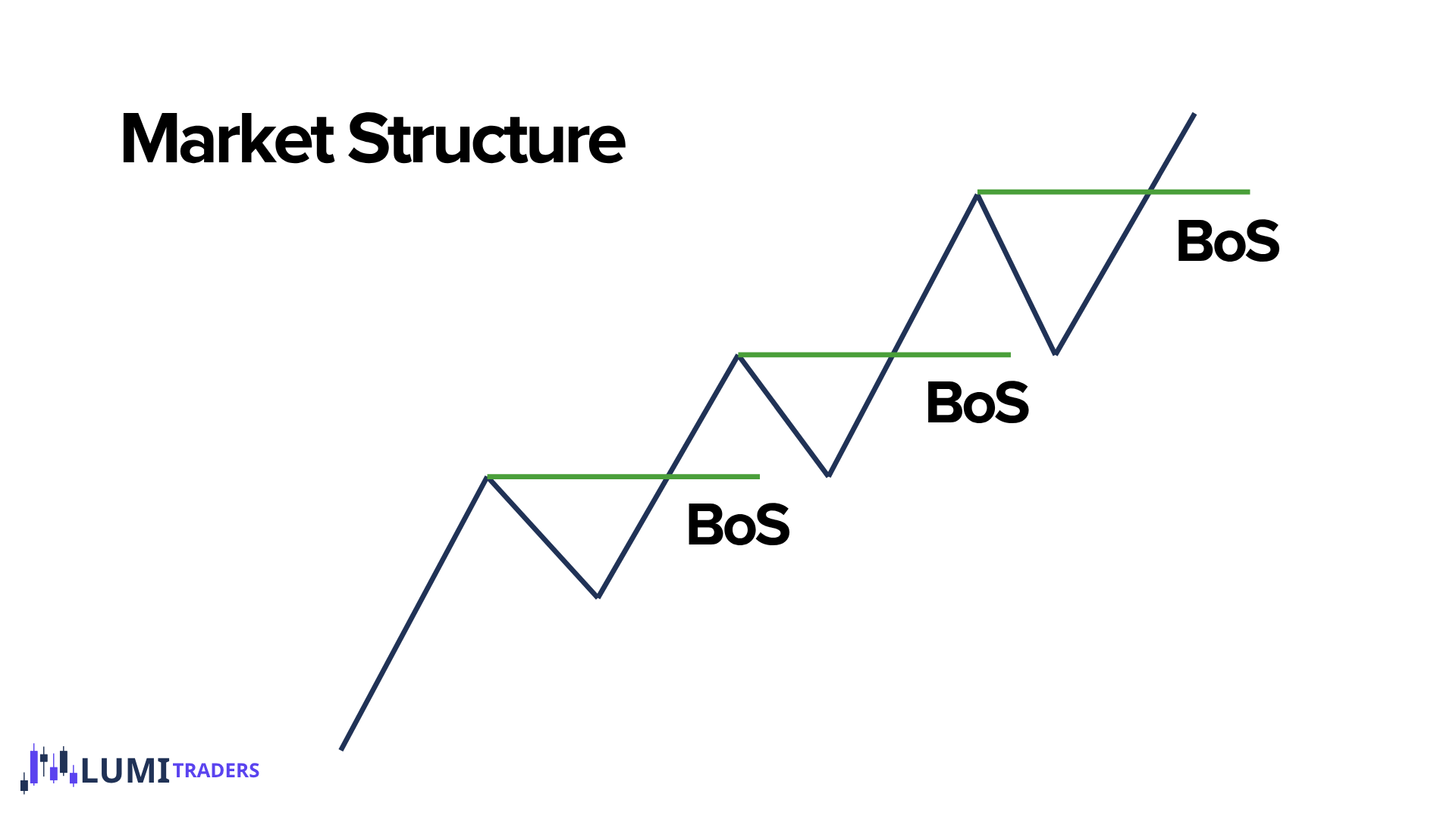
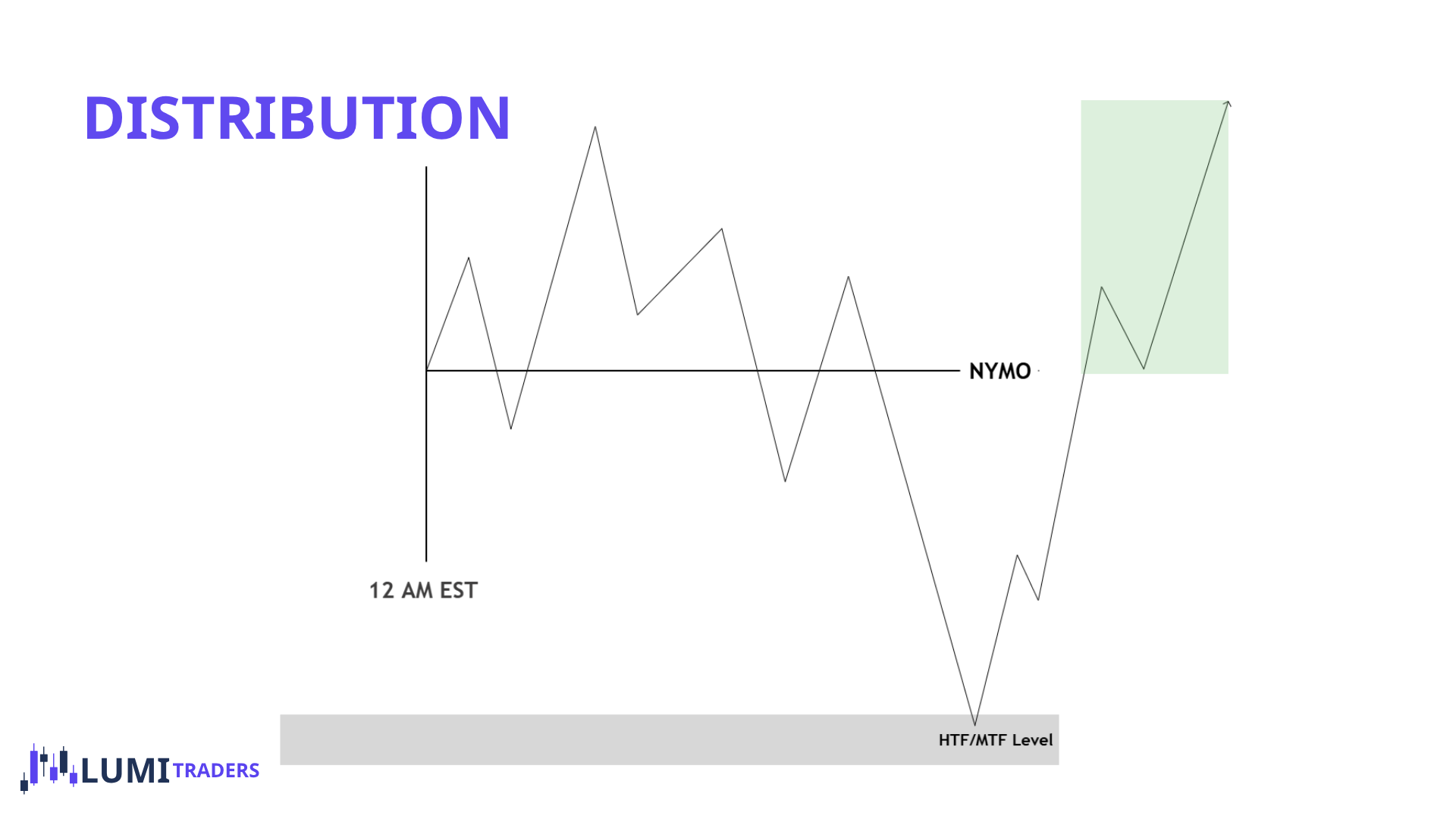
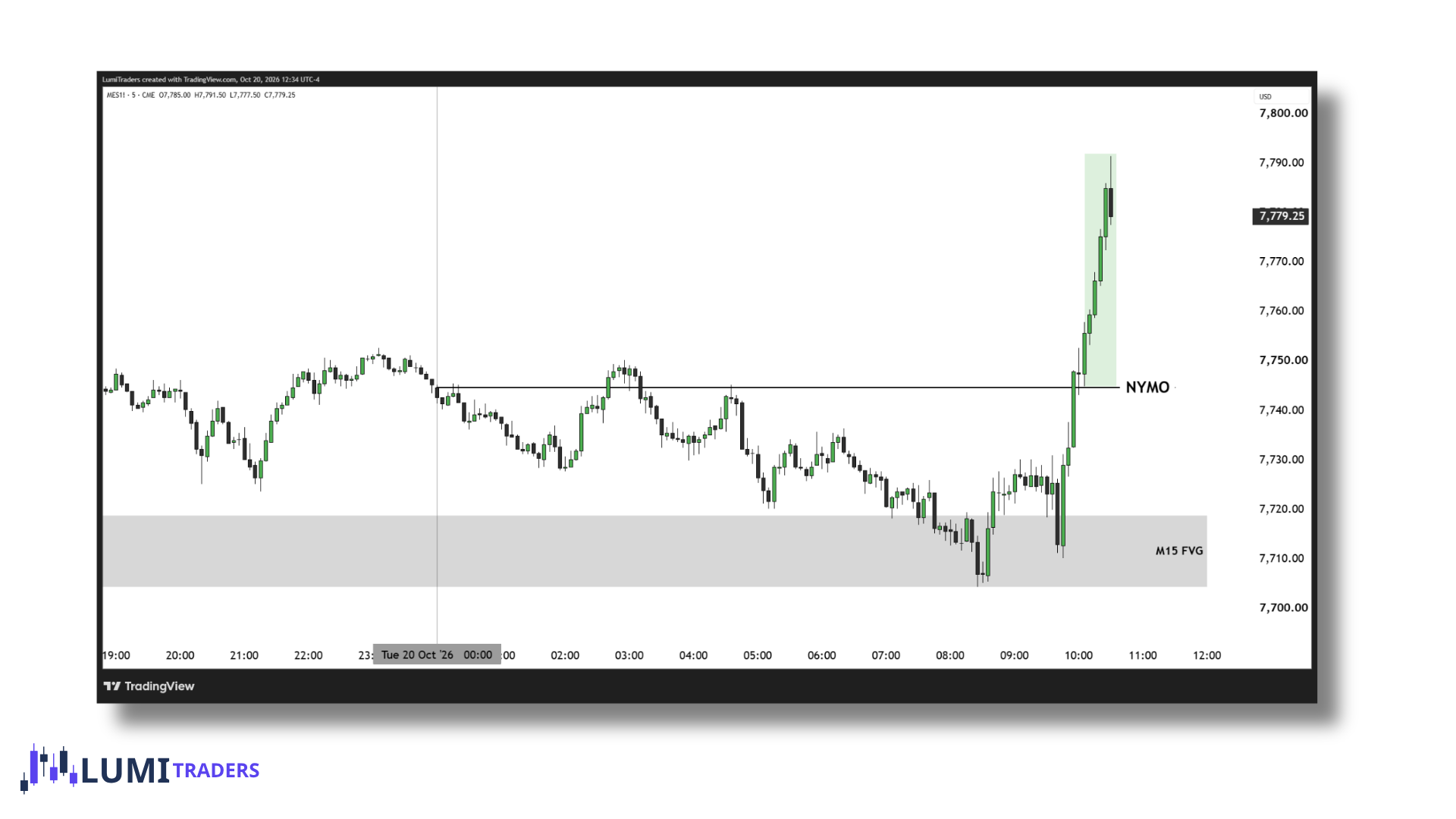
Distribution is where the real directional move begins.
Distribution begins when price:
breaks NYMO,
closes beyond NYMO,
and then stays away from the origin.
If price continuously returns to NYMO, the dealing range has not yet finalized and the market may still be in manipulation rather than true distribution.
Why Break + Close Matters
Imagine price is below NYMO.
It moves above it for a few seconds and then immediately falls back below.
That does not tell us much.
But if price:
displaces above NYMO → closes above → holds above → continues away
we have something completely different.
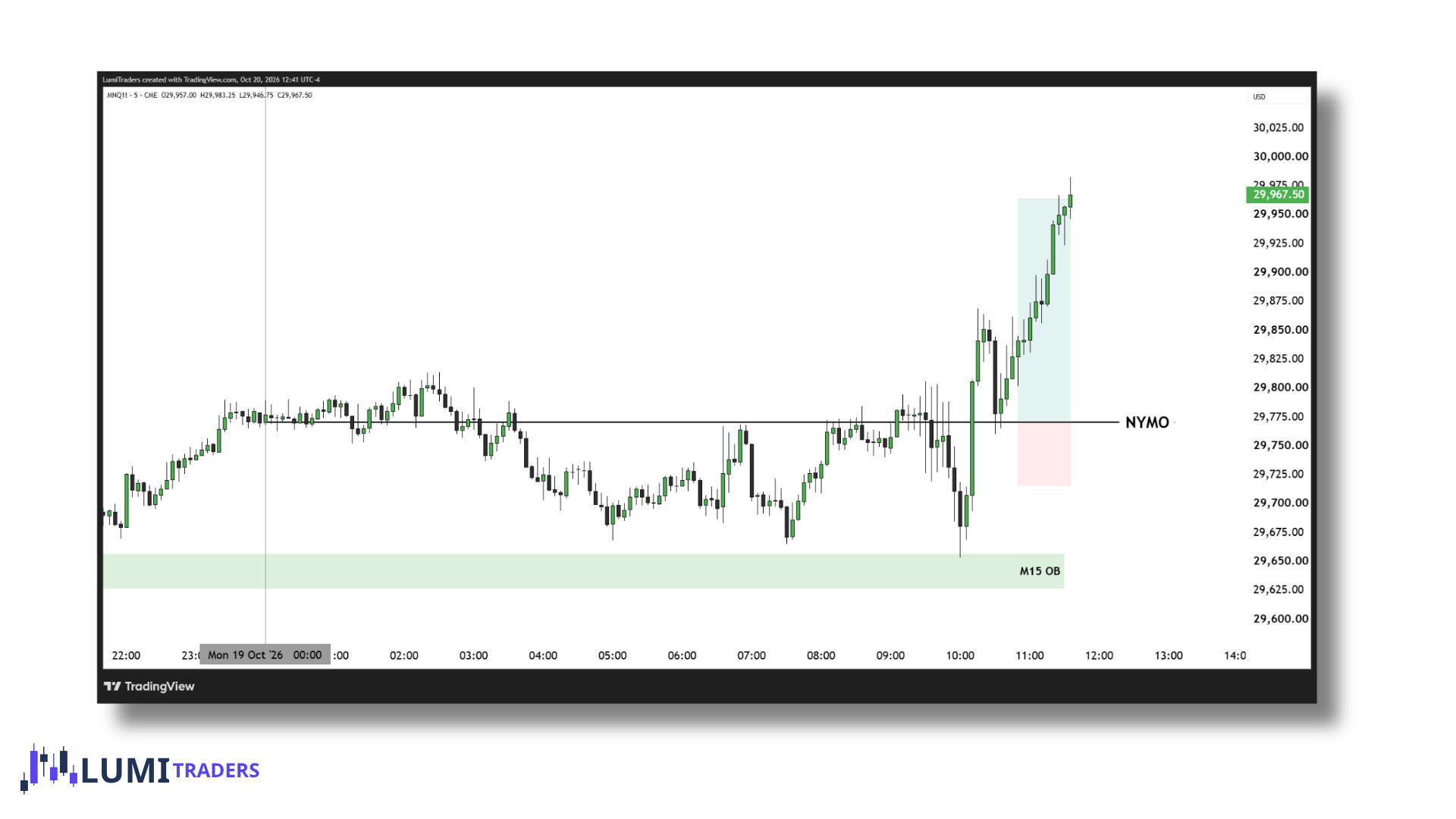
A break-and-close above NYMO as evidence that accumulation and manipulation have completed and upward distribution has begun; the same logic applies inversely below NYMO.
This is why we prefer:
Longs after a confirmed break and hold above NYMO.
Shorts after a confirmed break and hold below NYMO.
We are trying to trade distribution, not guess manipulation.
Why We Want Longs Above NYMO
This should be understood mechanically.
Suppose price first trades below NYMO.
It takes sell-side liquidity.
Bullish CISD appears.
Then price breaks above the open and begins holding above it.
Now the move below NYMO may have created the manipulation portion of the intraday range.
Once price accepts above NYMO:
the low may already be established,
the dealing range is expanding upward,
bullish body formation is developing,
and the draw on liquidity may remain above.
So our bullish sequence becomes:
Manipulation below NYMO → bullish CISD → reclaim → body close above → hold above → long distribution
This is why buying after the confirmed break makes more sense than blindly buying below NYMO.
You are no longer guessing whether the downside move will stop.
The market has shown that it is moving away from the manipulation origin.
Why We Want Shorts Below NYMO
The bearish version is the same.
Price trades above NYMO.
Buy-side liquidity is taken.
Bearish CISD forms.
Price then breaks below Midnight Open.
If it obtains a body closure and begins holding below:
the high may already be established,
the upper move may have been manipulation,
bearish body formation is beginning,
and the dealing range is expanding lower.
So:
Manipulation above NYMO → bearish CISD → break below → hold below → short distribution
This is why we want to short after sellers prove they can hold price below NYMO.
My Directional Rule
For practical execution:
Longs only after a 5-minute candle closes above NYMO.
Shorts only after a 5-minute candle closes below NYMO.
The close gives us directional permission.
It does not mean we blindly enter immediately.
We still want:
proper liquidity context,
CISD/MSS,
FVG/IFVG,
and a clear target.
But without a confirmed NYMO close, we are more likely still trading inside manipulation.
What Invalid NYMO Behavior Looks Like
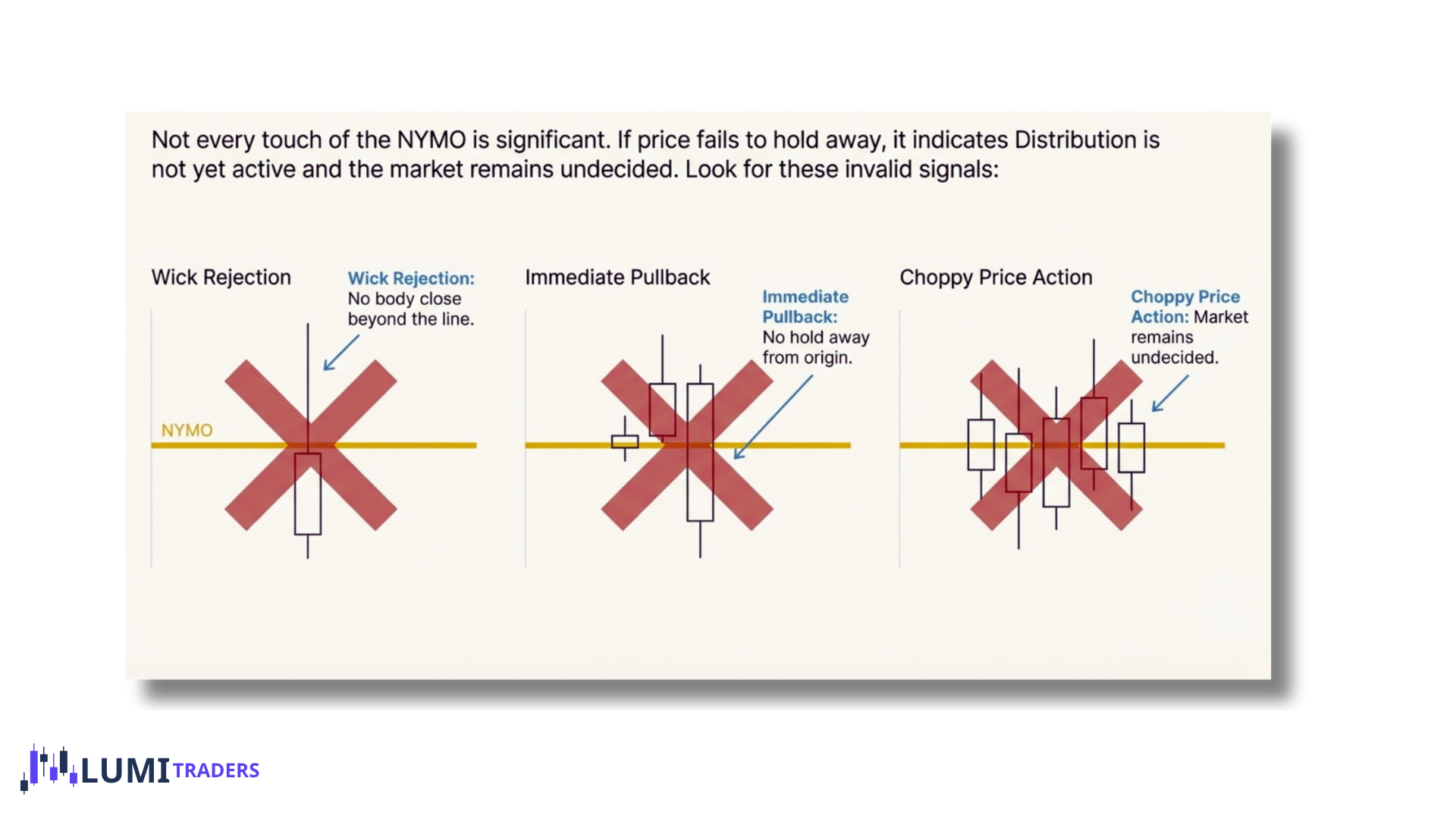
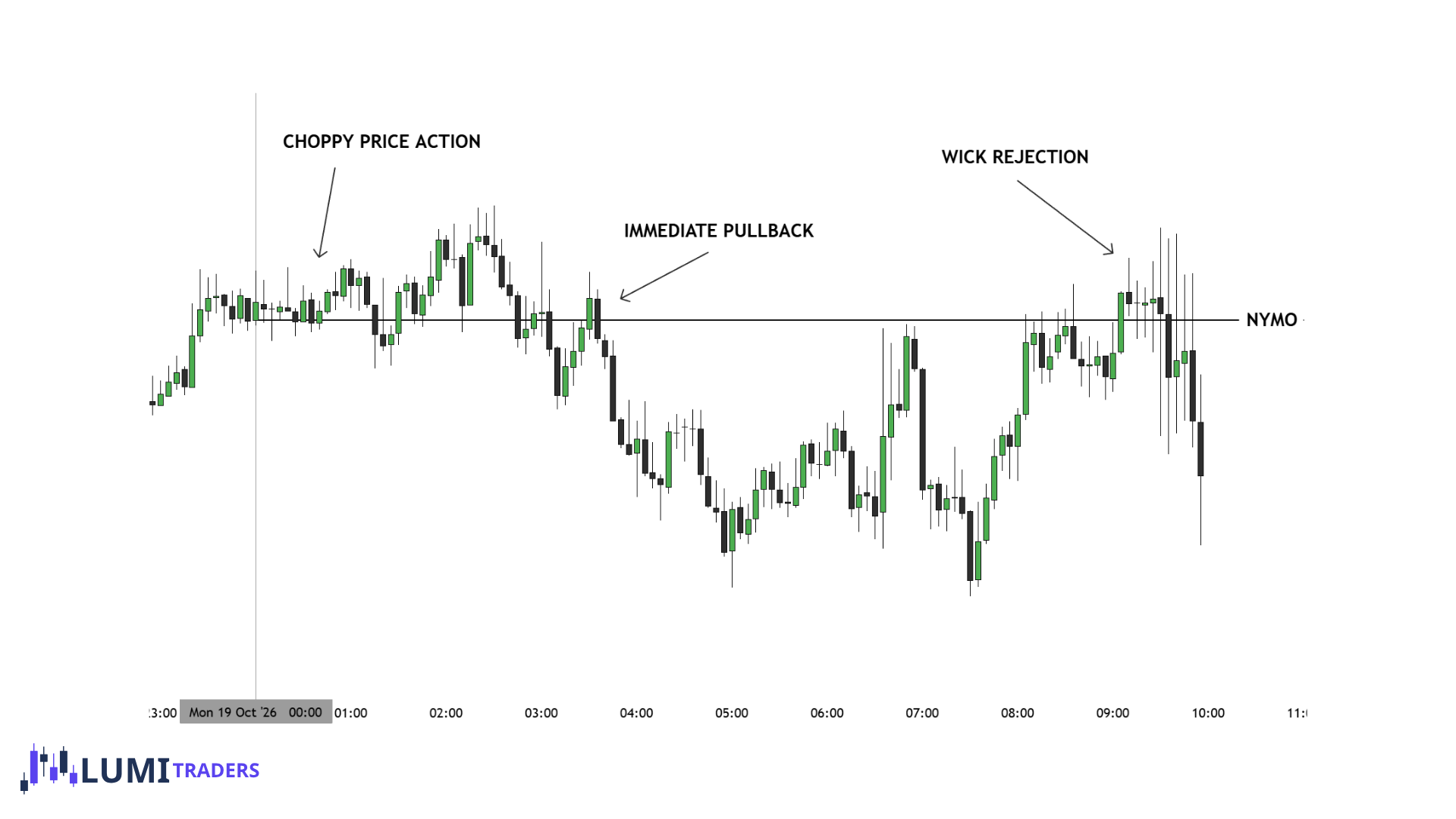
Not every interaction with NYMO matters.
My weak signals:
wick rejection without a body close,
immediate pullback to the open,
and choppy candles repeatedly crossing NYMO.
In all of these cases, price has failed to hold away from the origin, so distribution is not clearly active yet.
This is why we want to avoid trading:
NYMO → cross → reverse → cross → reverse
That is not clean distribution.
It is indecision.
The NYMO “Stay Away From Origin” Rule
After price breaks NYMO, we want it to stay away from the open.
This is very important.
If price continuously returns to NYMO after every small push:
the range is not expanding efficiently.
Distribution should show separation from the origin.
This does not mean price can never retest NYMO.
A clean mitigation/retest can be completely valid.
But repeated choppy returns through the open mean that the market is still undecided.
NYMO and the 3:00–7:00 AM Window
This is one of the most useful specific rules in this lesson.
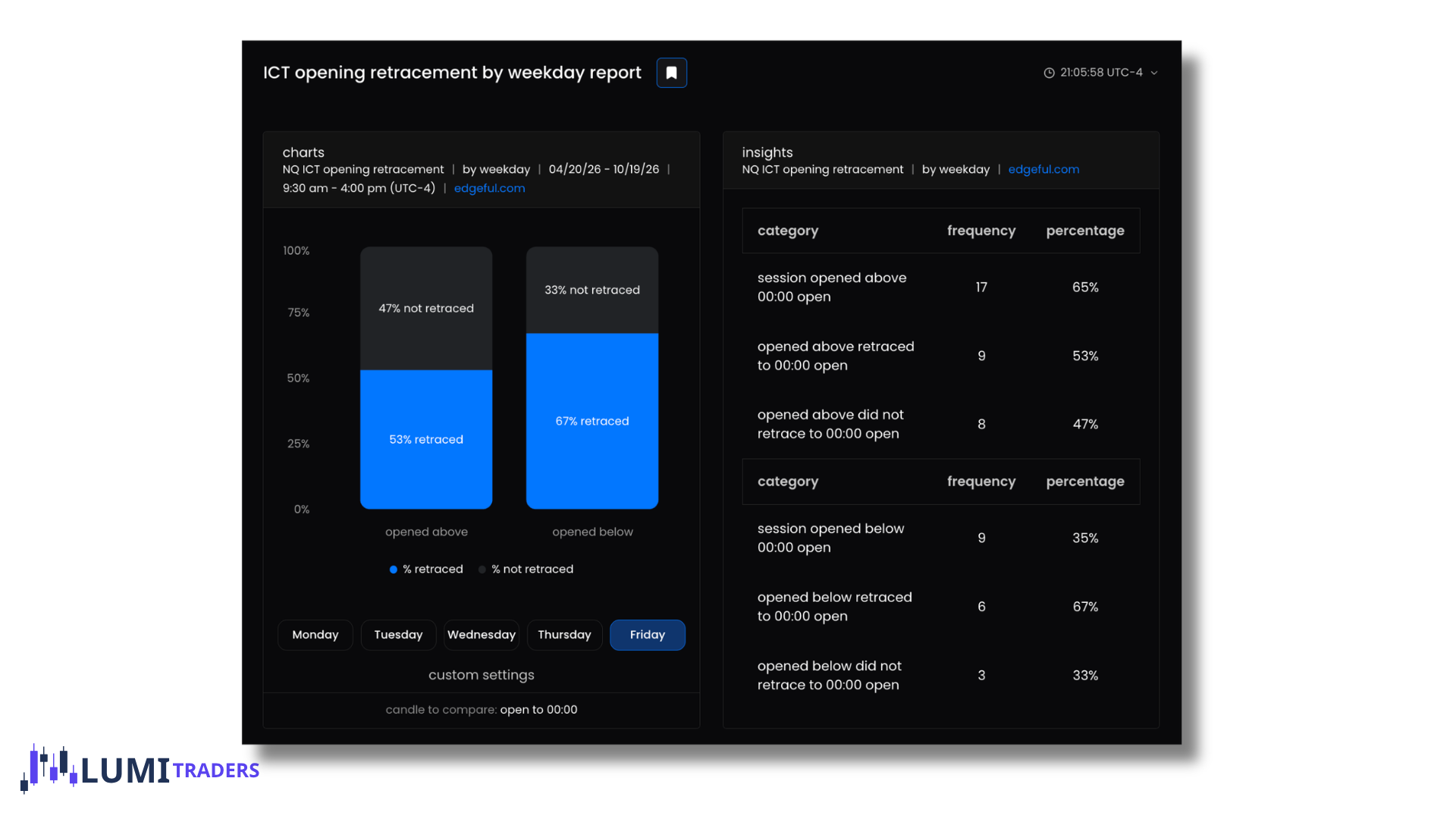
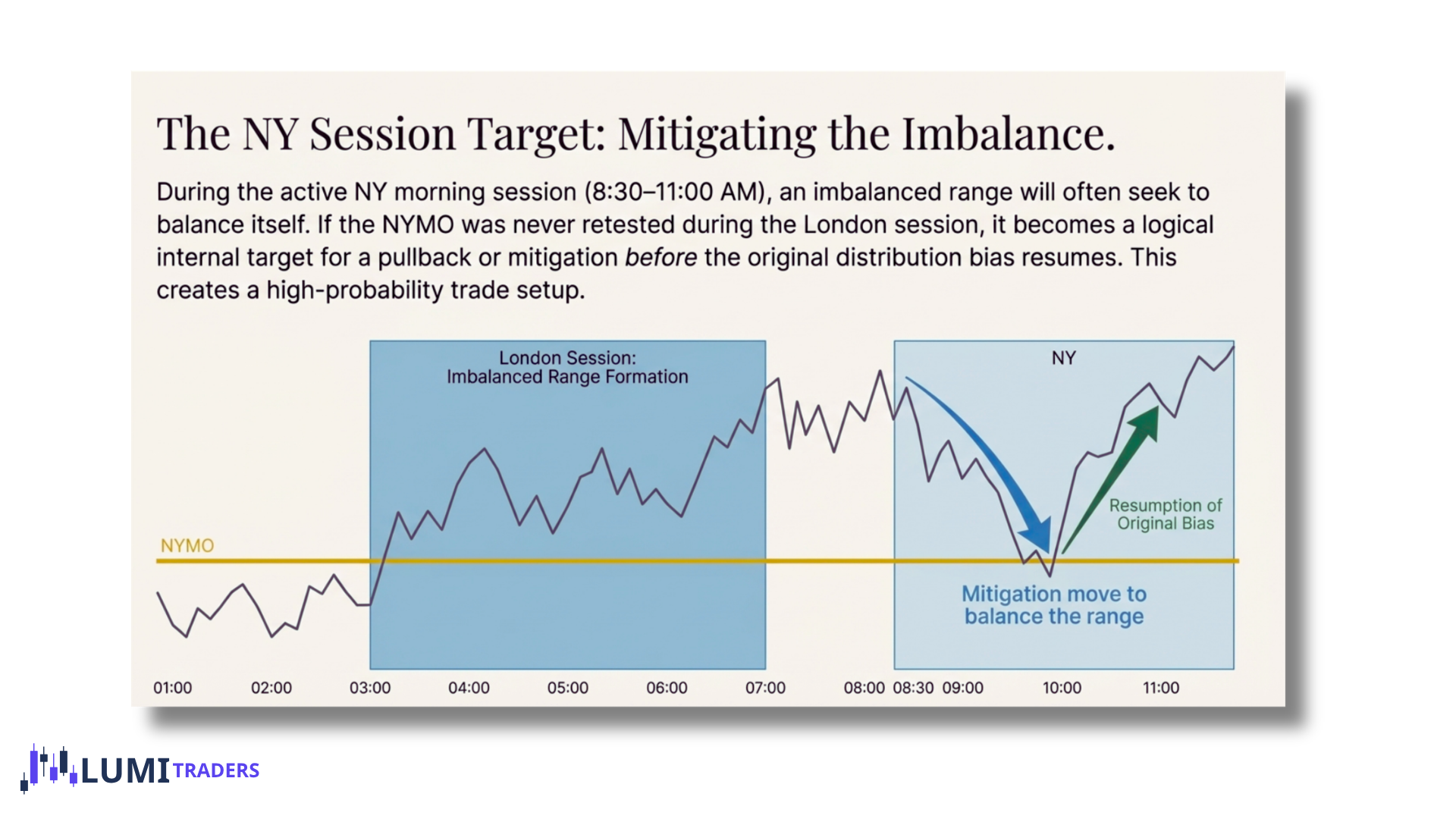
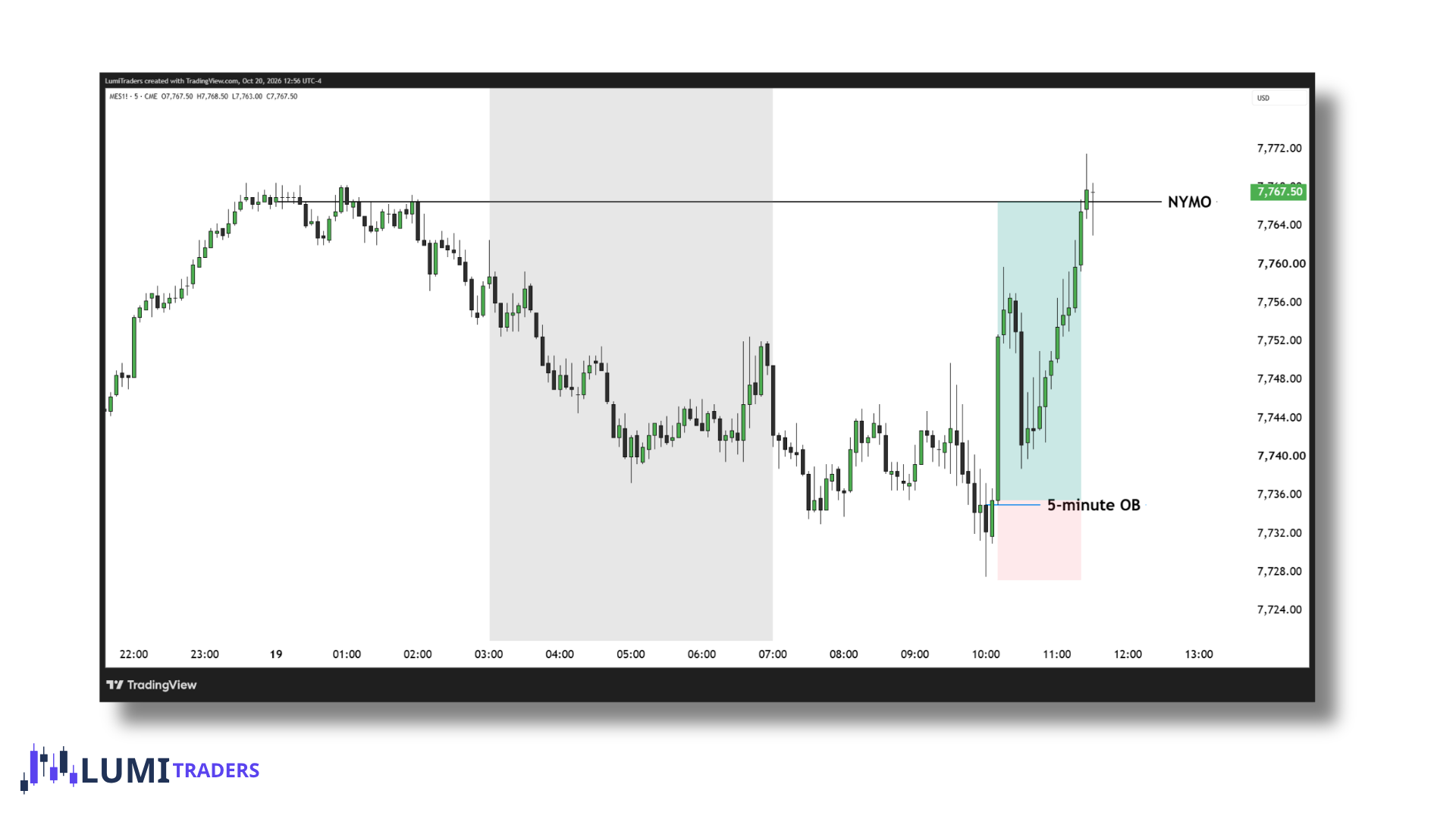
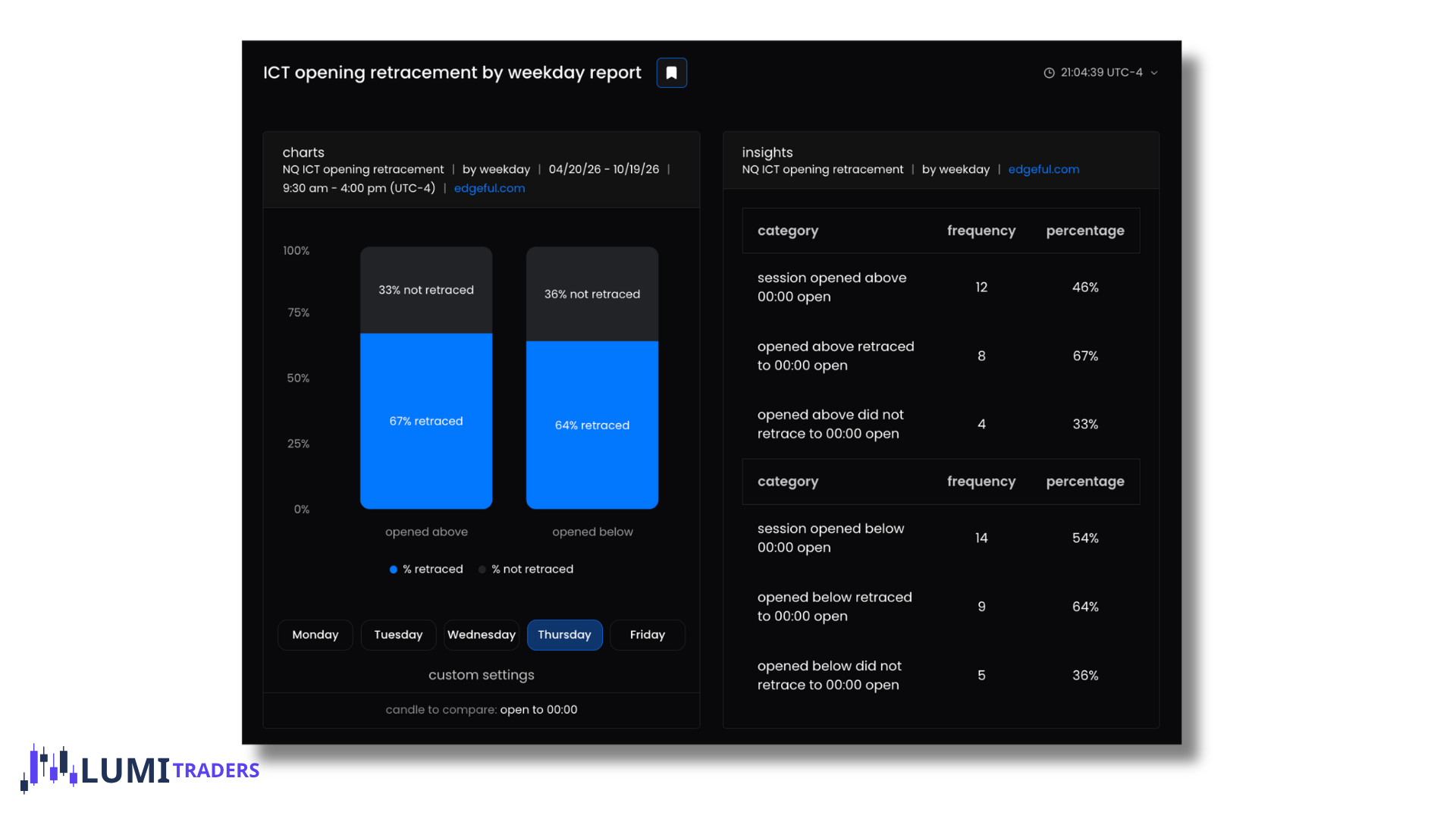
If NYMO is not retested between approximately 3:00 AM and 7:00 AM ET, the probability shifts toward a retest during the active New York morning window, approximately 8:30–11:00 AM.
According to 12 months data, we have a 70% chance to return to this level.
This gives us an important intraday framework.
Why 3–7 AM Matters
Between roughly 3 and 7 AM:
London is active,
overnight structure develops,
accumulation/manipulation may be occurring,
and the intraday dealing range begins to become more defined.
During this window, price often either:
tests NYMO
or:
clearly rejects it.
If NYMO is tested during 3–7 AM, the range has already had an opportunity to rebalance around its origin.
This is the range becoming more balanced, allowing later distribution to continue without necessarily needing to revisit NYMO again.
If NYMO Is Not Tested From 3–7 AM
Now the situation changes.
Price has expanded away from the open without mitigating the origin.
In Power of 3 terms:
Accumulation → Manipulation → Distribution began without returning to NYMO.
That leaves the range internally imbalanced.
This becomes an untested origin and “unfinished business” in the dealing range.
Now NYMO can become very important during the New York AM session.
Why the Retest Can Shift to 8:30–11:00 AM
The New York morning is an active expansion period.
If NYMO remains untouched, the market may need to:
rebalance the range,
reprice internally,
mitigate the origin,
and then resume the original distribution.
In this condition, NYMO can become a logical internal target.
A very important point from the source is:
The NYMO retest can be range maintenance, not a reversal.
Price may pull back to Midnight Open, mitigate it, and then continue in the original directional bias.
That distinction is crucial.
NYMO Retest Does Not Always Mean Reversal
Suppose London produced strong bullish distribution.
NYMO remained untouched between 3–7 AM.
During New York, price pulls back toward Midnight Open.
A trader may assume:
“The bullish move is over.”
The pullback can simply be:
mitigation to balance the range
before bullish distribution resumes.
So always ask:
Is NYMO the final reversal point, or is it only internal mitigation inside a larger directional program?
NYMO Far Away After Large Overnight Expansion
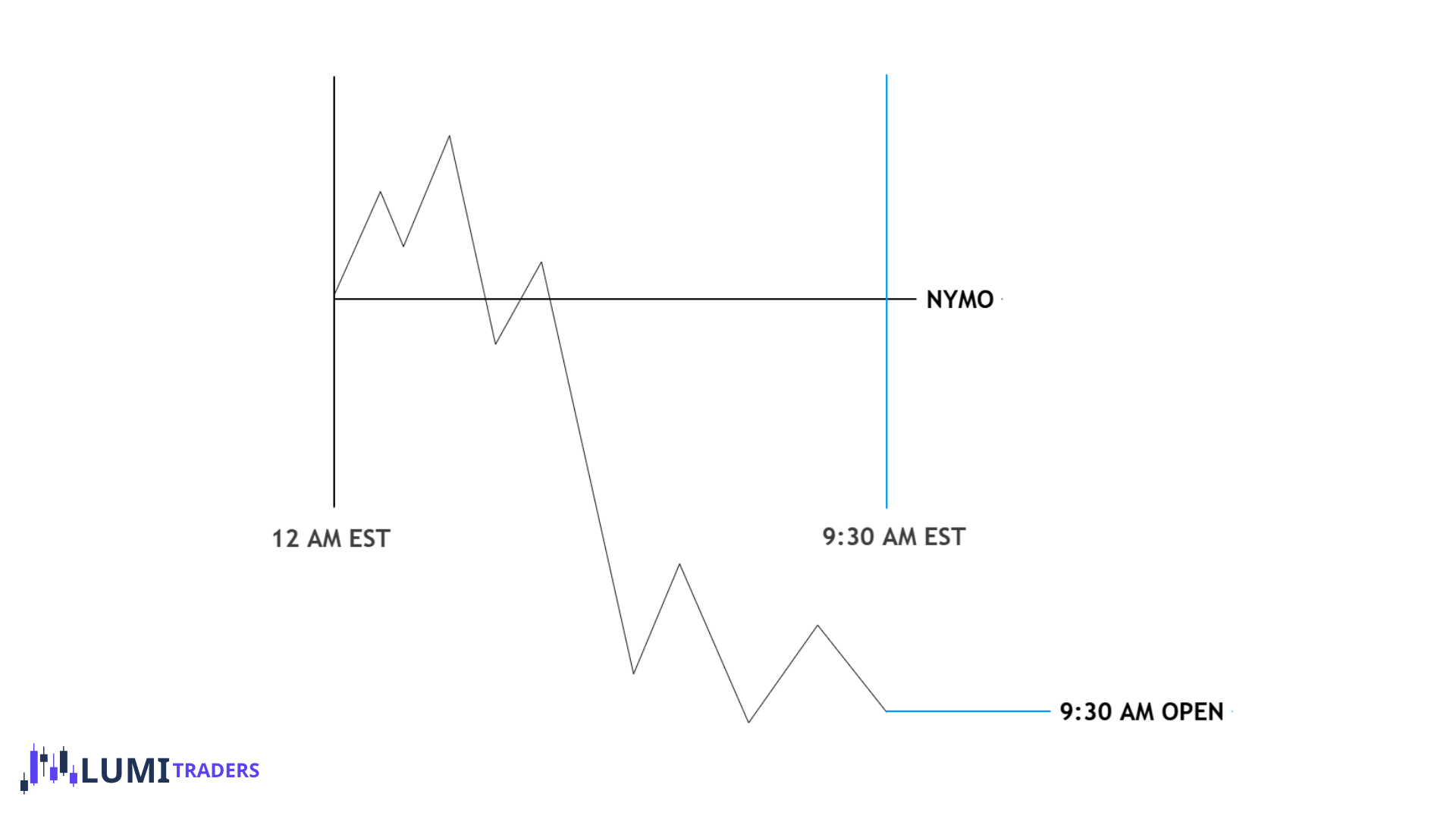
Sometimes NYMO is untouched, but New York opens far away from it.
For example:
NQ is 150+ points above NYMO after strong overnight bullish expansion.
Or ES is significantly below NYMO after sustained bearish delivery.
In this situation:
do not automatically expect a Midnight Open retest.
The large separation itself can tell us that the market is already in a strong directional program.
New York may produce:
Trend Expansion
rather than mean reversion.
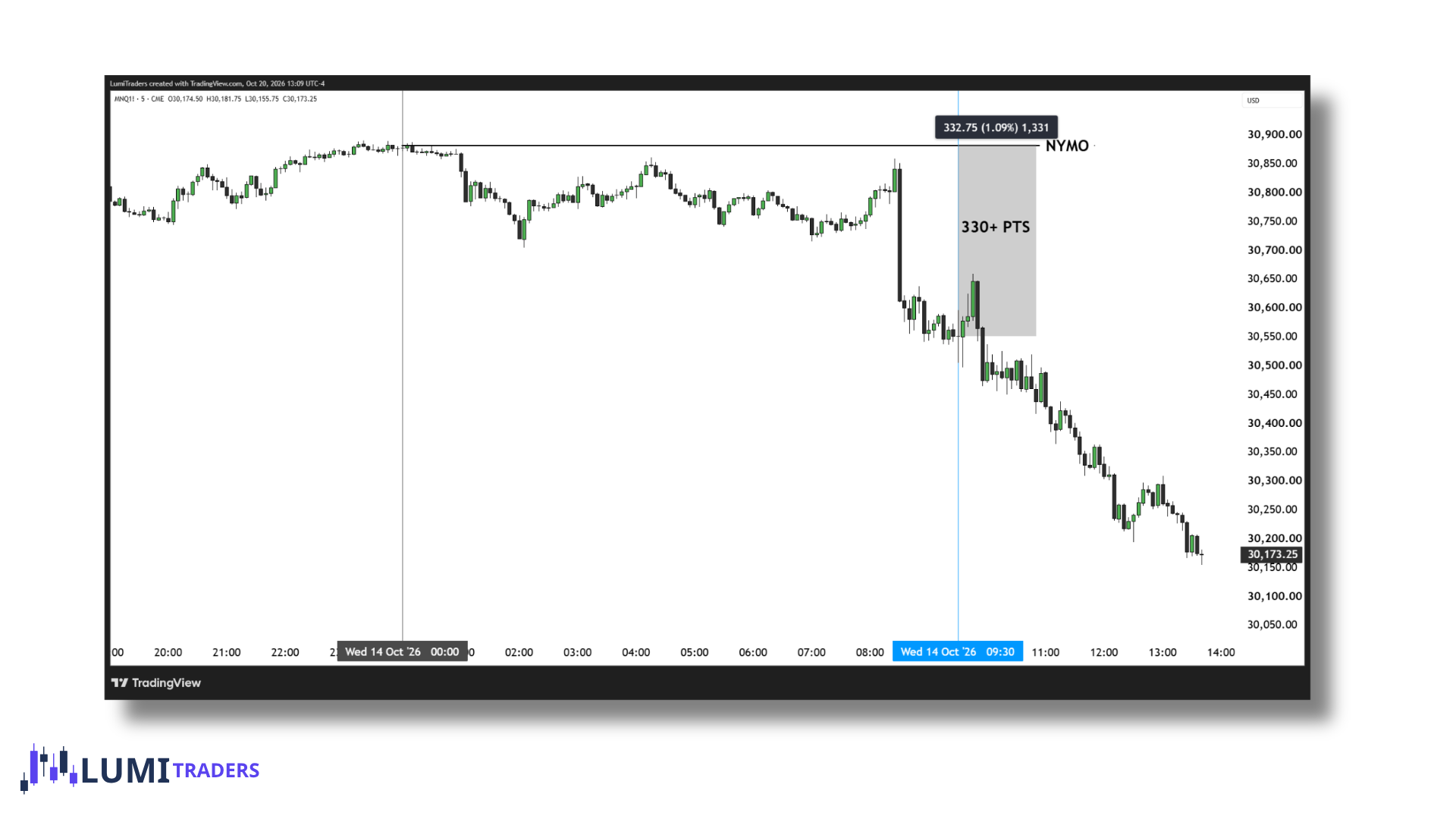
Price Opens Far Below NYMO (same logic applies for bullish scenario)
If New York opens far below NYMO after strong overnight downside delivery and:
HTF draw remains below,
structure remains bearish,
there is open SSL below,
and price shows no bullish reversal,
the AM session can continue lower.
Do not buy simply because:
“NYMO has not been filled.”
The market does not owe us a Midnight Open retest.
The NYMO Distance Rule
This creates a very useful distinction.
NYMO Untouched + Price Still Near
Think:
potential AM retest
NYMO Untouched + Price Very Far Away
Think:
potential AM trend expansion
This helps us avoid forcing a mean-reversion idea onto a strong trend day.
Price Stuck Around NYMO Into 9:30 AM
Another condition is when price never clearly leaves the opening area.
Suppose NYMO has been repeatedly crossed into the cash open.
This means:
accumulation/manipulation may still be active.
There is no clean dealing-range expansion.
This is exactly the environment where the simple “above = buy / below = sell” interpretation fails.
Instead, allow the 9:30–10:00 AM volatility to reveal the real move.
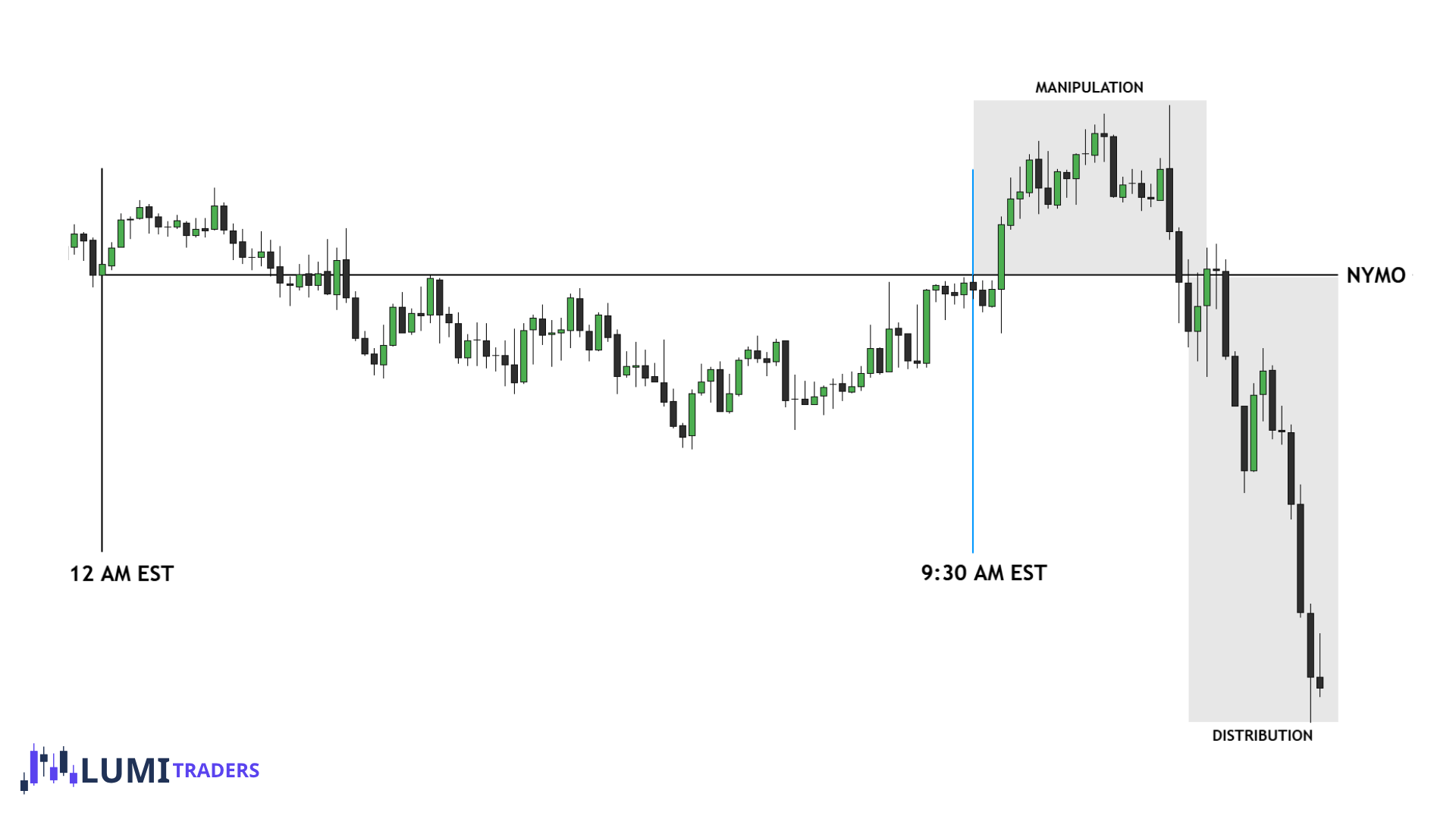
9:30–10:00 AM Manipulation Around NYMO
If price remains around NYMO before 9:30:
look for the equity open to take one side of the range.
For example:
Bullish
Price stuck near NYMO → 9:30 sweep below → SSL taken → bullish CISD → reclaim → 5M close above → long
Bearish
Price stuck near NYMO → 9:30 sweep above → BSL taken → bearish CISD → 5M close below → short
The opening volatility can finalize the manipulation phase.
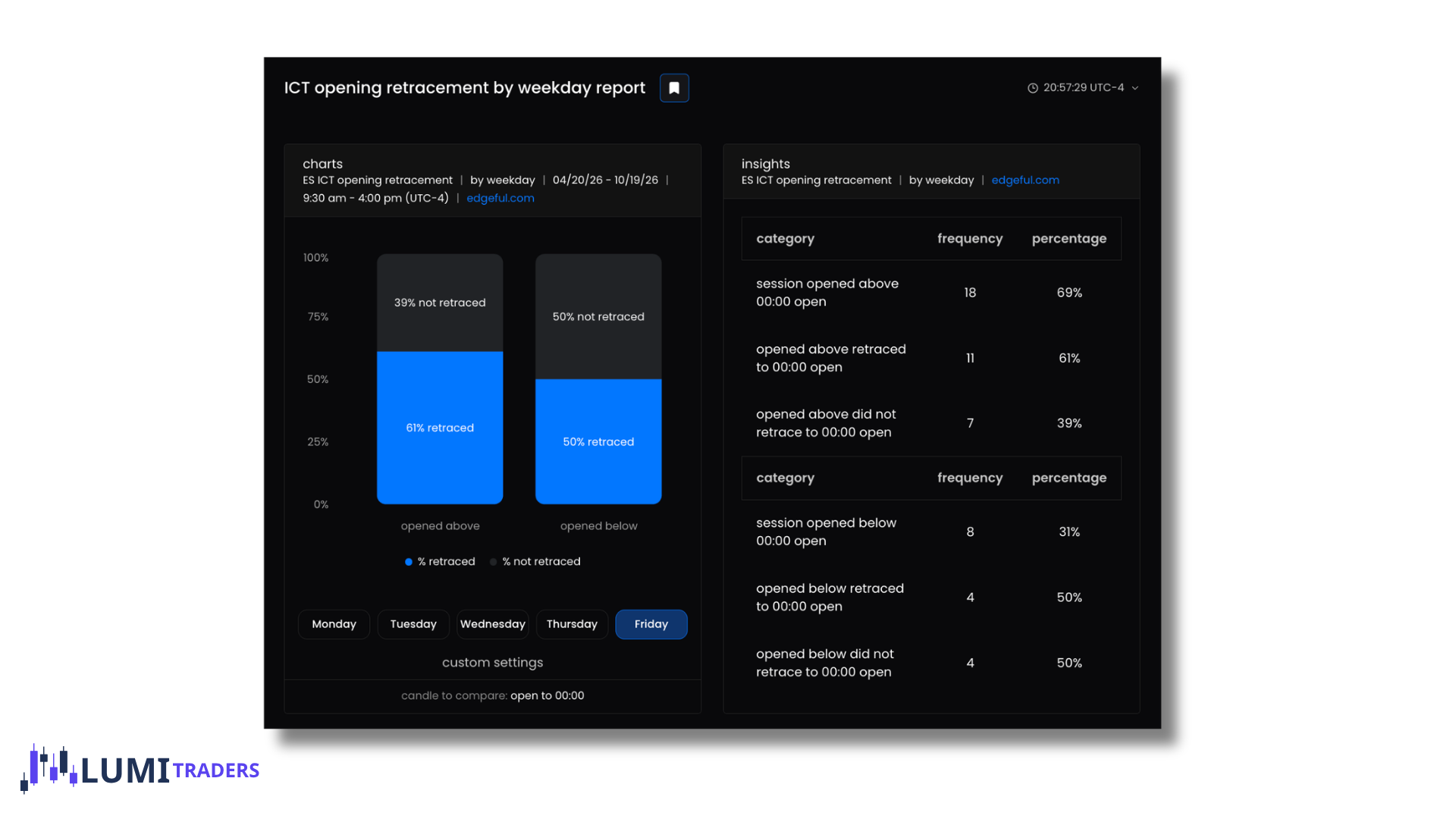
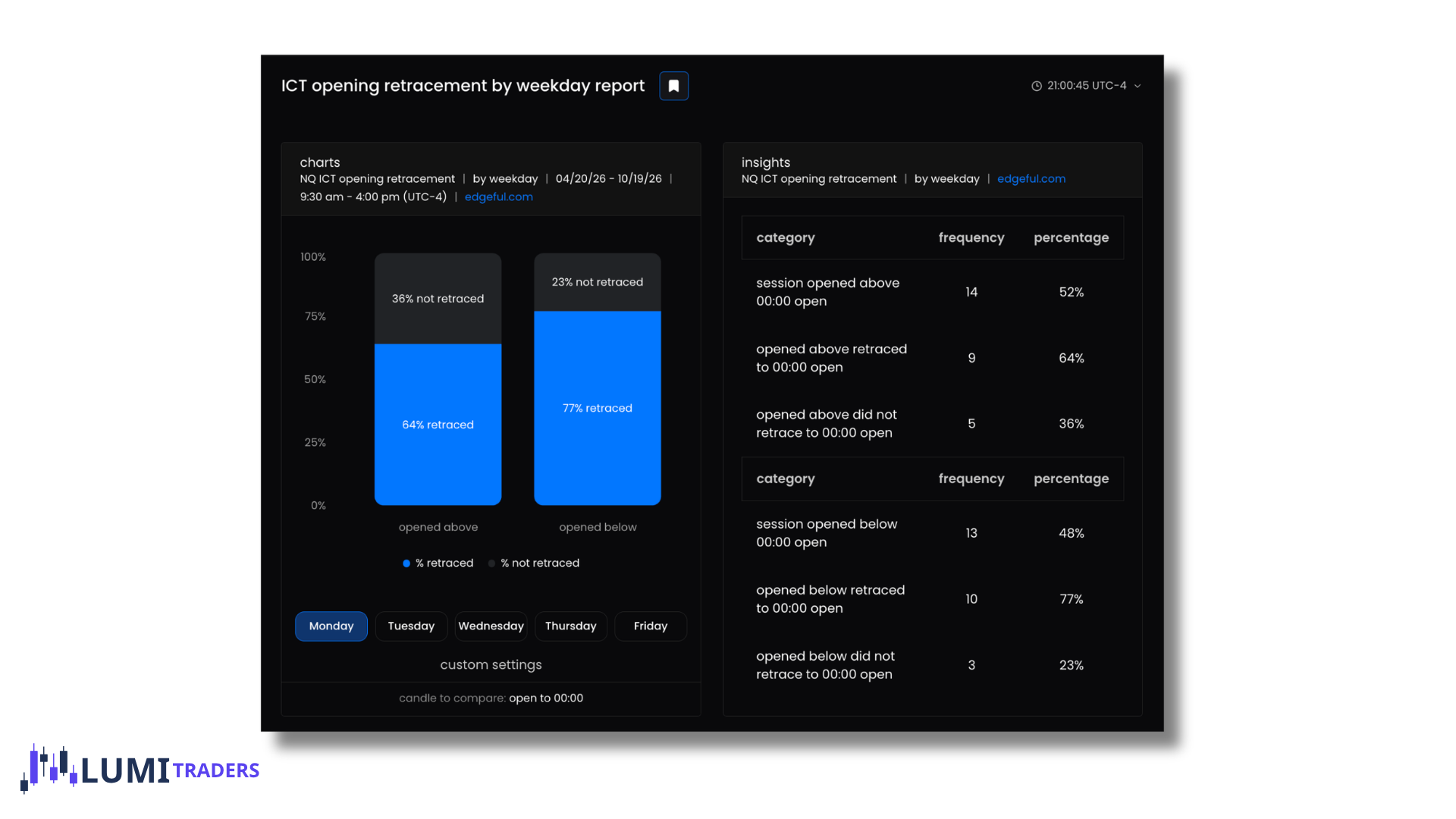
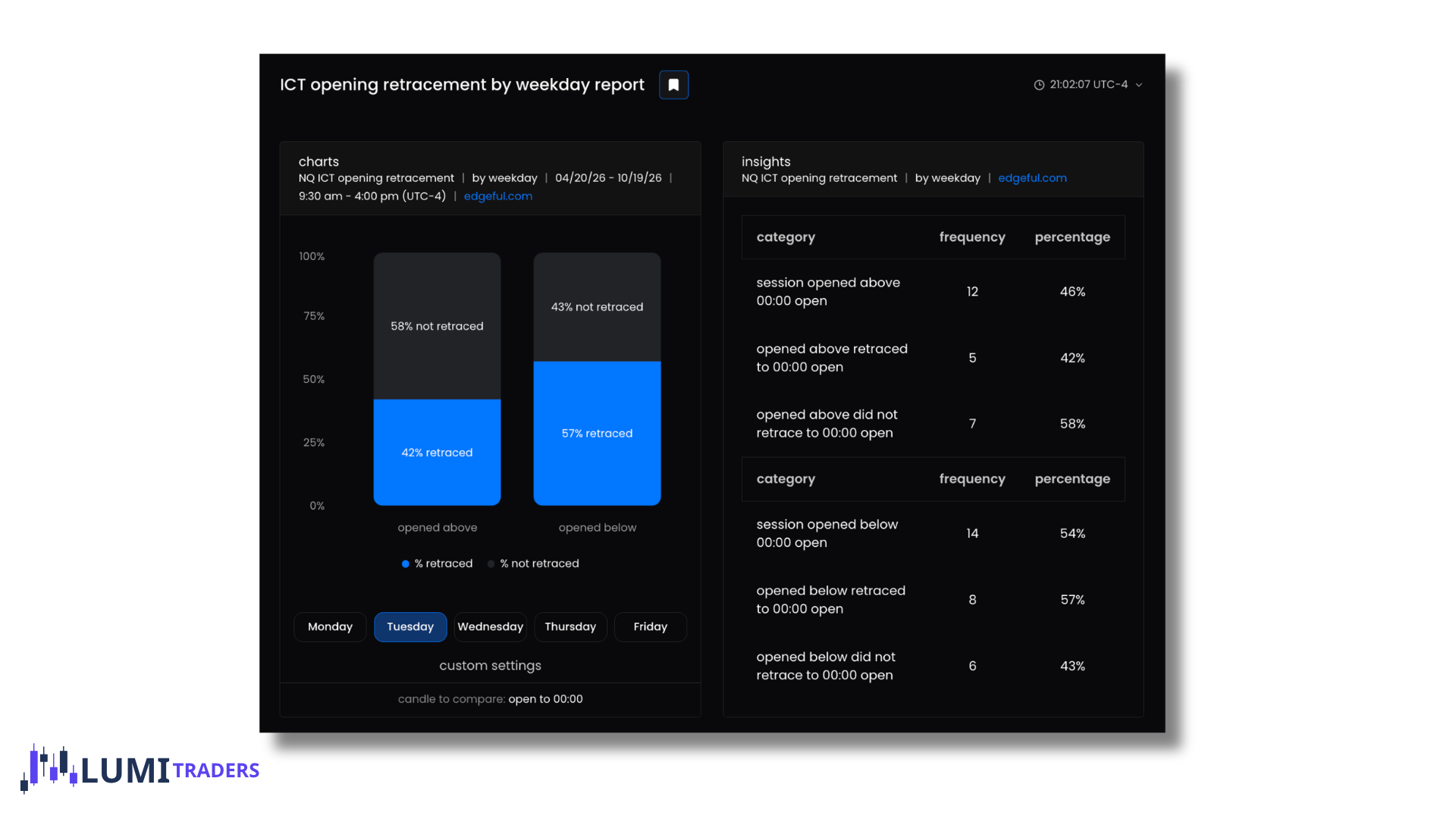
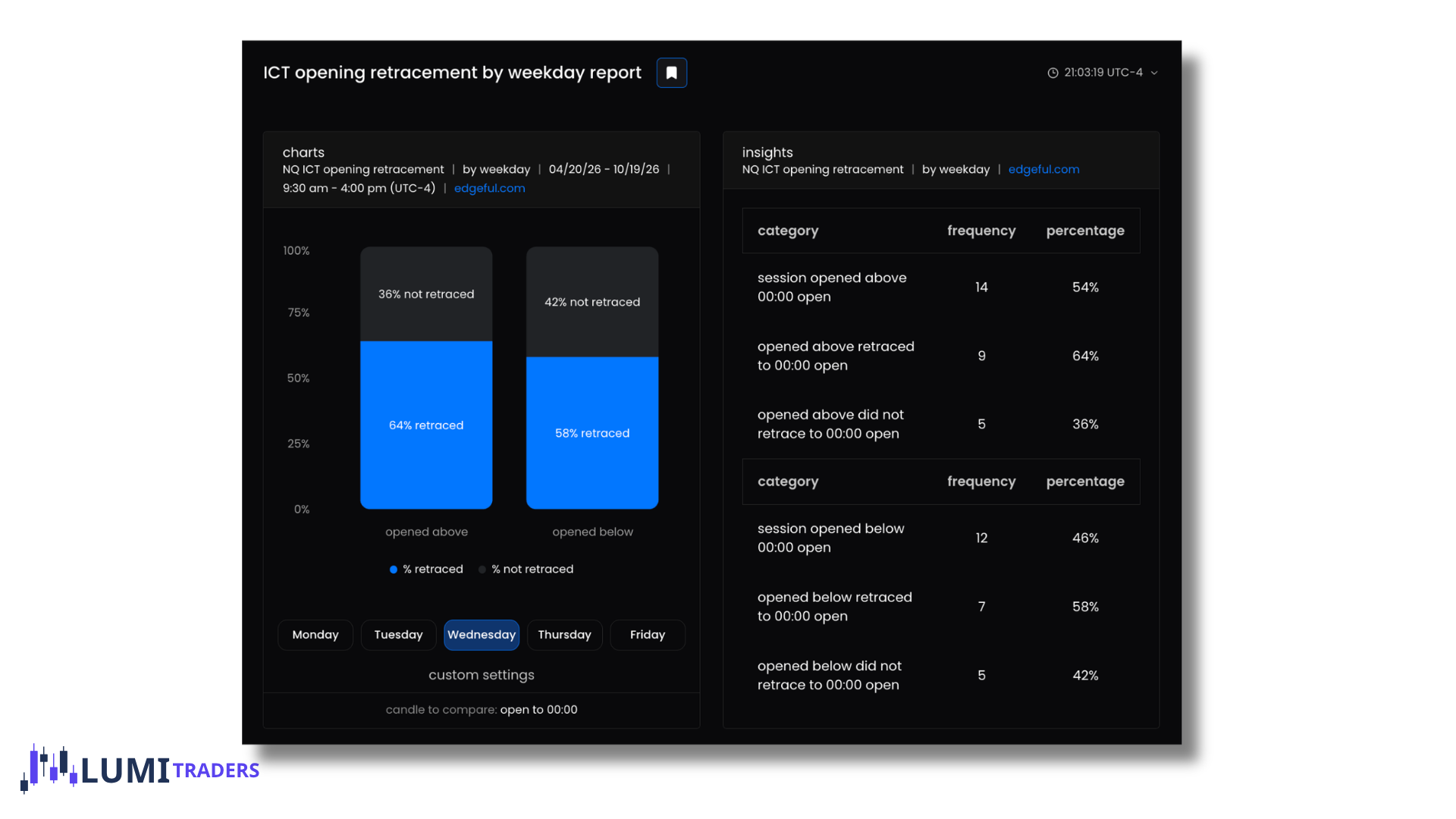
Data Report
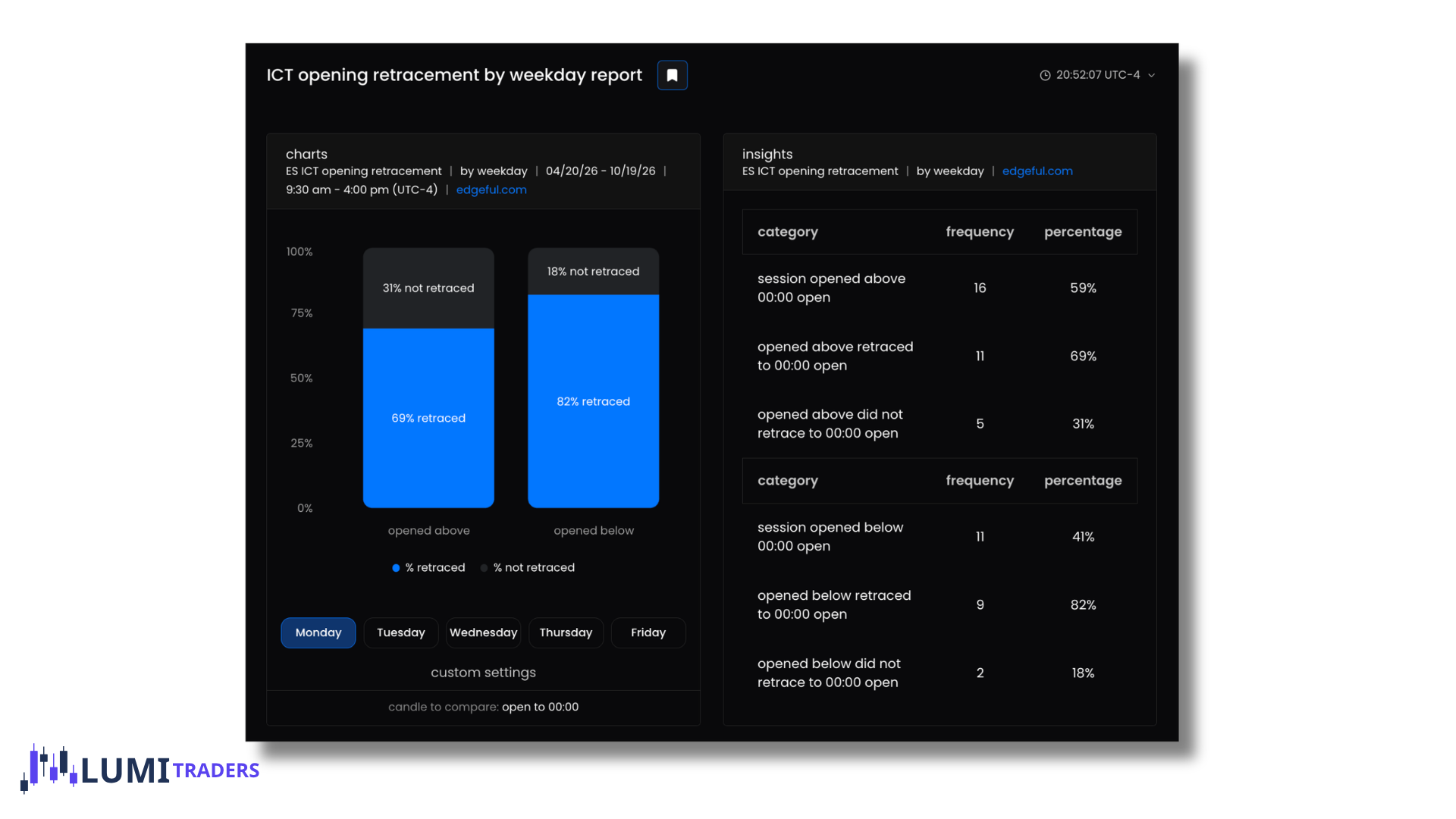
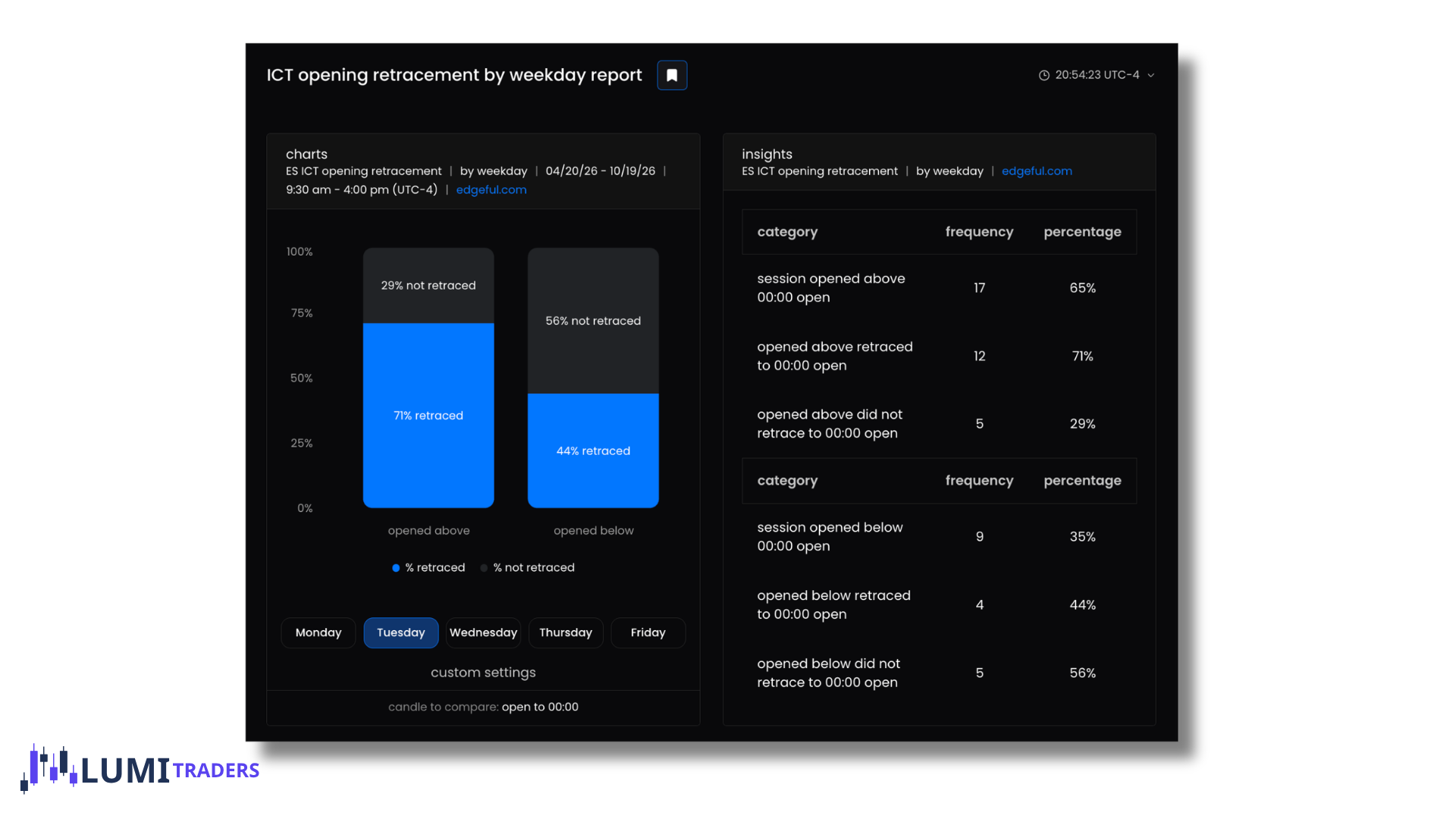
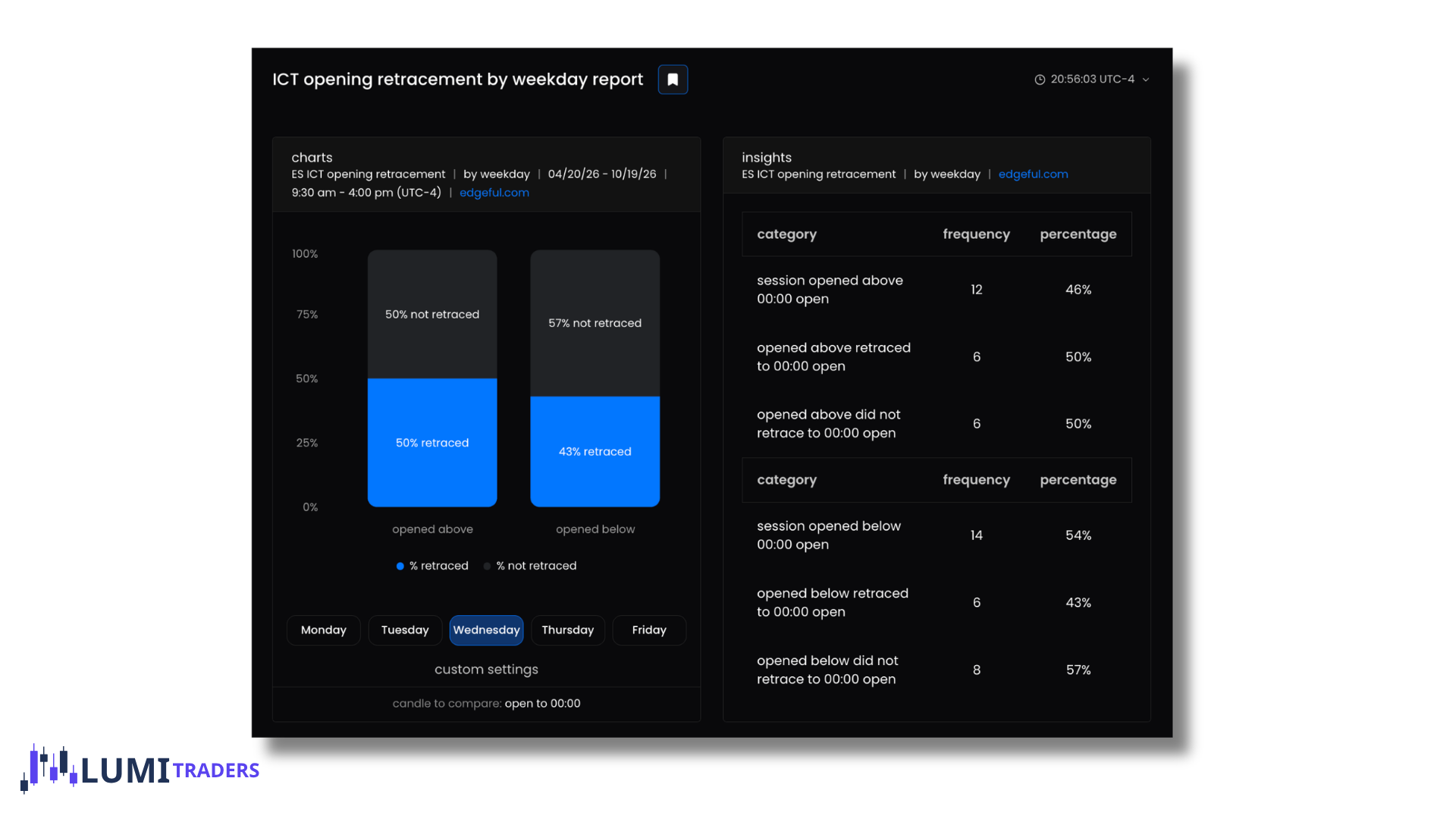
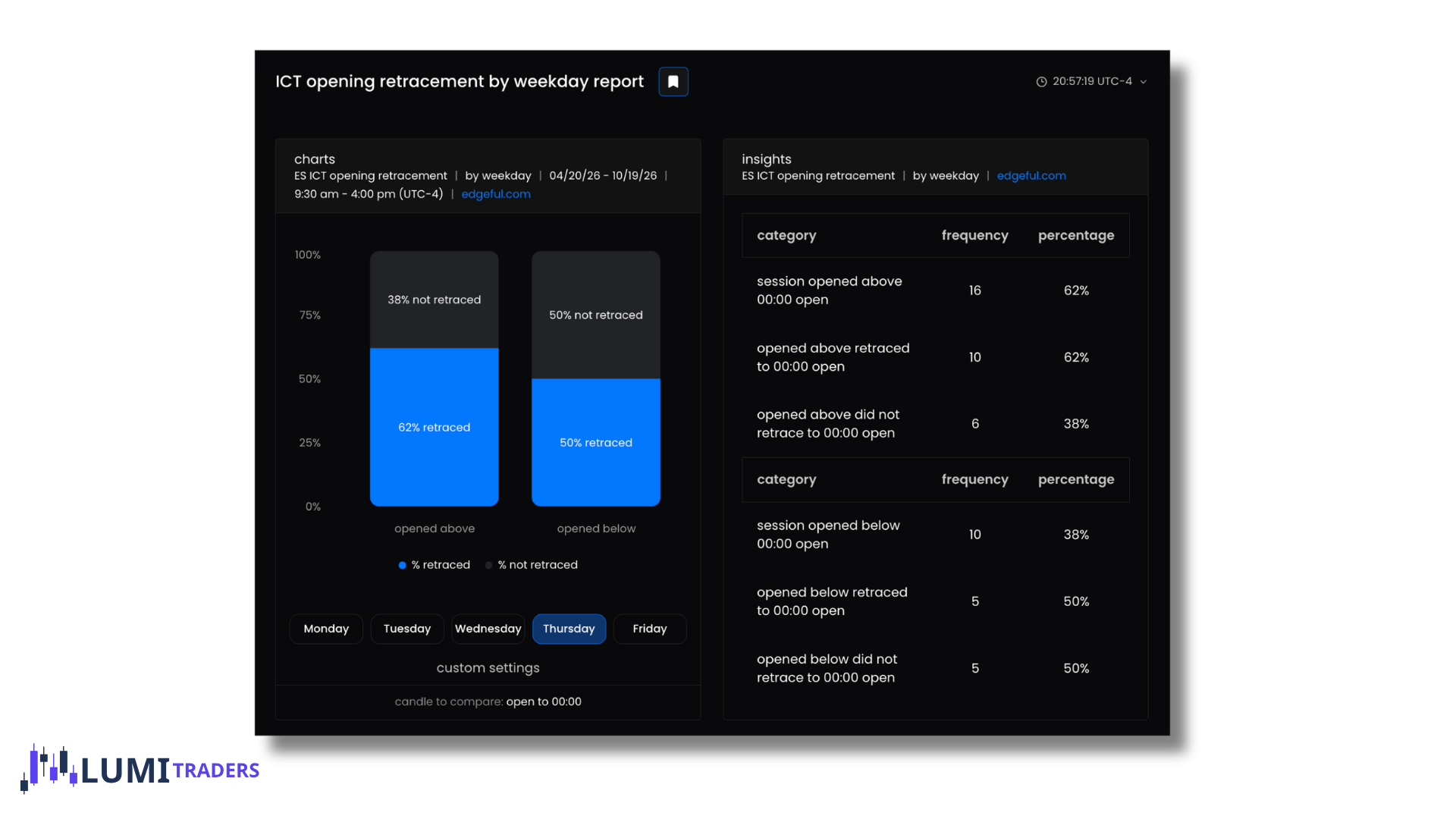
ES - 6 months data by weekdays
Monday
Tuesday
Wednesday
Thursday
Friday
NQ - 6 months data by weekdays
Monday
Tuesday
Wednesday
Thursday
Friday