The Funded.Now library
Perpetual Futures Explained: Funding, Leverage & Risk
Learn how perpetual futures work, who pays funding, and how leverage and liquidation affect risk. Includes examples, charts, and a spot vs. futures comparison.
Published
Start reading
On this page
Perpetual futures, often called perps, are derivatives that let you take a long or short position on an asset without a conventional expiration date. You trade price exposure rather than buying the underlying asset. Most perps use periodic funding payments to help their price track a spot-market reference.
The three numbers to understand first are position size, margin, and funding. Position size determines how much a price move changes your profit or loss. Margin supports that exposure. Funding can add a recurring cost—or credit—while you hold it. Contract terminology, funding mechanics.
Researched September 30, 2026. Educational information, not a trading recommendation. All numerical examples and charts below are hypothetical, not live prices, exchange fee quotes, or forecasts.
Perpetual futures in 60 seconds
| Question | Short answer |
|---|---|
| What do you own? | A derivatives position, not the underlying coin or asset. |
| What does “long” mean? | Positive exposure to an increase in the asset price. A short has the opposite exposure. |
| Do perps expire? | True perpetuals have no scheduled expiry; check the exact specifications for “perpetual-style” products. |
| What is funding? | Periodic payments between the two sides of the market. The rate can change sign. |
| What can close the position? | Your exit, liquidation, or a venue action under its rules. |
| Is a perp a funded account? | No. A perp is an instrument; a funded account is a trading program. |
A simple way to read a trade: “$1,200 margin at 5× leverage” means $6,000 of exposure, not a $1,200 position. Whether that exposure is appropriate is a separate decision from whether the platform permits it.
Perps vs. spot vs. dated futures
These products can reference the same asset while behaving differently.
| Feature | Unleveraged spot | Dated futures | True perpetual futures |
|---|---|---|---|
| Exposure | Hold the asset | Hold a derivative | Hold a derivative |
| Scheduled expiration | None | Yes, specified by the contract | None |
| Continuing exposure | Keep the asset | Close or roll before expiry, or settle | Keep the position while meeting requirements |
| Margin liquidation | No borrowed-position liquidation | Possible on margined positions | Possible on margined positions |
| Funding payments | No derivatives funding | Generally no perp-style funding; financing can appear in basis | Recurring payments under the contract rules |
A dated future can settle in cash or through delivery, depending on its specifications. Rolling means closing the expiring contract and opening a later one; it is another trade, with its own price and costs. CME: expiration and contract roll.
Read the contract, not just its marketing name. Coinbase documentation describes both a long-dated US “perpetual-style” design and a separate no-expiry perpetual design. Do not assume every product called a perp has identical expiry, funding, collateral, or trading hours. Long-dated design, no-expiry design.
How funding rates work
Funding helps reduce the gap between a perpetual contract and its spot reference. A positive funding rate means longs pay shorts. A negative rate means shorts pay longs. This is a payment mechanism, not a reliable forecast of the next price move.
For a simple linear contract:
Funding payment magnitude = position notional × funding rate for the applicable interval.
A $6,000 position at +0.015% costs the long $0.90 for one interval: $6,000 × 0.00015. The calculation uses the position's value, not the $1,200 margin deposit. At −0.015%, the payment direction reverses. Coinbase: funding rates.
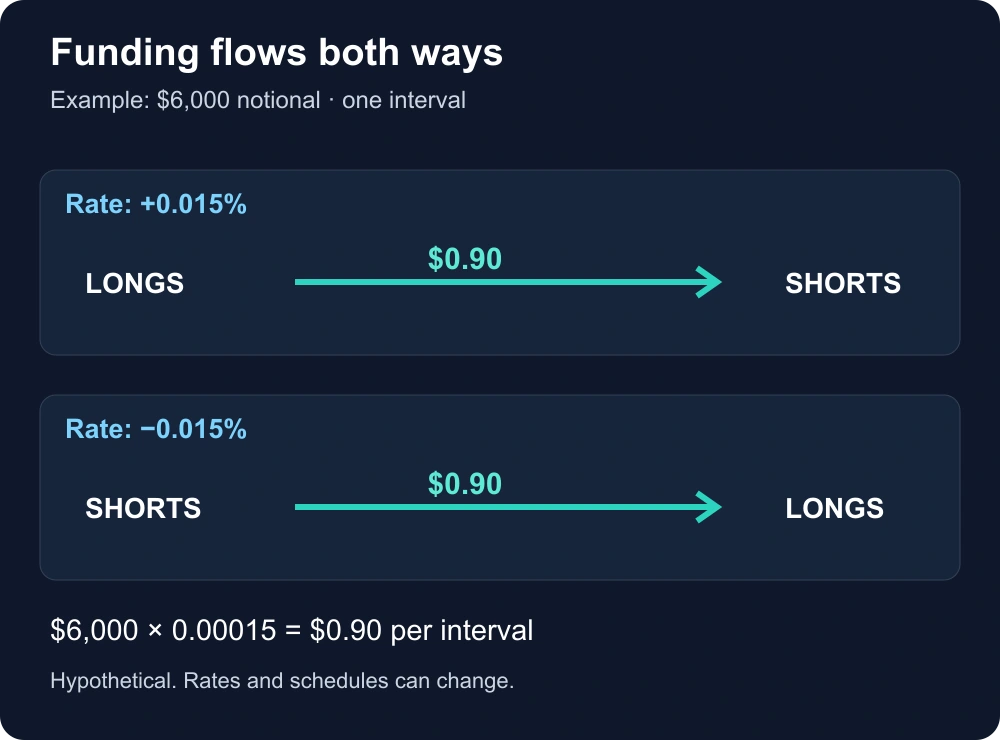
Illustration: one hypothetical funding interval. Actual rates, position values, calculation methods, and settlement schedules can change.
Check whether the displayed rate is hourly, per interval, or annualized before multiplying. Funding intervals are not universal: Kalshi's learning page describes different schedules by asset class, while Coinbase's international documentation describes hourly payments. Neither schedule should be applied to another venue without checking. Kalshi: perps explained.
For a second teaching example, hold the $6,000 notional and +0.015% interval rate constant for three applicable payments. The long pays 3 × $0.90 = $2.70. Real funding can rise, fall, or reverse during the trade.
What leverage actually changes
Leverage increases exposure relative to posted margin. To see the effect clearly, keep margin fixed at $1,200 and compare three position sizes.
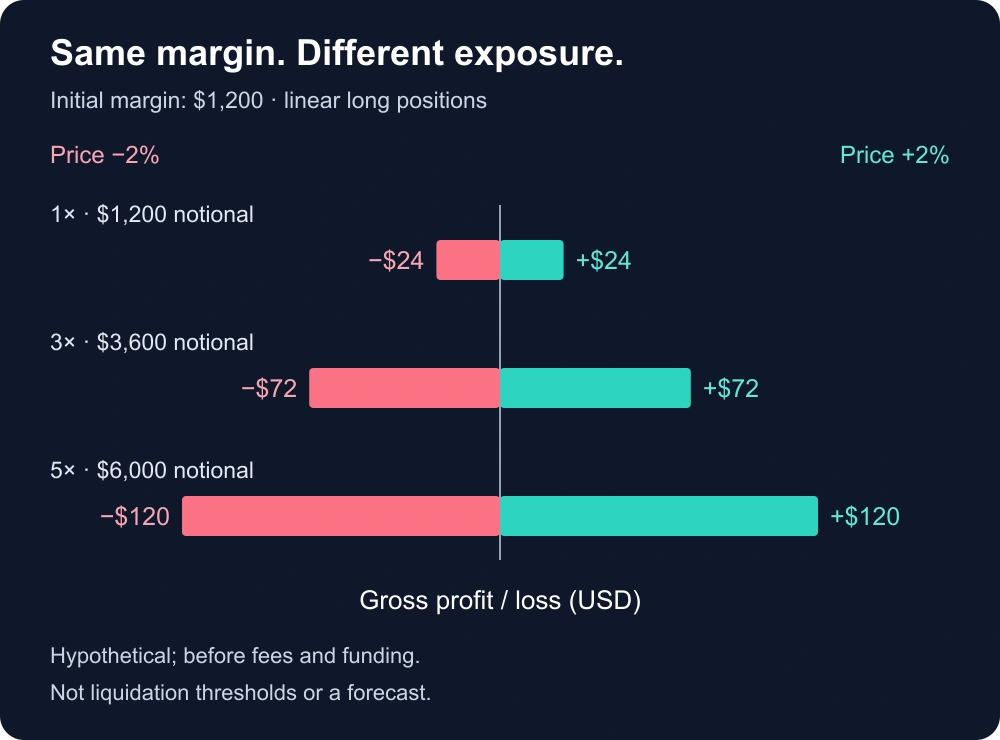
Hypothetical linear long positions, before fees and funding. The bars show the same 2% move in both directions, not liquidation thresholds or expected returns.
| Leverage | Initial margin | Entry notional | Price rises 2% | Price falls 2% |
|---|---|---|---|---|
| 1× | $1,200 | $1,200 | +$24 | −$24 |
| 3× | $1,200 | $3,600 | +$72 | −$72 |
| 5× | $1,200 | $6,000 | +$120 | −$120 |
At 5×, a 2% price move changes the position's value by 10% of initial margin. A short reverses the directional result. These calculations assume linear exposure; inverse or coin-margined contracts require their own formulas.
Increasing leverage does not improve a trade's probability of success. The CFTC warns that leverage magnifies losses as well as gains and that some futures arrangements can produce losses greater than the initial investment. CFTC risk advisory.
Margin and liquidation: where the risk sits
Initial margin is collateral required to open the position. Maintenance margin is the ongoing minimum needed to support it. Margin is not simply a trading fee. Losses and other debits can reduce the equity available to meet that requirement. Kraken: leverage and margin.
Liquidation can begin when account or position equity no longer meets maintenance requirements. Many venues use a mark price for this check rather than the last traded price. A displayed liquidation price may change with funding, collateral, other positions, or risk parameters. It is not a universal “100 divided by leverage” calculation, and liquidation can happen before equity reaches zero. Kraken: liquidation FAQ.
Two margin modes also change the collateral at stake:
- Isolated margin: collateral is allocated to a particular position, subject to the venue's rules and any automatic margin additions.
- Cross margin: eligible collateral is shared across positions. A loss in one trade can consume collateral supporting others.
Adding collateral may increase the buffer, but also places more money at risk. Read the product's actual loss protections and account agreement; do not infer them from the margin-mode name. Coinbase: margin types.
A planned stop is useful for defining an exit, but it is not a guaranteed execution price or a guarantee against liquidation. Fast markets and limited liquidity can change the outcome.
Calculate the result after costs
A profitable price move is only one line of the calculation. For our hypothetical $6,000 linear long:
| Item | Example amount |
|---|---|
| Gross profit from a 2% rise | +$120 |
| Opening and closing trading costs combined | −$6 |
| Funding paid across three assumed intervals | −$2.70 |
| Net profit under these assumptions | $111.30 |
The $6 cost is an invented assumption, not a venue quote. The three funding payments assume unchanged notional and rate. Slippage, changes in collateral value, and additional charges are excluded.
Use the same calculation for a loss. If gross P&L is −$120 with the same costs and funding debit, the result is −$128.70. Receiving funding would offset only part of a directional loss; it would not make the position risk-free.
Perpetual futures and prop firm accounts are different things
For Funded.Now readers, this distinction matters: a perp describes what you trade; a funded account describes the arrangement under which you trade. An account advertised as “$50,000” does not establish your withdrawable cash, margin balance, or permitted loss.
Prop programs can have simulated and live stages. For example, Topstep distinguishes its evaluation, Express Funded, and Live Funded stages; its Express agreement describes simulated trading. That example does not establish what another firm's account permits. Topstep program, Express agreement.
Before choosing a program, check the actual instruments, account stage, fees, drawdown calculation, holding restrictions, and payout conditions. A prop firm's rule breach and an exchange's margin liquidation are different mechanisms.
Use our crypto prop firm comparison as a starting point for program research, then confirm the selected plan's rules with its provider. For the account side of the comparison, read how prop firm drawdown rules work and the total cost of a prop firm account.
Funded.Now may earn a commission through partner links. A listing is not a promise of eligibility, profitability, or payouts.
A checklist before opening a perp position
- Identify the contract. Underlying asset, contract size, settlement currency, expiry terms, and trading schedule.
- Write down the exposure. Notional, posted margin, and the dollar effect of an adverse move.
- Check funding. Rate sign, interval, next payment, and whether the display is annualized.
- Read liquidation rules. Mark price, maintenance requirements, margin mode, and collateral scope.
- Budget the costs. Entry and exit fees, spread, possible slippage, and funding while holding.
- Confirm access and account rules. Product availability, jurisdiction, eligibility, and any program restrictions.
If you cannot explain those six items for the exact product, its headline leverage number is not enough information to evaluate it.
Sources and editorial method
This guide combines official contract, exchange, regulator, and program documentation linked beside the relevant explanations. The Kalshi page supplied by a reader was one reference; the text, numerical examples, and diagrams here are original. The cover is an AI-generated conceptual illustration. No exchange, trading strategy, or payout was personally tested for this article. Specifications can change, so verify the current contract before acting.
Frequently asked questions
What are perpetual futures?
Perpetual futures are derivatives without a conventional expiry. They provide long or short price exposure rather than ownership of the underlying asset, usually with periodic funding payments.
Who pays funding on perpetual futures?
With a positive funding rate, longs pay shorts. With a negative rate, shorts pay longs. The applicable interval rate and position notional determine the payment under the contract rules.
Can I hold a perpetual futures position forever?
No expiry does not guarantee an unlimited holding period. You must meet margin requirements and account rules, fund any debits, and remain subject to venue termination or liquidation.
Does 5× leverage mean liquidation after a 20% move?
Not necessarily. Maintenance margin, mark price, collateral, funding, fees, and other positions affect liquidation. A simplified leverage calculation is not the venue’s liquidation formula.
Are perpetual futures the same as a funded trading account?
No. A perpetual future is an instrument. A funded account is a program that may use simulated or live trading and has its own permitted products, loss limits, fees, and payout rules.
Are perpetual futures available in every country?
No. Access depends on the venue, the specific product, jurisdiction, and customer eligibility. Check current official terms rather than assuming another trader’s access applies to you.