The Funded.Now library
Futures Trading Plan Template for New Day Traders
Copy a practical futures trading plan template with risk limits, session rules, a simulation example and a journal checklist for new and prop firm traders.
Updated Published
Start reading
On this page
A futures trading plan template turns a trading idea into rules you can follow before, during, and after a session. It should specify the instrument, setup, entry condition, invalidation level, contract size, daily stop, news restrictions, and review process. For a prop firm account, add the current loss threshold, permitted size, and required close-out time.
Below is a copyable template, a completed simulation example, and a journal format. These are original educational worksheets, not a proven trading strategy or a promise of passing an evaluation. Source guidance was checked on September 17, 2026. Choose and test your own limits before risking money.
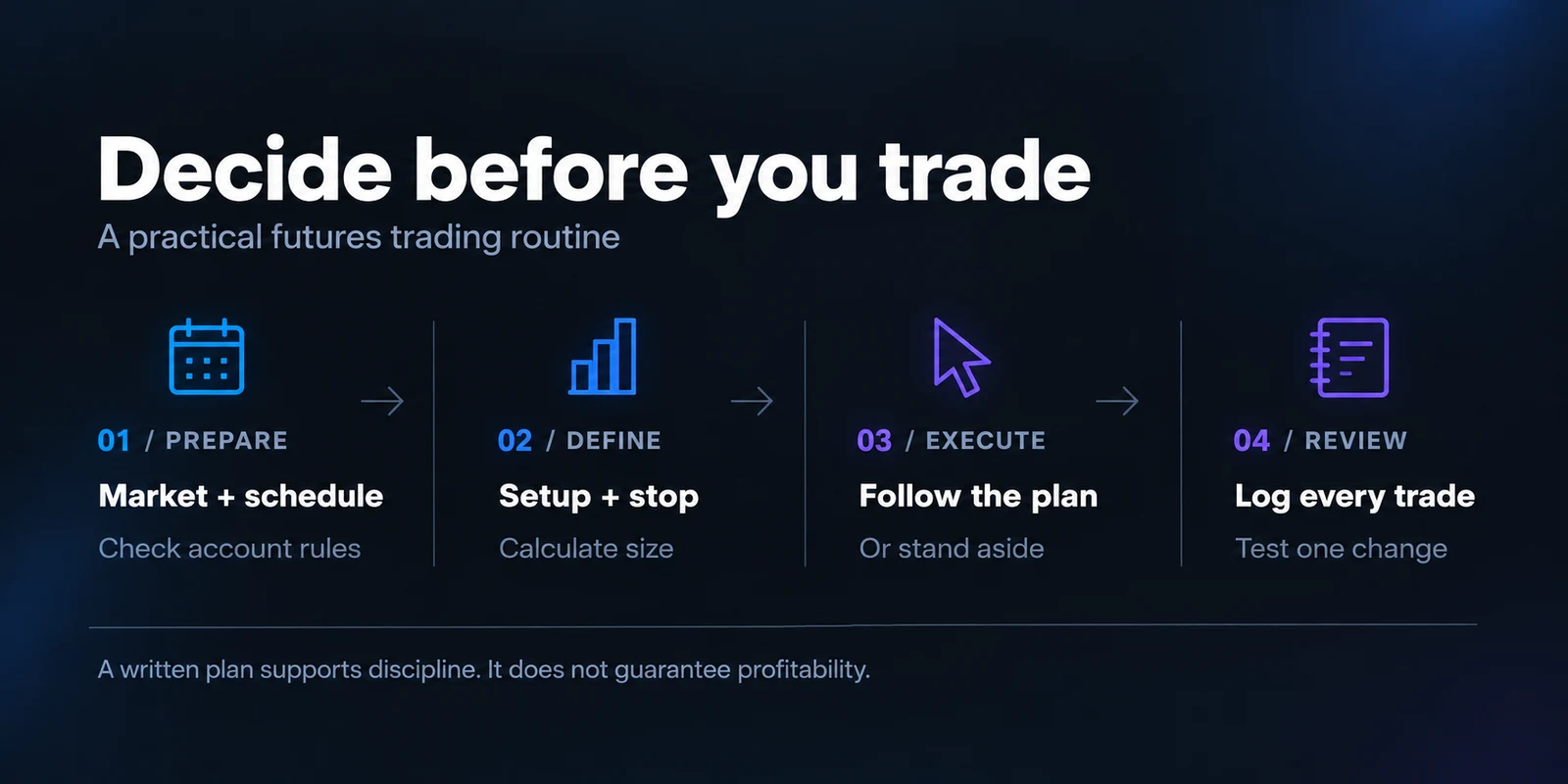
What a trading plan needs to decide
A plan is useful when it resolves a decision you would otherwise make impulsively. “Be disciplined” is an intention. “Do not enter after my last-entry cutoff” is a rule you can check. “Protect capital” is a goal. A written dollar limit and a defined response when it is reached are operational instructions.
CME's trade-plan course describes a structured plan covering objectives, methodology, risk, strategies, and a log. Its risk-management lesson emphasizes deciding trade and daily loss limits and considering overall exposure.
Your version does not need to be long. It needs enough detail that you can reconstruct why a trade was allowed. If the rules change whenever a losing trade occurs, you are testing neither a stable strategy nor a stable risk process.
Copy this futures trading plan template
Copy the following worksheet into a document or journal. Fill every blank that affects an entry before the session. Leave no-trade as the default when a required condition cannot be verified.
FUTURES TRADING PLAN
Plan version and date:
Account / provider / phase / simulated or live:
Official account rules checked on:

MARKET AND SESSION
Instrument and actual contract month:
Chart and calendar time zone:
Observation start / last entry / planned finish:
Provider or broker mandatory close-out time:
Today's scheduled events and my exclusion periods:

SETUP
Market context required:
Objective entry trigger:
Price or condition that invalidates the idea:
Initial stop order type and location:
Profit-taking or other exit rule:
Conditions that cancel the setup before entry:

RISK
Maximum planned loss per trade:
Stop distance in points / ticks:
Verified dollars per point / tick:
Round-trip charges and slippage allowance:
Calculated whole-contract count:
Current firm loss threshold and reserved cushion:
Personal daily stop and remaining allowance:
Maximum combined open-position risk:
Current provider position limit:
Maximum attempts and my rule after a loss:

NO-TRADE / EMERGENCY CONDITIONS
Market or personal conditions that stop new entries:
What I do if data, connectivity, or orders fail:
Verified backup access and provider support route:
How I confirm flat positions and canceled orders:

REVIEW
Where I record every trade and qualifying missed setup:
Screenshots and execution details to save:
Review date / sample size / one question to investigate:
Who can change the plan and when changes take effect:
This worksheet is intentionally a decision checklist rather than a preset list of trades. The blank entry trigger is not permission to improvise: it is the section where you must define a method you understand and intend to test.
Define a setup so another person could recognize it
A setup needs a market context, an entry trigger, and an invalidation condition. “Buy when it looks strong” cannot be audited consistently. A more testable description names the observation period, the price condition, and what must happen before an order is placed.
For example, you might study a precisely defined break-and-retest idea in simulation. You would still need to specify how the reference level is calculated, what counts as a break, the permitted retest behavior, and the exact cancellation condition. Naming the pattern alone does not do that work, and this guide does not claim that pattern has an edge.
Record the information that was available at the decision time. A chart marked after the session can make a vague rule look obvious. Save the before-entry screenshot and note any condition that was missing. The quality of the definition determines whether your later review measures a strategy or a collection of unrelated decisions.
Set risk limits before choosing contracts
Your stop distance and the instrument's dollar value determine price risk per contract. Add round-trip costs and an execution allowance, divide the trade budget by that amount, and round down. Also respect remaining daily room, aggregate exposure, margin where applicable, and provider limits.
The futures calculator helps check price and tick conversions. The prop firm risk management guide explains why an account's advertised balance is not the same as its available loss cushion.
Choose a personal daily stop that leaves room before a provider's hard failure level. Define whether reaching that stop means flattening immediately, canceling orders, and ending the session. Do not assume a platform lockout or stop order guarantees the eventual exit price. Verify the relevant order behavior and available controls before relying on them.
If the smallest contract does not fit the budget, write “zero contracts.” Tightening the stop solely to squeeze in a trade changes the setup. Raising the budget after a loss changes the risk plan. Neither should happen automatically in response to frustration.
Completed example: a simulation practice session
The following example demonstrates how the fields work together. Its numbers are fictional planning inputs, not a recommended risk level or an evidence-backed best session.
| Field | Completed simulation example |
|---|---|
| Account | Simulator; no paid evaluation |
| Market | MES, active contract verified before the session |
| Time zone | America/New_York |
| Observation window | 9:45–11:00 a.m. ET |
| Last new entry | 10:45 a.m. ET |
| Setup | Only the separately written, versioned setup definition |
| Planned trade budget | $100 maximum |
| Example stop distance | 8 MES points |
| Price risk at one contract | 8 × $5 = $40 |
| Assumed costs and slippage | $5 per contract total |
| Allowed size for this example | 2 contracts: $90 planned amount |
| Personal session stop | $180, or earlier if a no-trade condition occurs |
| Attempt limit | Two entries; no replacement attempt after the limit |
| Session finish | Flat positions, canceled orders, saved journal |
The MES multiplier comes from CME's contract specifications. All other amounts are illustrative. Two losses at the planned $90 amount would total $180, but execution can produce a larger loss. That is why the example is a planning exercise rather than a guaranteed ceiling.
Suppose the first trade actually loses $105 after execution. Only $75 remains under the personal session stop. You cannot place the same $90 planned-risk trade next. Recalculate size against the tighter remaining allowance or stop trading. A template that ignores the latest account state is no longer controlling risk.
Add the prop firm overlay separately
Keep the underlying trade method separate from the provider's eligibility conditions so you can see which requirement affects each decision. Record the exact program and phase, current failure threshold, daily loss rule, permitted instruments, scaling limit, news restrictions, and mandatory close-out time.
Then add any evaluation target, qualifying-day count, or payout consistency requirement that applies. These are constraints, not reasons to create an entry. A need for one more qualifying day does not make a marginal setup better.
Read drawdown rules and consistency rules before transferring a simulation routine to a paid program. Recheck the account agreement when you change phases or request a withdrawal. The rules that applied during evaluation may not be the rules that govern the next account.
If you operate several accounts, write the permitted copying arrangement and combined consequences into the plan. One mistaken order can be repeated across accounts. Do not multiply subscriptions while leaving the underlying execution problem unresolved.
Write no-trade and emergency rules
No-trade conditions should be specific enough to recognize immediately. Examples include a scheduled event inside your exclusion period, missing price data, an unresolved order-status discrepancy, a reached daily stop, or an interruption that prevents you from monitoring the position.
Before the first session, learn the supported procedure for flattening positions and canceling working orders. Confirm whether orders remain active if your device disconnects. Record the provider's official support route and an approved backup access method, if available.
When an order status is uncertain, do not keep submitting new orders to “make sure.” Establish what is already working or filled. A local chart or disconnected screen may not show the current account state. Treat an operational problem as a reason to stop new risk while you resolve it.
You should also define a personal interruption rule. If work, fatigue, or an urgent obligation makes focused monitoring impossible, the plan needs an exit or no-entry decision. A schedule only helps when it fits the life you actually lead.
Use this short post-trade journal
| Journal field | What to save |
|---|---|
| Trade identity | Date, account, symbol, contract month, session |
| Reason for entry | Exact setup version and conditions met |
| Planned risk | Entry, stop, size, fees and slippage allowance |
| Actual execution | Fills, exit, realized fees, slippage |
| Net outcome | Dollar result after actual transaction costs |
| Process result | Followed plan, or specific deviation |
| Evidence | Before-entry and after-exit screenshots |
| Learning note | One observation, without rewriting the plan mid-session |
Record valid setups you passed on as well as trades you took. Otherwise the journal can hide hesitation or selective execution. Keep recurring platform or evaluation expenses in an account-cost record so they are not lost when you focus on per-trade results.
Distinguish process quality from P&L. A trade can follow the plan and lose. Another can break the plan and profit. If you reward only the second outcome, the journal can train you to abandon controls at precisely the wrong time.
Review the plan without constantly changing it
Choose a review interval in advance. Twenty practice sessions could be an initial learning checkpoint, but that number is not statistical proof of an edge. Examine the number of observations, different market conditions, net results, average wins and losses, and adherence to the rules.
Separate three questions: Was the setup defined well enough to apply consistently? Could you execute it with realistic costs? Did the results justify further testing? If the answer to the first is no, refining the definition may be more useful than changing indicators or adding markets.
Make one clearly described change at a time and assign a new version. Keep the earlier results attached to the earlier rules. Combining several versions into one attractive performance figure makes the record difficult to interpret.
Use the economic calendar to prepare your next session, and review total prop firm costs before deciding to pay for an evaluation. The purpose of the template is to make decisions explicit, measurable, and repeatable. It cannot make an untested strategy profitable, but it can show you what you actually did and what needs further work.
Frequently asked questions
What should a beginner's futures trading plan include?
Include the contract, session and time zone, setup definition, entry trigger, stop and exit rules, calculated size, trade and daily limits, no-trade conditions, emergency procedure, and review log. Prop traders also need their exact account's loss threshold, size limit, and close-out rules.
Is this futures trading plan template a proven strategy?
No. It is a decision and recordkeeping framework. You must define and test the actual setup, include realistic costs, and evaluate execution. The completed example illustrates risk calculations in simulation and does not establish expected profitability.
Should my trading plan require a daily profit target?
A daily income quota can encourage forced entries when no valid setup appears. Prefer process goals you can control, such as following a defined setup, respecting risk limits, and recording every trade. A provider's evaluation target remains a separate account condition.
How often should I change my trading plan?
Set a review interval in advance and change one clearly defined element at a time. Keep results attached to the version used. Stop immediately for safety or operational problems, but do not rewrite trade rules during a losing position simply to justify staying in.
What should I record in a futures trading journal?
Record the account and contract, setup version, planned entry and stop, size and costs, actual fills, net outcome, rule adherence, and screenshots. Also record qualifying setups you skipped. Keep strategy execution separate from whether an individual trade won or lost.