The Funded.Now library
Futures Prop Firm Payout Rules: A Withdrawal Checklist
Check futures prop firm payout rules before withdrawing. Understand qualifying days, consistency, caps, profit splits and the loss cushion after a payout.
Updated Published
Start reading
On this page
Futures prop firm payout rules determine whether displayed profit is eligible for withdrawal, how much you may request, and what happens to your account afterward. A profit balance alone is not proof that you can withdraw it. Check your exact program, account phase, signup cohort, qualifying days, consistency test, payout limits, and remaining loss cushion before submitting a request.
This guide provides a withdrawal checklist and hypothetical calculations. It does not promise a payout or treat simulated profit as cash already earned. Provider examples were checked on September 17, 2026; the current agreement and account-specific dashboard control your request.
First identify which account rules apply
Retail futures programs can distinguish evaluation accounts, simulated funded accounts, and live accounts. The phrase “funded account” alone does not establish that orders are placed with live capital or that all displayed profits can be withdrawn.
Record the legal provider name, exact plan, account size, platform, purchase or activation date, and current stage. If the provider changed terms, confirm whether an earlier cohort keeps different conditions. A comparison table that is correct for a newly purchased plan can be wrong for an older account.
For example, Topstep distinguishes Express Funded Account paths and Live Funded Accounts in its official payout policy. Its rules also contain cohort and account-specific provisions. Apex publishes separate material for its current account types and legacy programs. Start from the correct section rather than applying a social-media summary to every account.
Read how to manage a funded account for the broader process. This guide focuses on the narrower decision: whether a particular withdrawal request is eligible and sensible under the applicable rules.
The payout eligibility checklist
| Check | What you need to verify |
|---|---|
| Account and phase | Exact plan, platform, cohort, simulated or live status |
| Qualifying days | Required count and the minimum result that makes a day qualify |
| Profit definition | Net or gross, fees included, and relevant calculation period |
| Consistency | Percentage, best-day calculation, reset point, and equality boundary |
| Withdrawal amount | Minimum, cap, percentage limit, and request frequency |
| Retained balance | Required safety net or profit buffer before and after withdrawal |
| Profit split | Trader share and whether historical thresholds affect it |
| Review | Identity checks, prohibited behavior, documentation, open positions |
| Payment | Method, recipient-name match, fees, processing and settlement times |
| After payout | New loss threshold, position limit, qualifying-day reset, account changes |
Treat each row as a question, not as a claim that every provider imposes the same requirement. Save the official links and the date you checked them. A screenshot of the dashboard is useful for your records, but it does not replace the written terms.
Trading days and winning days are different
A trading day might require only activity, while a qualifying winning day may require a specified net profit. A calendar day with no trade may not count. Several trades in one provider-defined session generally do not become several separate days just because you closed each position.
As one dated example, Topstep's Express Funded Account parameters distinguish a Standard path with five winning days of at least $150 from a Consistency path with three trading days and a 40% consistency condition. Those descriptions are not interchangeable, and they should not be transferred to another firm's account.
Check whether the count resets after a payout, whether it uses a particular time zone, and whether fees can turn an apparently qualifying day into a nonqualifying day. If your dashboard and your spreadsheet disagree, reconcile the inputs before making a request.
Avoid adding a low-quality trade merely to complete a day count. The eligibility condition is a constraint on the trading process; it is not evidence that a new entry has positive expected value.
How a consistency rule can affect a withdrawal
A common consistency calculation compares the largest profitable day with net profit over the relevant period. The precise denominator and reset rules must come from the provider.
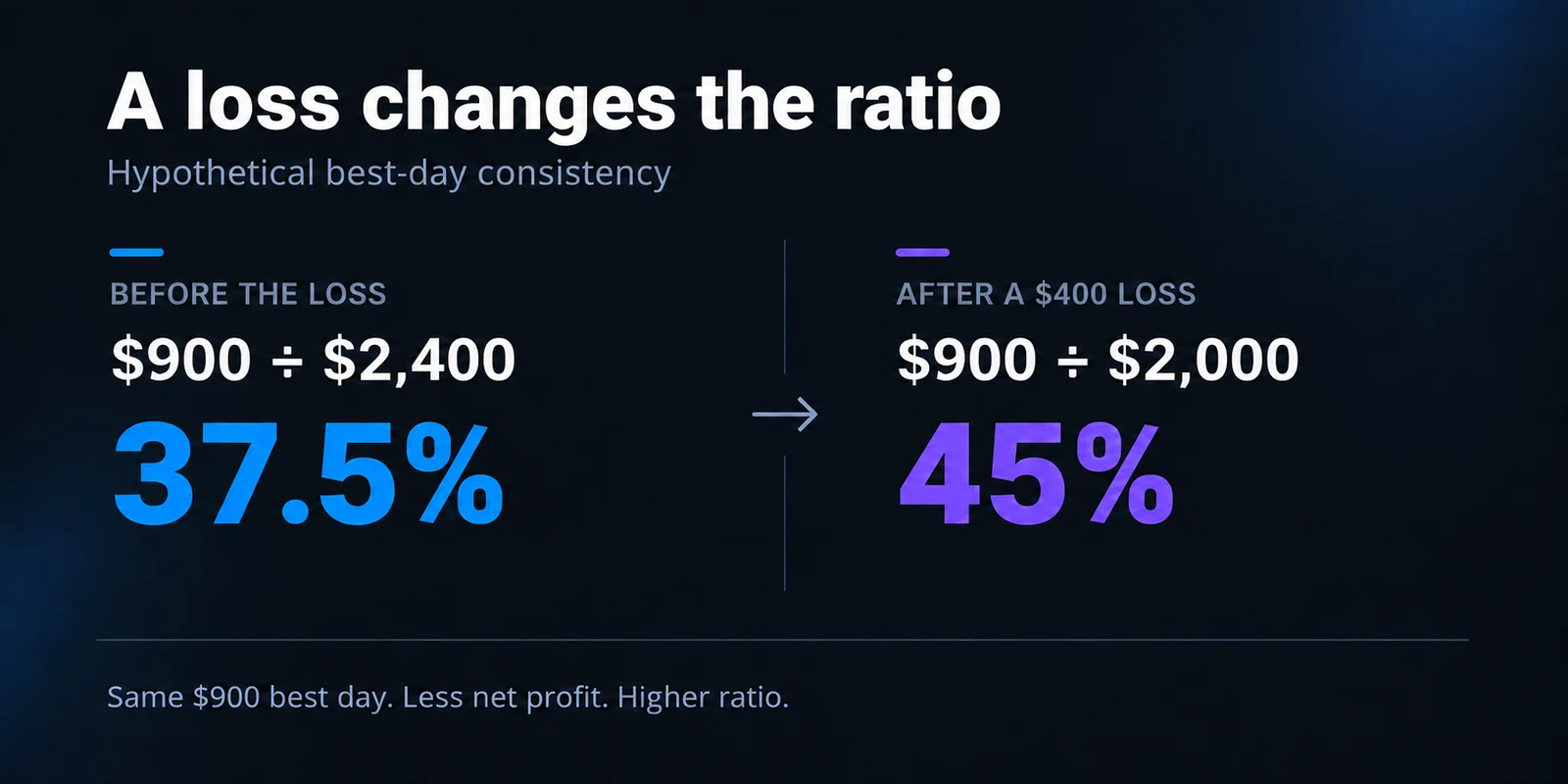
Consider a hypothetical rule that allows the best day to be at most 40% of net cycle profit. If the best day is $900 and net profit is $2,400, the ratio is $900 ÷ $2,400 = 37.5%. This example satisfies that particular condition before considering the other payout requirements.
Now suppose the next day loses $400. Net profit becomes $2,000 while the largest winning day remains $900. The ratio rises to 45%. A loss can therefore make consistency worse without creating a new best day.
For an at-most-40% condition, a $900 best day requires at least $2,250 total net profit because $900 ÷ 0.40 = $2,250, assuming the best day stays unchanged. If the rule instead says strictly less than 40%, equality would not qualify. Rounding can also matter.
| Hypothetical state | Best day | Net period profit | Ratio |
|---|---|---|---|
| Before another loss | $900 | $2,400 | 37.5% |
| After a $400 loss | $900 | $2,000 | 45% |
| Exact boundary for an at-most-40% rule | $900 | $2,250 | 40% |
Do not resolve ambiguous wording in your own favor. At the research date, Apex's 50% consistency page contains wording and examples that are not fully aligned at equality. Confirm the exact boundary with the provider and avoid planning around a rounded display reading precisely 50%.
Use the consistency calculator for arithmetic, then check its assumptions against your program. The existing consistency rule guide gives more background. Neither a calculator nor an article can approve a withdrawal.
Displayed profit, approved payout, and cash received
Keep three numbers separate: the account's displayed profit, the approved gross payout, and the net cash that reaches you. Caps or buffer requirements can limit the request. A profit split and payment charges can then change the amount received.
For a hypothetical $1,000 approved gross payout, a 90% trader share gives $900. If a $30 transfer charge is then deducted from that share, net proceeds are $870 before taxes or other applicable costs. This is an arithmetic example, not a quote from any provider.
Also verify how much is deducted from the trading account. Do not assume that account deduction equals the cash received after the split and fees. If a request reduces the account by $1,000, its risk cushion falls by that amount even if the transfer to you is smaller.
Processing time and settlement time are different. An approval notice does not necessarily mean your bank or payment wallet has received cleared funds. Avoid committing to expenses based only on a requested withdrawal.
Recalculate risk after the payout
Suppose a hypothetical profit-only account has a $3,000 balance and a fixed $0 failure floor. A $1,000 account deduction leaves a $2,000 balance and a $2,000 cushion, assuming no other rule changes or fees. Your former position size may now consume a larger fraction of the remaining room.
Other programs may change their loss threshold, scaling tier, or permitted contracts after a withdrawal. Topstep's current payout policy states that its Maximum Loss Limit is set to $0 after the first payout. Read the details for the account type; do not transplant that mechanism into another provider's displayed balance system.
Before trading again, record the new balance, current loss threshold, daily limit, permitted size, and any reset eligibility counters. Rebuild your trade budget from those inputs. A payout is a change in account state, not simply money removed from an unrelated savings balance.
The drawdown rules guide helps distinguish trailing and fixed thresholds. Remember that an end-of-day threshold calculation can still be enforced during the session.
What to do while a request is pending
Check whether trading is permitted during review and what happens if the balance falls below the required amount. A pending request might not reserve funds in the way you expect. Ask whether the provider evaluates eligibility at submission, approval, processing, or more than one stage.
Keep your account identity and payment recipient details consistent. If documentation is requested, use the provider's authenticated portal and official instructions. Do not send sensitive documents to a stranger offering to accelerate an approval.
If the request is delayed or declined, record the stated reason, the relevant rule, and the account figures used. Request a specific explanation rather than assuming the dashboard number proves the request must pass. A rules dispute is separate from the question of whether the trading strategy performed well.
A withdrawal worksheet to complete before submitting
Write these fields into your journal:
- Exact account, phase, platform, and cohort date.
- Current balance and profit for the applicable payout period.
- Number of qualifying days and how each was calculated.
- Largest qualifying profit day, denominator, and consistency ratio.
- Requested amount, applicable minimum or cap, and retained buffer.
- Expected account deduction, trader share, and payment charges.
- Post-withdrawal failure threshold and intended new risk budget.
- Whether trading continues during review and what can invalidate the request.
- Official policy links, date checked, and any written clarification.
Then compare the worksheet with the provider's dashboard while the numbers are current. If a requirement is unclear, clarify it before submitting or placing additional trades.
Compare payout rules before choosing a program
A headline profit split is only one part of a program's practical value. Consider eligibility, retained capital, caps, recurring costs, and the rules you must follow to keep the account. A high stated split cannot compensate for a plan you cannot operate consistently.
Use total prop firm costs alongside the payout checklist when researching an account. For a current Apex example, read its Intraday PA payout policy and verify that it is the policy matching your purchase.
Your goal is an auditable request with understood consequences. Keep the calculations separate from promises about future income, and continue to treat unapproved simulated profit as conditional under the program agreement.
Frequently asked questions
Can I withdraw all the profit shown in a funded account?
Not necessarily. Your exact plan may impose qualifying-day requirements, consistency conditions, caps, minimum requests, and retained buffers. Displayed profit, approved gross payout, account deduction, and net cash received are different amounts. Confirm the applicable policy before submitting.
What is a qualifying winning day for a prop firm payout?
It is a day meeting the provider's specific profit and session definition. It can differ from a day on which you simply traded. Verify the minimum net result, fees, time zone, account path, and whether the counter resets after a withdrawal.
Can a losing day make my consistency ratio worse?
Yes, when the rule compares the best profitable day with net period profit. A $900 best day over $2,400 is 37.5%. A subsequent $400 loss leaves $2,000 net profit and raises the ratio to 45%, even though the best day is unchanged.
Does taking a payout change the account's drawdown cushion?
A payout deduction can reduce the remaining cushion, and a provider may also change the failure threshold or position tier. Record the new balance and rules before trading again. Do not assume the cash you receive is identical to the account deduction.
Do all accounts at the same firm use the same payout rules?
No. Rules can differ by program, phase, platform, account size, and signup cohort. Check the official terms for your exact account rather than applying a newly advertised policy or a rule from another trader's account.