The Funded.Now library
Best Time to Trade Futures: Hours, Sessions and News
Find a futures trading session that fits your plan. Check CME hours, ET and CT conversions, economic releases, holiday schedules and prop firm deadlines.
Updated Published
Start reading
On this page
The best time to trade futures is the session in which your tested setup, execution conditions, personal availability, and account rules fit together. There is no hour that guarantees easier trades or higher profits. For new MES and MNQ traders, the U.S. cash-equity open at 9:30 a.m. Eastern is a useful reference point for observation, but it is not the opening of the futures market.
This guide explains ordinary equity-index futures hours, news-calendar checks, and a method for choosing a repeatable practice window. It focuses on CME equity-index futures, not every commodity or financial futures contract. Schedules and example provider rules were checked on September 17, 2026; use the linked official calendars for the date you intend to trade.
Futures trading hours versus stock market hours
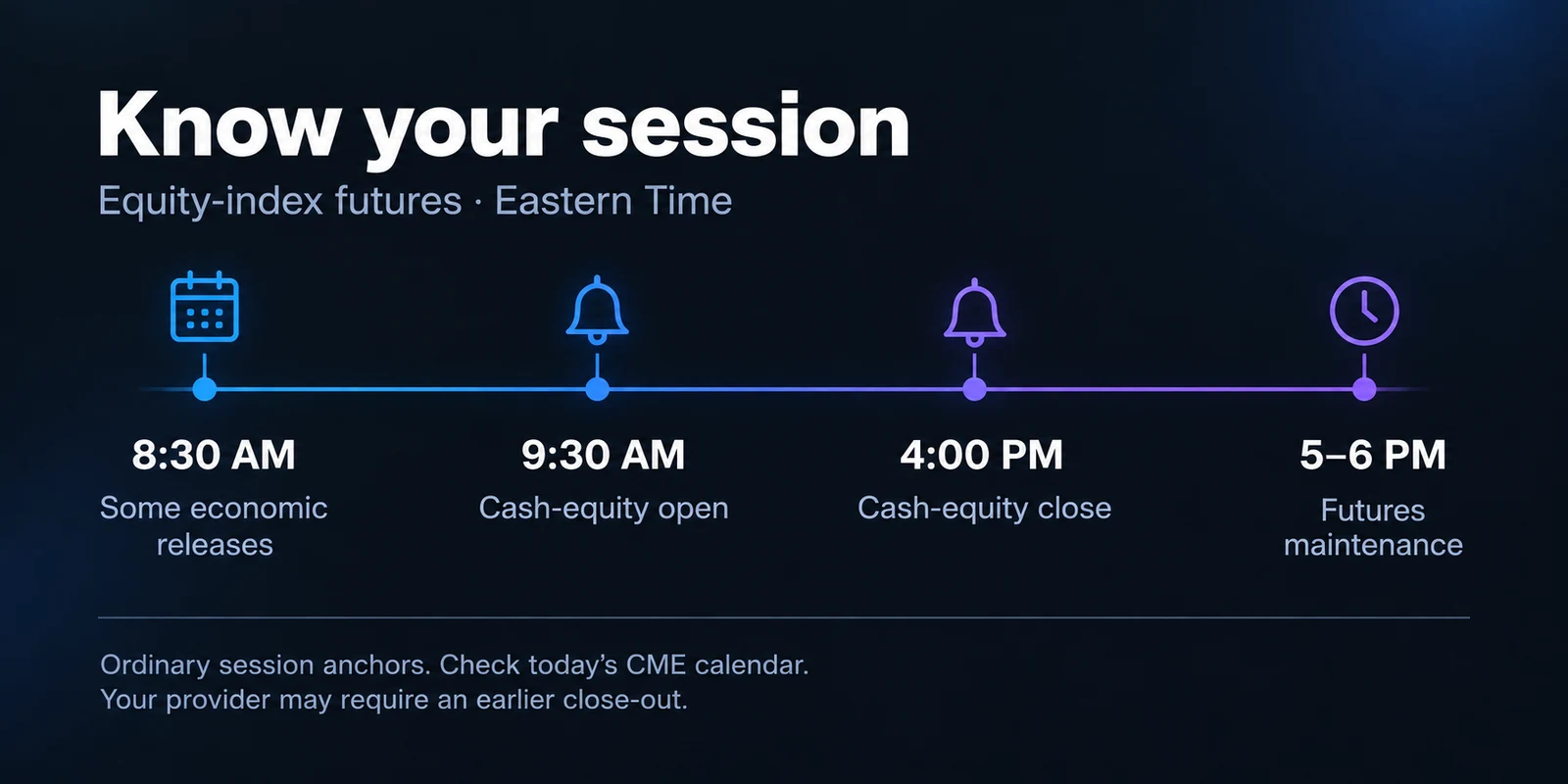
CME's current Micro E-mini contract specifications show ordinary trading from Sunday at 6:00 p.m. through Friday at 5:00 p.m. Eastern, with a daily 5:00–6:00 p.m. Eastern maintenance break. Friday's session ends before the weekend and trading ordinarily resumes Sunday evening. Holidays and expiring contracts can have different schedules. Check the current MES specifications and CME's current trading-hours calendar.
The ordinary NYSE core equity session is 9:30 a.m.–4:00 p.m. Eastern. That cash-market schedule is a reference for stock-index futures traders, not a substitute for their contract specifications. See the NYSE hours and holiday calendar.
| Reference event | Eastern Time | Central Time |
|---|---|---|
| Ordinary Sunday futures session begins | 6:00 p.m. | 5:00 p.m. |
| Common CPI or employment release time; verify the date | 8:30 a.m. | 7:30 a.m. |
| Ordinary U.S. core cash-equity open | 9:30 a.m. | 8:30 a.m. |
| Ordinary U.S. core cash-equity close | 4:00 p.m. | 3:00 p.m. |
| Ordinary weekday futures session break | 5:00–6:00 p.m. | 4:00–5:00 p.m. |
Do not interpret “nearly 24-hour trading” as uninterrupted access. A scheduled break, holiday close, trading halt, or provider restriction can prevent the exit you expected. Use the current product calendar when older summaries show a different schedule, and resolve uncertainty before opening a position near a boundary.
Use ET and CT, not fixed offsets all year
Eastern Time and Central Time adjust for U.S. daylight saving. EST and CST specifically mean standard time; using those labels year-round can shift a calendar by an hour.
If you live outside the United States, choose a named zone such as America/New_York in your calendar and trading journal. Countries change clocks on different dates, and some do not change them at all. A local routine that matches 9:30 a.m. New York time in one month may occur at a different local time later.
Before each session, check your chart's zone, the economic calendar's zone, and the account dashboard's trading-day definition. A Sunday-evening futures trade can belong to Monday's exchange business date. Likewise, a provider's qualifying-day calculation may not reset at your local midnight. Write the provider's definition into your plan rather than guessing from the date on a screenshot.
How to compare the main session windows
Think of these as environments to study, not a ranking from safest to most profitable. The behavior you observe can change with economic releases, earnings, volatility, holidays, and the active contract month.
Overnight and European hours
Equity-index futures can react to information while the U.S. core stock session is closed. If this is the only time you can monitor trades, test your actual setup in that window. Do not import results collected at the U.S. open and assume they apply.
Observe the spread, available depth, actual fills, and the distance to a logical stop. A quiet chart does not prove orders will execute well, and a fast chart does not prove an attractive opportunity exists. Your comparison should record both trading results and execution difficulty.
U.S. economic releases before the cash open
Some widely followed releases occur at 8:30 a.m. Eastern, including scheduled CPI and Employment Situation reports. Verify the event's actual date and time on the BLS CPI calendar and Employment Situation calendar.
A scheduled announcement is a reason to check risk, not a prediction of direction. Price can react to several details at once, and the first move may reverse. If you have not tested execution through releases, a prewritten decision to remain flat is a legitimate practice rule.
The cash open and morning session
The 9:30 a.m. Eastern opening provides a consistent event around which to organize observations. It does not mean you must enter at 9:30. A beginner can observe the opening, wait for a defined setup, or begin a practice block later.
For example, 9:45–11:00 a.m. Eastern is a possible simulation window to test. It is an editorial example, not an evidence-backed claim that those minutes are optimal. Record whether it suits your method and attention span. If you consistently miss entries because you are commuting or working, that window does not fit your circumstances.
Midday and afternoon
Do not label the entire midday period untradeable or assume the closing hour always offers clean trends. An afternoon central-bank announcement can change the character of a session. Check the Federal Reserve FOMC calendar, then open the relevant meeting materials for the scheduled events.
Late trading also brings operational deadlines closer. A setup may look valid but leave too little time before your account must be flat. Decide the last time you will initiate a new position separately from the final time you must close all positions.
A prop firm's close-out time can be earlier
Your provider can require you to stop before the exchange does. As a dated example, Topstep's product-and-hours page requires positions to be closed by 3:10 p.m. Central and observes earlier closes for applicable products. That is 4:10 p.m. Eastern, before the ordinary CME daily session end. Verify your account and product on Topstep's official hours page.
This is one provider's rule, not an industry standard. A different provider, account phase, platform, holiday, or contract may use a different cutoff. Do not depend on a platform's automatic liquidation as your planned exit process.
Set a personal last-entry time and a flatten reminder before the required deadline. When you finish, confirm both that the position is flat and that working orders have been canceled. A resting order can create fresh exposure after you think the session is over.
For broader account constraints, read prop firm drawdown rules and futures trading basics. The exchange being open is only one of the conditions needed to trade.
Build a news check into your session
Use the Funded.Now economic calendar as a working overview, then verify critical events against the issuing agency. Calendars can be updated. Avoid memorizing that a release happens on a particular Friday or assuming a calendar is already showing your time zone.
A useful pre-session check answers these questions:
- Which scheduled events fall before or inside my practice window?
- What time zone is being displayed?
- Does the provider prohibit opening, holding, or closing around those events?
- If trading is allowed, does my own plan still call for remaining flat?
- What conditions must normalize before I consider another entry?
There is no universal five-minute or ten-minute exclusion period suitable for every account and release. A provider's restriction must be followed as written; your personal exclusion period can be more cautious. Define it before the event so it does not become a decision driven by fear of missing out.
Unexpected news remains possible even after you complete the calendar check. That is another reason to keep size within a realistic loss budget and understand how your stop order works.
Test a session with a simple comparison log
Choose a single instrument and setup for a predefined observation period. Compare a manageable number of windows rather than trading all day. Keep the trade criteria the same so a change in results is not simply a change in strategy.
| Journal field | What to record |
|---|---|
| Session | Date, named time zone, start and finish |
| Market | Instrument and actual contract month |
| News | Event, time, and whether you stayed flat |
| Opportunities | Every setup meeting the written definition |
| Execution | Spread, slippage, missed entries, order mistakes |
| Risk | Stop distance, contracts, planned loss, net result |
| Personal fit | Interruptions, fatigue, attention, rule adherence |
After a learning block, review net results after realistic costs, average wins and losses, the number of observations, and adherence to the plan. One unusually profitable news day can dominate a small sample. More observations across different conditions are needed before treating a session preference as robust.
Keep observation quality separate from profit. A session with no valid entries can be a well-executed session. A profitable entry taken outside the plan is still evidence that the process needs work.
Your daily hours checklist
Before trading, confirm today's contract schedule, holiday exceptions, calendar zone, major releases, provider close-out time, and your own last-entry cutoff. Check the active contract if rollover is near. If any of those inputs is uncertain, resolve it before entering.
Use the risk calculator to support the dollar-risk portion of the routine and the prop firm risk management guide for the account-level view. A session choice is useful only when it fits both.
The practical answer to “when should I trade?” is a repeatable window you can monitor, with understood rules and a documented setup. Begin by observing, collect your own evidence, and keep the freedom to skip a session that does not meet your conditions.
Frequently asked questions
What is the best time to trade futures for beginners?
There is no universally best hour. Choose a window where your tested setup, execution conditions, attention, and account rules fit. The 9:30 a.m. Eastern cash-equity open is a useful observation reference for index futures, not a guarantee of easier or profitable trades.
Do MES and MNQ futures trade 24 hours a day?
They trade nearly around the clock during the ordinary Sunday-to-Friday schedule, with a daily 5–6 p.m. Eastern maintenance break. Weekend, holiday, expiration, and provider restrictions also matter. Check CME's current product calendar for the date you plan to trade.
Is the futures market opening the same as the stock market opening?
No. The ordinary U.S. core stock session opens at 9:30 a.m. Eastern, while equity-index futures ordinarily resume their session at 6 p.m. Eastern. The stock-market open is an event within the longer futures session.
Can I hold a prop firm trade until the CME close?
Only if the rules for your exact provider, plan, phase, and product permit it. A provider may require positions to be closed earlier than the exchange session ends. Confirm today's cutoff and any holiday exception, and cancel remaining working orders when finished.
Should I use EST or ET in my trading plan?
Use ET or a named zone such as America/New_York for a year-round schedule. EST means standard time and does not describe daylight-saving time. Check international clock-change differences and confirm the time zones of your chart, calendar, and account dashboard.