The Funded.Now library
Futures Position Sizing: Calculate Contracts and Risk
Learn futures position sizing with MES and MNQ examples. Calculate whole contracts from stop distance, costs and the remaining risk limits in your account.
Updated Published
Start reading
On this page
Futures position sizing converts the distance from your entry to your stop into a contract count that fits a planned dollar risk budget. Calculate the risk for one contract, include trading costs and an execution allowance, divide the budget by that amount, and round down. If the answer is zero, skip the trade or keep practicing in simulation.
In a prop firm account, also check the remaining drawdown cushion, daily limit, and permitted contract count. The advertised account size is not a usable loss budget. This educational guide uses hypothetical numbers, not personalized risk recommendations. Exchange specifications were checked on September 17, 2026.
The futures position sizing formula
For a trade with one entry and one planned stop:
Planned risk per contract = stop distance in points × dollars per point + round-trip costs + slippage allowance.
Contract count = round down(trade risk budget ÷ planned risk per contract).
You can calculate the same price risk in ticks: stop distance in ticks multiplied by dollars per tick. Use one version, not a mixture. Points multiplied by tick value will understate risk on instruments where several ticks make a point.
The calculation estimates a planned loss. It does not cap the eventual loss. Gaps, thin liquidity, fast markets, connection problems, and order behavior can cause a worse exit. A stop-limit order may not fill at all if the market moves past its limit; a triggered stop order's behavior depends on the order type and venue. Review CME's futures order-type explanations.
Start with correct tick and point values
| Contract | Point value | Tick size | Tick value |
|---|---|---|---|
| MES | $5 | 0.25 points | $1.25 |
| MNQ | $2 | 0.25 points | $0.50 |
| ES | $50 | 0.25 points | $12.50 |
| NQ | $20 | 0.25 points | $5.00 |
Sources: CME Micro E-mini contract information, MES specifications, and MNQ specifications. Confirm the symbol and expiry month on the order ticket. Other futures products can use different increments or quote conventions.
The cost input should include charges for both entry and exit. If your provider quotes a commission per side, adding it only once understates the round trip. Separate recurring evaluation or platform charges from per-trade charges: both matter to profitability, but a monthly fee is not automatically incurred anew on every order.
Worked example: sizing an MES trade
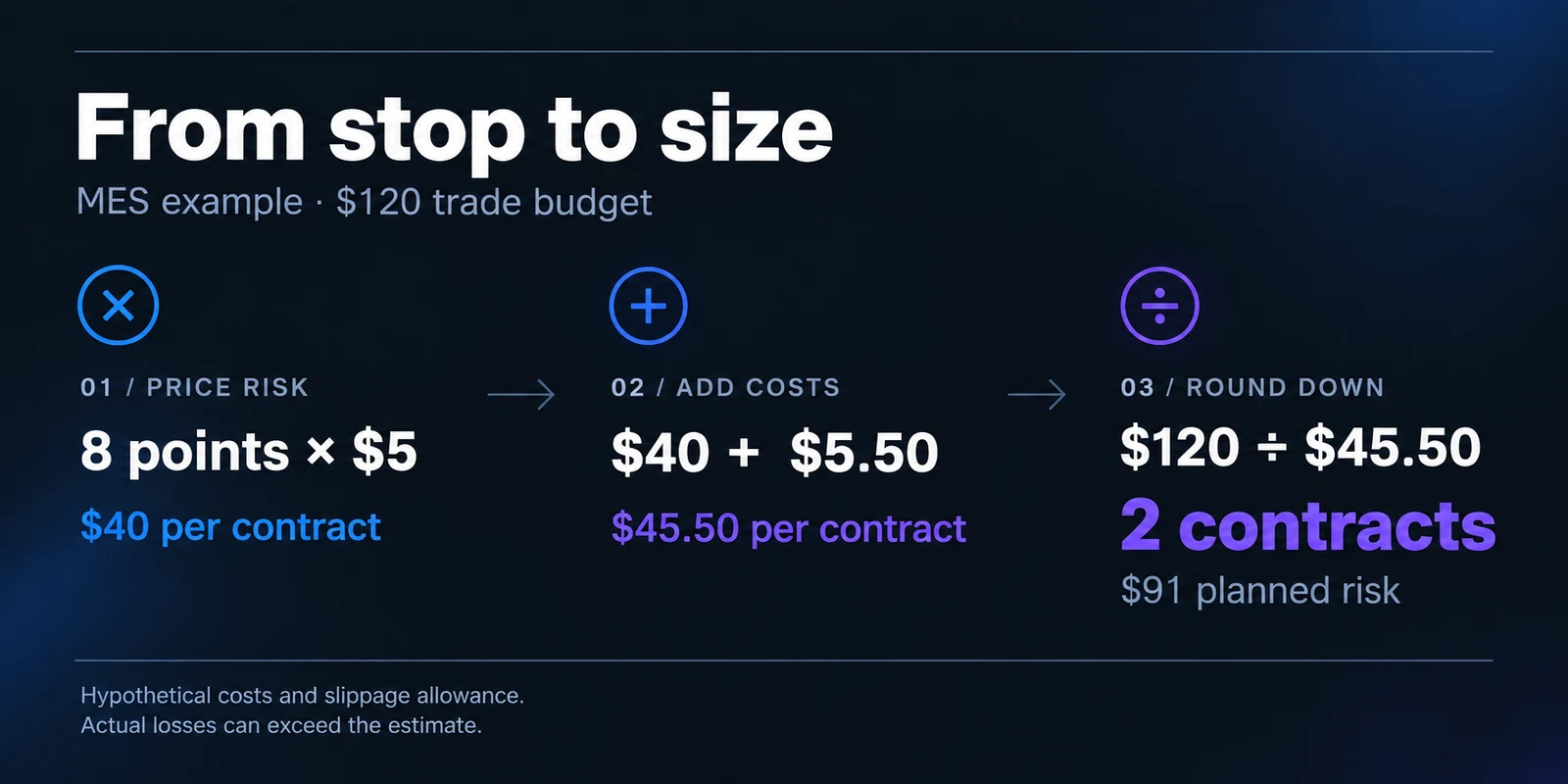
Assume a hypothetical long entry at 6,000.00 and a stop at 5,992.00. The stop distance is eight points. At $5 per point, the price risk is $40 for one MES contract.
Suppose your preselected trade budget is $120. For this example only, allow $3 per contract for round-trip charges and $2.50 for slippage. The total planned amount per contract is $45.50.
The calculation is $120 ÷ $45.50 = approximately 2.64. Round down to two contracts. Planned total risk is $91. Three contracts would use $136.50, which exceeds the budget. Do not round to the nearest whole number.
| Input or result | Amount |
|---|---|
| Stop distance | 8 points, or 32 ticks |
| Price risk per contract | $40 |
| Illustrative costs and slippage allowance | $5.50 |
| Planned amount per contract | $45.50 |
| Trade budget | $120 |
| Maximum size from this calculation | 2 MES |
| Planned amount at that size | $91 |
The unused $29 is not a reason to tighten the stop or add a third contract. Contract size is discrete. Having unused budget is normal. Replace the example charges with your actual schedule and a deliberately chosen execution allowance.
Worked example: sizing an MNQ trade
Assume a hypothetical MNQ entry at 22,000.00 and a stop at 21,965.00. That is 35 points, or 140 ticks. One contract has $70 of price risk: 35 × $2.
With illustrative round-trip costs of $3 and an execution allowance of $4, the planned amount becomes $77 per contract. Under a $150 trade budget, one contract fits and two do not: two would use $154.
This small difference matters. It is tempting to say the extra $4 is harmless, but doing so changes a predetermined limit into a negotiable preference. If you routinely exceed the limit for a slightly larger position, the written budget no longer controls your behavior.
You can independently check the conversion using the futures calculator. Confirm whether any tool includes fees and slippage before treating its displayed result as a complete risk estimate.
Size against the actual prop firm loss cushion
Imagine a simulated account showing $50,600 of equity and a current failure threshold of $49,100. The immediate distance between those numbers is $1,500. It is not $50,600 of available risk, and it is not necessarily a fixed cushion for the rest of the day.
If the account trails unrealized highs, the threshold can rise while a position is open. A daily loss rule may also impose a closer restriction. Read the rules for how commissions, open P&L, and touching versus crossing the threshold are treated. The trailing drawdown guide explains why a profitable trade can still consume future room.
A practical pre-trade worksheet records four separate constraints:
- Your chosen per-trade risk budget.
- Remaining room under your personal daily stop.
- Remaining room under the provider's applicable loss rules, with a reserve.
- The provider's current position limit.
Your planned position must satisfy all four. The reserve is a deliberate amount left unused for costs, execution uncertainty, and rule mechanics. There is no universal reserve suitable for all products or accounts. Do not trade right against a hard failure threshold simply because a spreadsheet shows one more contract fits.
For example, your usual trade budget might be $100, but only $60 remains under your personal daily stop. A trade with $77 planned risk for one MNQ does not fit. The earlier $150 sizing example does not override today's tighter constraint.
Where should the stop go?
Identify the condition that invalidates the trade idea before selecting size. That might be a price level defined by a tested setup. The guide does not prescribe a technical setup or claim any pattern is profitable.
Once you have that level, calculate the distance and size accordingly. Moving a stop closer solely to trade more contracts changes the strategy. Moving it farther away after entry increases the loss beyond the amount you approved. Both decisions should be evaluated as strategy changes, not arithmetic adjustments.
If market conditions require a stop so wide that one micro exceeds your budget, there is no smaller fraction of that contract to trade. Sitting out is a valid outcome. An evaluation deadline, subscription renewal, or desire to recover a loss does not make the position affordable.
Adding positions, scaling out, and correlated trades
The simple formula assumes a single entry. When adding to a position, recalculate the planned combined loss at the actual stop levels, including added transaction costs. Do not count an unrealized gain as guaranteed protection; price can reverse before you exit.
Suppose two MES positions would each lose $45.50 under their individual plans. Taking both at once creates $91 of combined planned exposure. If they express the same market idea, treat that concentration explicitly. A long MNQ position alongside them can add more exposure to the same broad equity move.
Scaling out also changes the outcome distribution. With one contract, you cannot close half. With several contracts, taking partial profits may reduce the remaining exposure, but it also changes the average winner. Record the actual exit plan rather than assuming every contract reaches the full target.
On multiple copied accounts, distinguish per-account risk from combined financial consequences. An identical error may fail several evaluations or remove several potential payouts at once. The technical ability to copy an order is not proof that the provider permits the arrangement.
A sizing checklist you can use before each entry
| Question | Your entry |
|---|---|
| Correct instrument and contract month? | Symbol and expiry |
| Planned entry and stop? | Prices and order types |
| Stop distance? | Points and ticks |
| Verified dollar value? | Point or tick value |
| Costs included? | Entry plus exit charges |
| Execution allowance? | Dollar amount per contract |
| Tightest risk constraint today? | Dollar budget after reserves |
| Rounded-down contract count? | Whole number, possibly zero |
| Combined open exposure? | Include correlated positions |
| Provider's limit and session rules checked? | Yes, or do not enter |
Prepare this before the market reaches your entry condition. Rushing the calculation at the moment of entry creates opportunities for unit errors. If you use a platform order template, verify its default size each time you switch between accounts or instruments.
Review actual losses against planned losses
After the session, compare the estimated loss for each stopped trade with the realized result after costs. Record the difference separately from the market-direction decision. A useful journal explains whether the discrepancy came from slippage, commissions, a late manual exit, a changed stop, or an incorrect contract count.
If repeated losses exceed your allowances, update the assumptions or reduce exposure. Do not keep a convenient estimate simply because it produces the size you want. A sizing formula is only as useful as its inputs.
Finally, review the full prop firm risk management guide and total evaluation costs. Good sizing helps control a trade's planned downside; it does not establish a profitable strategy or guarantee that an account survives. The immediate goal is a decision you can calculate, execute, and audit consistently.
Frequently asked questions
How do you calculate futures position size?
Multiply stop distance in points by dollars per point, then add round-trip charges and a slippage allowance per contract. Divide your trade budget by that amount and round down. Apply tighter daily, account, margin, and position constraints before entering.
What if the calculation gives less than one contract?
The permitted whole-contract count is zero. Skip the trade, keep using simulation, or evaluate a smaller suitable instrument. Do not round up or move a logical stop just to force a contract to fit.
Should I risk one percent of a prop firm's account size?
The displayed account label is not the available loss cushion. Identify the current failure threshold, daily limit, reserved room, and your own budget first. A generic percentage of the advertised balance can consume a large part of the actual remaining cushion.
Do futures margin requirements define my maximum loss?
No. Margin is collateral required to hold a position, not a stop-loss amount or maximum possible loss. Size using the trade's risk and your account constraints, and separately confirm the broker's current margin requirements.
Can a stop order guarantee the planned dollar loss?
No. Execution may differ from the trigger during fast moves, gaps, thin liquidity, or technical problems. A stop-limit may remain unfilled. Understand your platform's order behavior and treat a slippage allowance as an estimate, not a guarantee.