The Funded.Now library
MES vs MNQ: Tick Values, Risk and Which to Trade
Compare MES and MNQ tick values, stop-loss risk, fees and prop firm limits. Use worked examples to choose a micro futures contract that fits your trading plan.
Updated Published
Start reading
On this page
MES vs MNQ is a choice between two different stock index exposures, not simply two prices per tick. MES tracks the S&P 500 and moves $5 per index point per contract. MNQ tracks the Nasdaq-100 and moves $2 per point. Both trade in 0.25-point increments, making a tick worth $1.25 for MES and $0.50 for MNQ. The smaller MNQ tick does not automatically make it the lower-risk trade.
This guide shows you how to compare the contracts using a planned stop, transaction costs, and the rules of your account. It is educational, and the trade examples are hypothetical. Contract specifications were checked on September 17, 2026; recheck the exchange and your provider before trading.
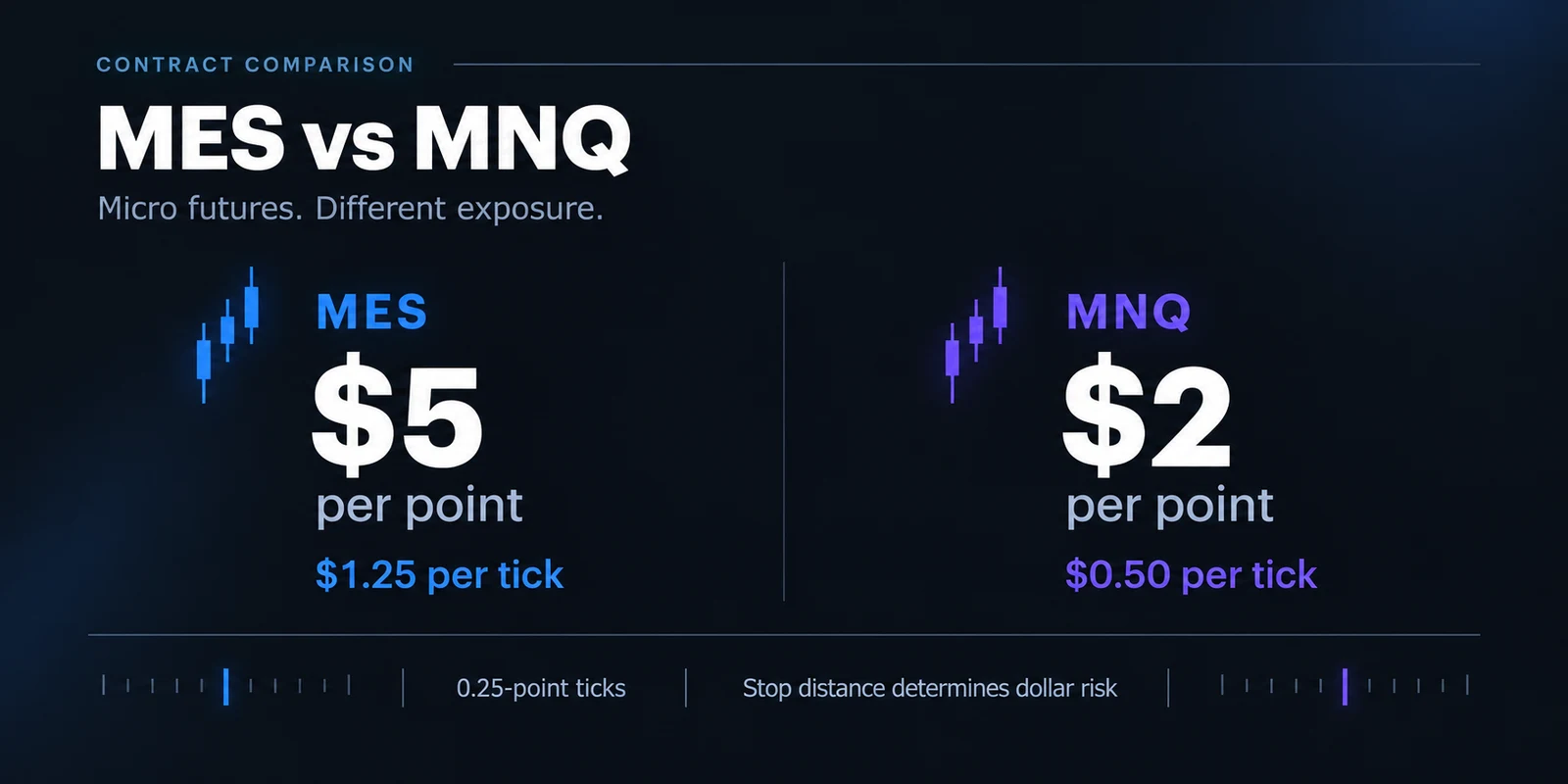
MES vs MNQ: contract specifications at a glance
| Feature | MES | MNQ |
|---|---|---|
| Full name | Micro E-mini S&P 500 futures | Micro E-mini Nasdaq-100 futures |
| Underlying index | S&P 500 | Nasdaq-100 |
| Dollars per index point | $5 | $2 |
| Minimum price increment | 0.25 points | 0.25 points |
| Dollars per tick | $1.25 | $0.50 |
| Gross P&L on a 10-point move, one contract | $50 | $20 |
| Larger E-mini counterpart | ES | NQ |
Sources: CME MES specifications and CME MNQ specifications. P&L examples are calculations from those specifications, before fees and slippage.
The table answers what each price movement is worth. It does not tell you how many points either market will move during your trade. You need both pieces of information to compare actual dollar exposure.
Understand points, ticks, and contracts first
A point is a full index-price unit. A tick is the minimum price increment. On MES and MNQ, four ticks make one point. A contract is the unit you buy or sell.
Suppose MES moves from a hypothetical 6,000.00 entry to 6,008.00. That is an eight-point move, or 32 ticks. One long MES contract has $40 of gross profit: eight points multiplied by $5. Two contracts have $80 of gross profit. A short position held through the same upward move has an equivalent gross loss.
Now suppose MNQ moves from a hypothetical 22,000.00 to 22,025.00. That is 25 points, or 100 ticks. One long contract has $50 of gross profit: 25 multiplied by $2. These prices are teaching examples, not current quotes or trade recommendations.
Do not multiply a point distance by tick value. An eight-point MES stop is $40 per contract, not $10. Equally, do not multiply a tick distance by point value. Label the units on every calculation until the conversion becomes routine. The futures tick value reference can help you check the inputs.
Why the smaller MNQ tick can still mean more risk
The Nasdaq-100 and S&P 500 have different constituent sets and weightings. Their charts can move together without moving the same number of points. A trade setup that needs an eight-point stop in MES might need a substantially different stop in MNQ. The distance must come from the setup and prevailing market conditions, not from a desire to make a chosen contract count fit.
Consider two hypothetical trades:
| Trade | Planned stop | Gross risk per contract | Two contracts |
|---|---|---|---|
| MES example | 8 points | 8 × $5 = $40 | $80 |
| MNQ example | 30 points | 30 × $2 = $60 | $120 |
MNQ has the smaller tick value but the larger planned loss in this example. This is why “MNQ is cheaper” is an incomplete answer to a beginner's question. Conversely, a different pair of stop distances could reverse the result.
For comparison, write down the stop your method actually requires in each market. Convert each to dollars, then add a realistic allowance for costs and execution. Choose the size only after that calculation. Neither a market's reputation nor its tick value proves it is suitable for your budget.
Micro futures versus E-mini futures
MES and MNQ are one-tenth the size of their respective E-mini contracts. ES has a $50 point value and NQ has a $20 point value. Ten micros therefore have the same point exposure as one corresponding E-mini, before differences in transaction costs and execution. See CME's Micro E-mini overview.
Micros give you smaller increments when adjusting size. Reducing three MES contracts to two cuts point exposure from $15 to $10. If you trade one ES contract, you cannot reduce it to half a contract. You must exit or use a different contract size.
That flexibility is useful when learning, but it can be undermined by taking many micros simply because the platform permits it. Ten MNQ contracts still represent $20 per point. A 30-point adverse move is $600 before costs. “Micro” describes the contract, not the seriousness of the potential loss.
Fees also deserve attention. Ten micros do not necessarily cost the same to trade as one E-mini. Compare the actual round-trip commission and exchange or clearing charges for your provider, and do not assume every advertised price includes both entry and exit.
Choose using a risk budget, not an income target
Start with the maximum planned loss you can justify for the trade. Do not start with a daily dollar income target and reverse-engineer an oversized position to reach it.
For an illustrative $100 trade budget, an MES setup with an eight-point stop has $40 of price risk per contract. Assume, purely for the exercise, $5 per contract for round-trip charges and a slippage allowance. The planned amount is $45 per contract. Two contracts use $90; three use $135 and exceed the budget.
If an MNQ setup requires a 30-point stop and the same illustrative $5 allowance, its planned amount is $65 per contract. One fits; two do not. Your actual costs will differ, and stop orders cannot guarantee that losses remain within these estimates.
This comparison does not show that MES is universally better. It shows why identical contract counts are a poor way to compare trades. Use the futures calculator to check point and tick arithmetic, then apply your own costs and account constraints.
What changes in a futures prop firm account?
The exchange's contract specifications stay the same, but the program adds another layer of limits. A retail evaluation or simulated funded account may restrict eligible instruments, contract counts, trading times, or behavior. The label “$50,000 account” does not mean you can lose $50,000, nor does it necessarily mean you control that amount of live capital.
Check these items in the agreement for your exact plan and phase:
- Whether MES and MNQ are both permitted on your chosen platform.
- How micros count toward the position limit and whether that limit scales.
- The current failure threshold and whether unrealized gains move it.
- Whether simultaneous index positions or offsetting trades are restricted.
- The required close-out time, news rules, and treatment of commissions.
Do not assume the ten-to-one economic relationship between micros and E-minis is the provider's position-limit conversion. Those are separate questions. A permission to hold ten micros also does not make ten micros an appropriate size.
Read prop firm drawdown rules before choosing your trade budget. If the remaining loss cushion is small, a trade that looked modest against the displayed balance may consume a large share of the account's remaining room.
A practical comparison exercise for beginners
Use simulation to compare MES and MNQ under the same written process. Pick one session and one clearly defined setup. Record every qualifying occurrence, including occasions you decide not to trade. Do not change the setup mid-test to make one contract look better.
For each observation, record the contract month, session, intended entry, planned stop in points, dollar risk at one contract, assumed fees, and actual or simulated execution. Add a screenshot showing the information available when the decision was made. Avoid marking a perfect entry only after you have seen the subsequent move.
At review time, ask practical questions: Did the setup need a stop larger than your budget allowed? Were spreads or slippage material relative to the intended target? Did you enter late because the movement was difficult to follow? Could you execute without switching repeatedly between charts?
A few attractive screenshots do not establish an edge. You are first testing whether the instrument and routine are manageable. A larger, representative record is needed before making claims about profitability, and simulated fills may flatter the results.
Common MES and MNQ mistakes
Using the same stop distance in both markets. Eight points represents the same number of ticks but a different dollar amount and potentially a different amount of market movement. Define the setup separately in each instrument.
Treating correlated positions as independent. Long MES plus long MNQ can concentrate exposure to a broad equity selloff. Review the combined dollar loss if both stops are reached; do not rely on one contract rescuing the other.
Confusing margin with a loss limit. Broker margin is collateral required to hold a position. It is not the most you can lose. Requirements can change, and account-level liquidation rules do not guarantee a particular exit price. CME explains the role of futures margin.
Ignoring the expiry month. A continuous chart is a research view, not always the contract your order ticket will trade. Confirm the active contract and the provider's rollover instructions before submitting orders.
Buying an evaluation before understanding order entry. Practice placing, modifying, and canceling orders, and confirm that closing a position also leaves no unintended working orders. Operational errors can be expensive even when your market idea is sound.
Make the choice repeatable
Choose the instrument whose required stop, total costs, execution demands, and account rules fit your documented budget. If neither fits, the correct size is zero. You can keep studying or using simulation without buying additional risk.
Start with the futures trading basics guide if contract terminology still feels unfamiliar. Once you can explain the tick arithmetic without guessing, write a one-page comparison using your own setup and costs. That is a more useful decision tool than a blanket claim that one symbol is best for every beginner.
Frequently asked questions
What is the difference between MES and MNQ?
MES is the Micro E-mini S&P 500 futures contract; MNQ is the Micro E-mini Nasdaq-100 contract. They track different indexes. MES is worth $5 per point and MNQ $2 per point. Both have 0.25-point ticks, worth $1.25 and $0.50 respectively.
Is MES or MNQ better for a beginner?
Neither is universally better. Compare the dollar risk of your actual stop distance, transaction costs, execution demands, and account rules. Test one written setup in simulation and choose an instrument only if its required risk and routine fit your budget.
How much is a 10-point move in MES or MNQ?
For one contract, a 10-point move is $50 of gross profit or loss in MES and $20 in MNQ. Multiply by the number of contracts, then account for commissions and execution costs. A point is four ticks in both contracts.
Are ten micros the same as one E-mini?
Ten MES contracts have the same index-point exposure as one ES; ten MNQ match one NQ. Commission costs and execution may differ. A prop program can also use its own contract-limit counting rules, so confirm those separately.
Does a smaller MNQ tick mean a smaller possible loss?
No. Loss depends on price movement, contract count, and execution. A 30-point stop in one MNQ represents $60 before costs, while an eight-point stop in one MES represents $40. Stops do not guarantee a maximum realized loss.