The Funded.Now library
Lucid Trading Beginner Guide: Flex Rules and Payouts
Learn how LucidFlex works, from evaluation and drawdown to qualifying days and withdrawals, with clear 50K examples and a beginner checklist.
Updated Published
Start reading
On this page
Lucid Trading offers futures evaluation accounts and simulated funded accounts with different drawdown and payout rules. LucidFlex is one of those paths: you complete an evaluation, then trade a simulated funded account and request payouts when its conditions are met. Passing an evaluation does not turn the account label into money you can withdraw.
This guide uses LucidFlex 50K to explain the process. The most useful detail to understand early is what happens when you request a payout: your drawdown floor can lock at $50,100, changing how much room you have left to trade.
Rules and advertised prices checked September 27, 2026. This is a researched educational guide, not a report of personal trading results. Examples are hypothetical. FundedNow may earn a commission when you purchase through links in this guide. Fees and trading involve risk; passing and payouts are not guaranteed.
Rule-reference links open the Lucid Trading homepage. Find the named policies in its Help Center.

What is Lucid Trading?
Lucid provides account programs for futures traders. Its current public lineup includes LucidPro, LucidFlex, LucidDaily and LucidDirect. The names matter because rules belong to a specific product and stage. A payout explanation for Flex should not be applied to Daily or Direct. Official account lineup
Flex starts with a simulated evaluation. You need to reach its profit target while respecting loss, consistency and position rules. The next stage is also simulated, but qualifying performance can lead to contractual payouts. A later live brokerage account requires a separate review. Flex evaluation, Flex funded account
Think of the process as learning two sets of rules: how to qualify, then how to keep and use the funded account. Reading only the evaluation rules leaves half the work unfinished.
Current Lucid Trading offers
Current listed discounts for Lucid Trading: up to 46% off eligible accounts.
| Account plan | Entry price from | Billing | Code |
|---|---|---|---|
| LucidPro | $70.60 | One-time | LUMI |
| LucidDirect | $230.30 | One-time | LUMI |
| LucidFlex | $50.30 | One-time | LUMI |
| LucidDaily | $55.30 | One-time | LUMI |
Special coupon pricing Code: LUMI.
Entry prices exclude separate activation fees, resets and optional extras. Offer eligibility and renewal terms depend on the selected account. Confirm the final total at checkout.
Flex uses a one-time evaluation fee, without monthly rebilling or a funded activation fee. A reset is a separate purchase. Third-party platform or data costs should be checked for the setup you intend to use. Evaluation billing, simulated account fees
Don't decide your budget from the first purchase alone. Write down how much you can spend on the entire learning attempt, including a possible reset. If your plan depends on passing immediately to afford the fee, the budget is too tight for that plan.
The 50K LucidFlex evaluation at a glance
| Rule | LucidFlex 50K evaluation |
|---|---|
| Starting simulated balance | $50,000 |
| Profit target | $3,000 |
| Maximum loss allowance | $2,000 |
| Drawdown model | End-of-day trailing |
| Best-day consistency | 50% or less under the headline formula |
| Maximum position | 4 minis or 40 micros |
| Daily loss limit | ON or OFF, selected at purchase |
These are account boundaries, not recommended trading targets. The maximum position is especially easy to misuse: being allowed four contracts doesn't mean four contracts fit your stop distance. Evaluation parameters
With the daily loss limit turned ON, the 50K selector showed a $1,200 limit. Reaching it causes a session lockout. The ON/OFF choice carries into the funded stage and cannot be changed later. The separate maximum-loss boundary can still fail the account. Flex customization, official selector
A personal daily stop can be smaller than either firm limit. It should reflect how your strategy behaves and how much of the remaining allowance you are willing to risk in one session.
How does the consistency rule work?
The headline calculation is your largest profitable day divided by your total account profit. If your best day is $1,800 and total profit is $3,000, the result is 60%. Reaching the $3,000 target alone would not satisfy the headline 50% test.
With the best day unchanged, $3,600 total profit makes the ratio 50%: $1,800 ÷ $3,600. Lucid describes a small variable cushion in its policy, so use your dashboard's actual requirement rather than treating an example allowance as universal. Flex consistency policy
The practical lesson is to notice concentrated profits early. If one day becomes much larger than the others, calculate the effect before your next session. Don't force trades merely to change a percentage. Funded Flex has no consistency requirement, but the evaluation still does.
How does LucidFlex drawdown move?
A 50K Flex account begins with a $48,000 loss floor. The floor follows the highest session-closing balance and doesn't move downward after a losing session. It eventually locks at $50,100. A payout request also moves it to $50,100. Flex drawdown rules
For example, a $50,800 close raises the floor to $48,800. A later $50,500 close leaves that floor unchanged and reduces your room to $1,700. These are hypothetical balances before any payout.
End-of-day tells you how the floor updates; it isn't permission to touch the current failure boundary during the session. Before placing an order, use the floor actually displayed on your account and allow room for execution costs. See our drawdown guide if this is your first trailing account.
Why five winning days may not produce a payout
For each Flex 50K payout cycle, Lucid requires five qualifying days with at least $150 profit per day and positive net profit. The minimum request is $500. The maximum is 50% of account profit, capped at $2,000. The trader receives 90% of an approved request. Qualifying days reset after approval. Flex payout policy
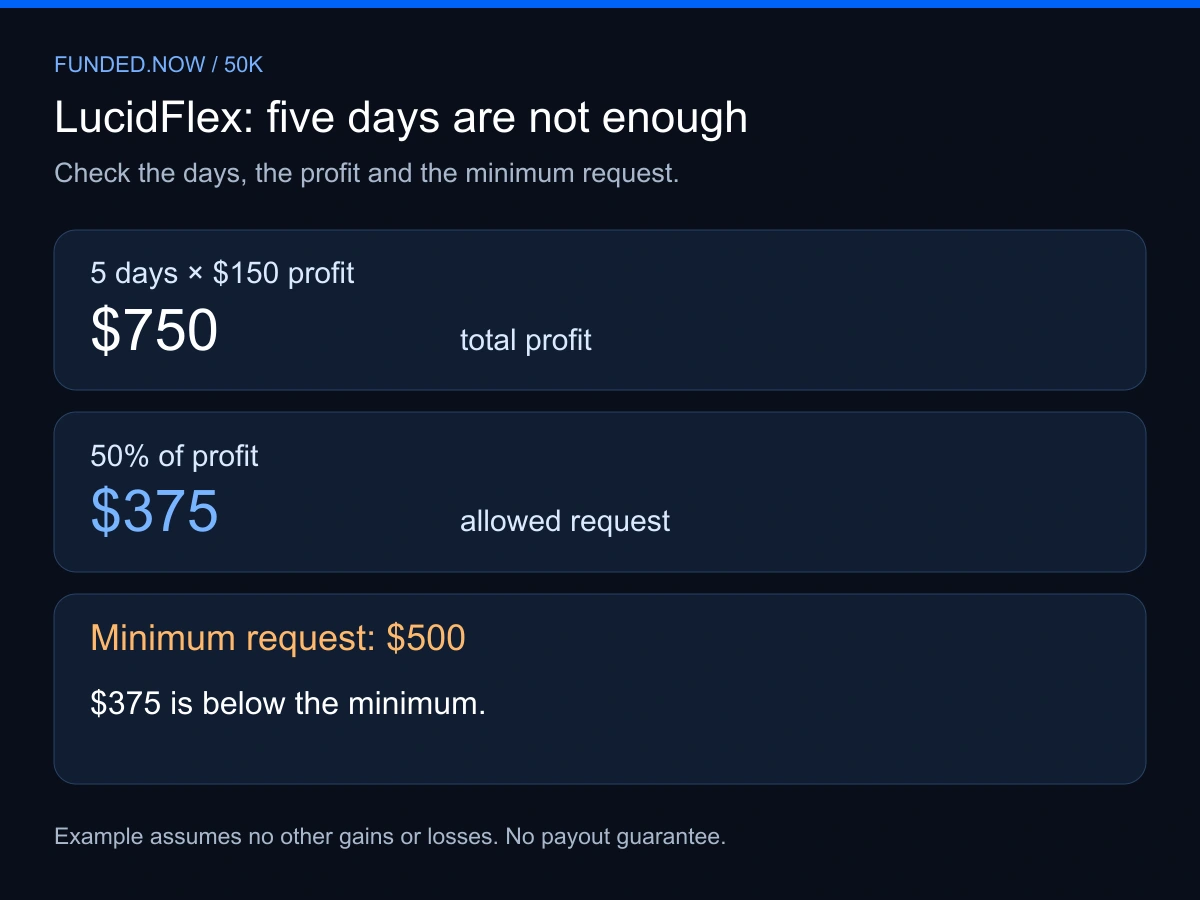
Five $150 days add up to $750 if there are no other gains or losses. Half of $750 is $375. You have met the qualifying-day count, but the allowed request is still below $500.
At $4,000 profit, 50% reaches the $2,000 request cap. A 90% share would give the trader $1,800 before applicable external charges, assuming every other requirement is met. These calculations illustrate the rules; they are not an earnings target or a prediction.
Payout requests cannot be cancelled. Check eligibility as a group of conditions. A green day counter by itself isn't enough, and a profitable balance doesn't replace the required days.
What changes after a payout request?
Flex advertises no separate payout buffer, but it still has a drawdown floor. The payout-triggered lock at $50,100 matters especially if you request money before the floor has naturally finished trailing.
For a hypothetical account with $51,000 balance, a $500 deduction would leave $50,500. Against a $50,100 floor, that is only $400 of room. This example assumes the day and other eligibility requirements are satisfied. It illustrates why you should calculate the post-withdrawal balance before making the request. Drawdown policy
Funded Flex also uses position scaling: 2 minis or 20 micros at $0–$999 profit, 3 or 30 at $1,000–$1,999, and 4 or 40 at $2,000 or more. Limits update at session end and can move down after withdrawals. Flex scaling plan
A withdrawal can therefore change both your remaining loss allowance and your permitted size. Recheck both before the next session.
Trading rules to check before your first order
News trading is permitted on Flex, while Daily has different restrictions. Allowed news trading still leaves you responsible for slippage. Confirm the exact product when reading a rule. Permitted activities
Lucid publishes a 4:45 p.m. Eastern cutoff for Flex and writes “EST” in its policy. Close all positions by the weekday cutoff, or earlier for holiday closes. Check the platform clock rather than assuming a fixed UTC offset. Trading during an evening session is different from carrying a position through its daily close. Trading hours
Cross-account hedging and simulated-fill exploitation are prohibited. Lucid also reviews accounts where more than half of profits come from trades held five seconds or less. Don't assume every brief trade is prohibited, or that any profitable scalping strategy will automatically qualify. Hedging policy, microscalping policy
No fixed evaluation deadline does not mean unlimited inactivity. Lucid's policy requires trading that produces at least $1 net profit or loss within 30 calendar days. Inactivity policy
Your pre-purchase and first-week checklist
Before purchasing, confirm your age, citizenship, residence and payout eligibility directly with Lucid. Its terms require age 18 or older, and country restrictions consider citizenship as well as residence. Check that your preferred platform connection is supported. Terms, country restrictions, platforms
During the first week:
- Keep the product name, DLL choice, target and current floor in your journal.
- Size each trade from its stop distance and remaining allowance.
- Review the best-day ratio after every evaluation session.
- On funded accounts, track qualifying days and net profit separately.
- Rehearse payout math before submitting a request.
Our position-sizing guide and payout checklist provide practical worksheets for those decisions.
Is LucidFlex suitable for a beginner?
Flex may suit someone who values one-time evaluation billing and can maintain a careful payout journal. It is less comfortable for someone who wants to withdraw every available dollar without recalculating risk room.
The live transition is also subject to risk-team review. Five simulated payouts is a maximum under the current structure, not a guarantee that a live account will be granted. Live account structure
Learn the plan on one account first. If you can explain why a payout request could leave you with less room than expected, you understand one of LucidFlex's most consequential rules.
Frequently asked questions
Is LucidFlex funded trading simulated?
Yes. Flex evaluation and funded accounts are simulated. Eligible funded results can generate contractual payouts; a live brokerage account requires a separate transition and review.
Does LucidFlex charge a monthly evaluation fee?
Flex uses a one-time evaluation fee with no monthly rebilling or funded activation fee. Resets and any optional third-party services need separate budgeting.
Is the LucidFlex daily loss limit optional?
Flex lets you select the daily loss limit ON or OFF at purchase. That choice applies to evaluation and funded stages and cannot be changed later.
Do five winning days guarantee a LucidFlex payout?
No. You must also meet the profit, minimum-request and other eligibility requirements. The qualifying-day count is only one part of the check.
Does LucidFlex automatically become live after five payouts?
The current live structure reserves review to Lucid's risk team. The maximum simulated payout count is not a guarantee that a live account will be granted.